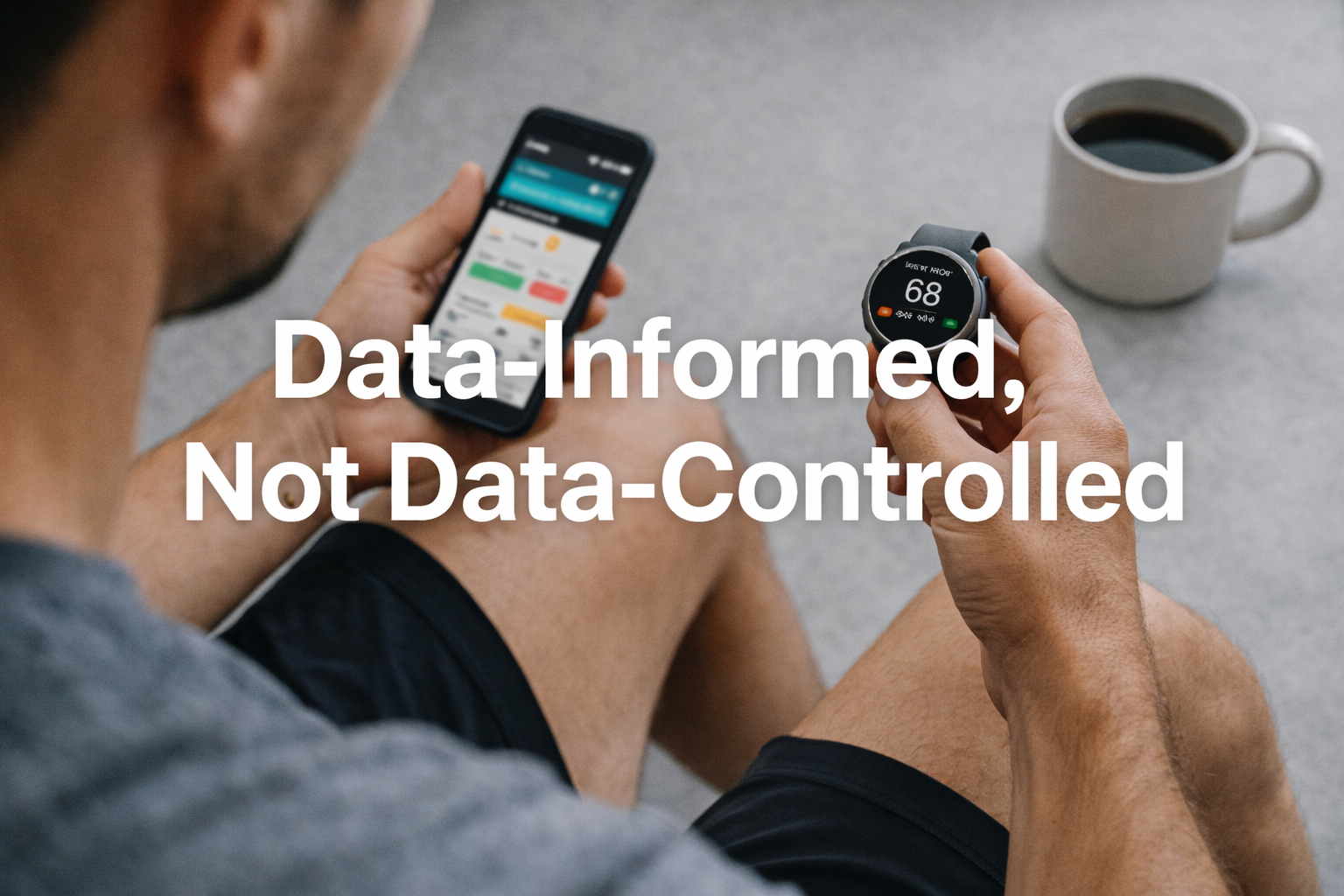
Track Your Progress — Without Letting the Data Run Your Life
Wearables and tracking tools can dramatically improve your progress — but only if you avoid obsessing over the wrong metrics. Learn what to track, what to ignore, and how to build a healthy, balanced relationship with data.
You don’t forge better performance by chasing perfect numbers.
You forge it by combining objective data with subjective awareness — using both to make better decisions, one day at a time.
Data pertaining to our health and wellness has never been more in-depth or more available than it is today with the digitization of medical records, more control given to individuals, and the boom of apps and wearables. This data can be incredibly useful to track things like performance, recovery, progress, and spot trends or illnesses early enough to act before they get out of hand. However, that amount of data sometimes become overwhelming, and it can also become easy to get wrapped up in individual metrics and miss the bigger picture.
There ae some pieces of data that are rathe straightforward and can combined with objective data to make them even more powerful indicators. For example, the weight you can squat is a good strength metric, but when you combine that with level of effort you now have a gauge for how well you're performing at that weight on that given day. As you progress lifting with that same weight, it will feel easier, and that ease (in this example) is an indication of when you're ready to progress and increase the weight. Another example would be from your blood work (something everyone should do at least a couple times a year) vitamin levels compared with the optimal levels for that nutrient helps guide towards potential supplementation, with repeat tests helping to understand absorption.
Where this process can lead to challenges is when focus is put on any one signal number with the exclusion of any subjective correlation. For example, many wearables provide some metric that represents how ready you are for the next day. And while that information usually combines a number of different pieces of information (heart rate, heart rate variability, previous days activates, sleep, etc.) it is only a snapshot of those metrics and even ignoring any potential inaccuracies, that is only one snapshot in time such that it is providing a limited view into the complex working of the body. Over time, you may come to find you typically feel similar to how that "ready" score indicates you should feel, but it is an important exercise to continue to check in to verify you feel in the ballpark of that number. Chasing the numbers can lead to additional stress, over-reaction/correction, exercising too hard or too easy, or prioritizing the wrong behaviors. It is more important to chase the process and not the numbers.
Another powerful way to leverage data is to not look at the single values, but the trends in those values over a longer period of time. When looking at something like sleep duration or heart rate variability, individual values don't tell the whole story but general movement or significant outliers can be useful to look at. Trends can help determine if behavioral changes are having a positive or negative impact while outliers can be an indication of a potential illness. Looking at trends, also helps with looking at the bigger picture as each data point builds on the previous data to form a more powerful story and helps minimize focusing on the small details.
If you're looking to make a change in a metric, first make sure it is one that you can easily and consistently track, and remember that absolute accuracy isn't a firm requirement, but the data should be consistent, or accurate compared to itself. Track that metric for a week without making any changes so you have a decent starting trend and rough idea of the variations. Then change one (maybe two) behaviors and continue monitoring for at least two weeks. This period will allow you to account for any normal variations and any issues with consistency in your behavior changes. After that period, you should be able to determine if the changes improved your metric or not. Based on that, either continue, shift behaviors, or maybe look at the next metric to attack.
Data is powerful — but only when used wisely.
Track what matters. Ignore what distracts. Let the numbers guide, not judge.
When you combine data with awareness, you make better decisions, improve consistency, and unlock higher performance.
If you want support building a balanced, data-informed approach to your health and training, I’m here to help.
🔗 Subscribe to The Wellness Forge to get weekly insights that strengthen your body, mind, and performance without the burnout.
Data-Driven Wellness: When the Numbers Matter — And When They Don’t
Data can guide your training, recovery, and nutrition — but only if you pair it with honest, real-world awareness. Learn how to blend metrics and intuition to make smarter decisions.
High performers use data to make sharper decisions, focus effort, and avoid wasted time.
But over-reliance on numbers without real-world feedback leads to poor choices.
The best results come from blending data with experience, intuition, and honest reflection.
In the world we live in now, everyone has a definition of what "Data" is, so let's start with how I look at "Data" - any piece of information that can be used to make a decision. When we dive a little deeper data typically falls into 2 categories, quantitative and qualitative, and lately in the Health and Wellness space many are leaning entirely on the quantitative side. These are all useful pieces of information, things like Heart Rate Variability (HRV), sleep duration, resting heart rate, calories and macro distribution, body weight, and I could go on but you get the point. The boom of wearables and the continued prevalence of phones has made gathering this information easier than ever and it can be very comforting to look at a single number or metric and make a decision. However the key piece that is missing from all these numbers is CONTEXT which allows you to better understand if that value is in a positive space or towards a more negative direction. Context allows you to better evaluate how your body and mind are responding to the pieces of quantitative data and how they impact you specifically. For example, knowing that you were asleep for 8 hours last night is helpful, but without the feedback of how you felt this morning mentally and physically, it is hard to know if more sleep is needed or if maybe you're a member of the group that doesn't always need 8 hours, if you should push a hard workout or aim to recover.
Let's take a look at another common example of when numbers alone can foster incorrect next steps, tracking calories and macros. For many of my clients (I also do this from time to time) tracking can be a very powerful tool as it helps bring awareness to what exactly and how much food you're consuming. But, when you look to take only this information and make weight management decisions (either losing weight or building muscle) you'll most likely struggle as this problem is way more complex then just a couple of numbers. Our body continues to adapt and without paying attention to the qualitative pieces, consistent progress will be almost impossible to maintain. The great part is that when you become more attuned to the qualitative metrics you can loosen up on your strict adherence to the numbers, which again promotes a more sustainable path. In practice, this looks like keeping track of the following:
how did you feel, including any stomach issues
how was your energy
how was your QUALITY of sleep
how hungry did you feel
what was your activity level
you can add more if you want, but this will be a good start.
As you can imagine, the answers to these questions combined with the calorie and macro numbers allows for a better understanding of not only how well did you fuel your body, but how much fuel your body likely needs.
Now that you're on board with both numbers and context, where do you start? As I've mentioned in other posts the goal is to start small and build momentum. Track a couple metrics of each type for a period, and then look for trends. For example, let's say you want to work on feeling more rested in the morning and believe getting better quality sleep is the place to start. Pick whatever logging tool makes the most sense for you short term (if you like this process you can always change) and pick a couple of each kind of data to start with, something like this:
(Quantitative) Hours of sleep (either from a wearable or an estimation based on when you went to bed and woke up)
(Quantitative) heart rate shortly after you wake up, your resting heart rate is a good data proxy for overall stress levels
(Qualitative) how you feel in the morning
(Qualitative) level of stress (mentally and physically) from your previous day
Starting with these 4 pieces you'll have a great starting point to understand how much sleep you're getting and how much your body needs. Keep this log for a week or two and you'll start to be able to observe some trends and begin to plan better for those days when you're going to NEED more sleep. With a data set small like this, it becomes easier to not only keep track of things but run your own tests to better understand the connections. You can apply a similar methodology across the board to different challenges, but I suggest keeping the amount of things you're varying to a small number such that you can better understand which changes are correlated to which result.
The best decisions come from blending numbers with awareness.
Track what matters. Listen to your body.
Let data inform — not dictate.
🔗 Subscribe to The Wellness Forge for more tools to help you make smarter decisions and build lasting health.