The Sleep Problem That Looks Like a Hormone Problem
Testosterone rises during a specific sleep window in men; in women, it's estrogen and progesterone that govern whether sleep holds together at all. After 40, both get misread as the wrong problem — a hormone issue treated as sleep, or sleep treated as a standalone issue when hormones are driving it.
The single most underrated variable in the performance equation for high-output professionals over 40 is sleep. Not because of recovery. Because of what it's doing — or failing to do — to hormonal function.
The mechanism runs in opposite directions depending on sex. In men, sleep architecture drives testosterone production. In women, hormonal change drives sleep architecture. Same entanglement, opposite arrow. Both get misdiagnosed as something else.
In men: sleep architecture drives production
Testosterone release follows a nocturnal rhythm tied specifically to sleep stage, not just time of night. The nocturnal rise consistently precedes the first REM episode by about 90 minutes, and the rate of that rise tracks REM latency — the longer it takes to reach REM, the slower testosterone climbs.
Fragment the sleep and the rhythm fragments with it. In one study, the nocturnal testosterone rise was delayed by hours under fragmented sleep, and in subjects who never reached REM during the fragmented protocol, the rise often didn't occur at all. Restrict healthy men to 5 hours of sleep for a week — lab-monitored — and daytime testosterone drops 10-15%.
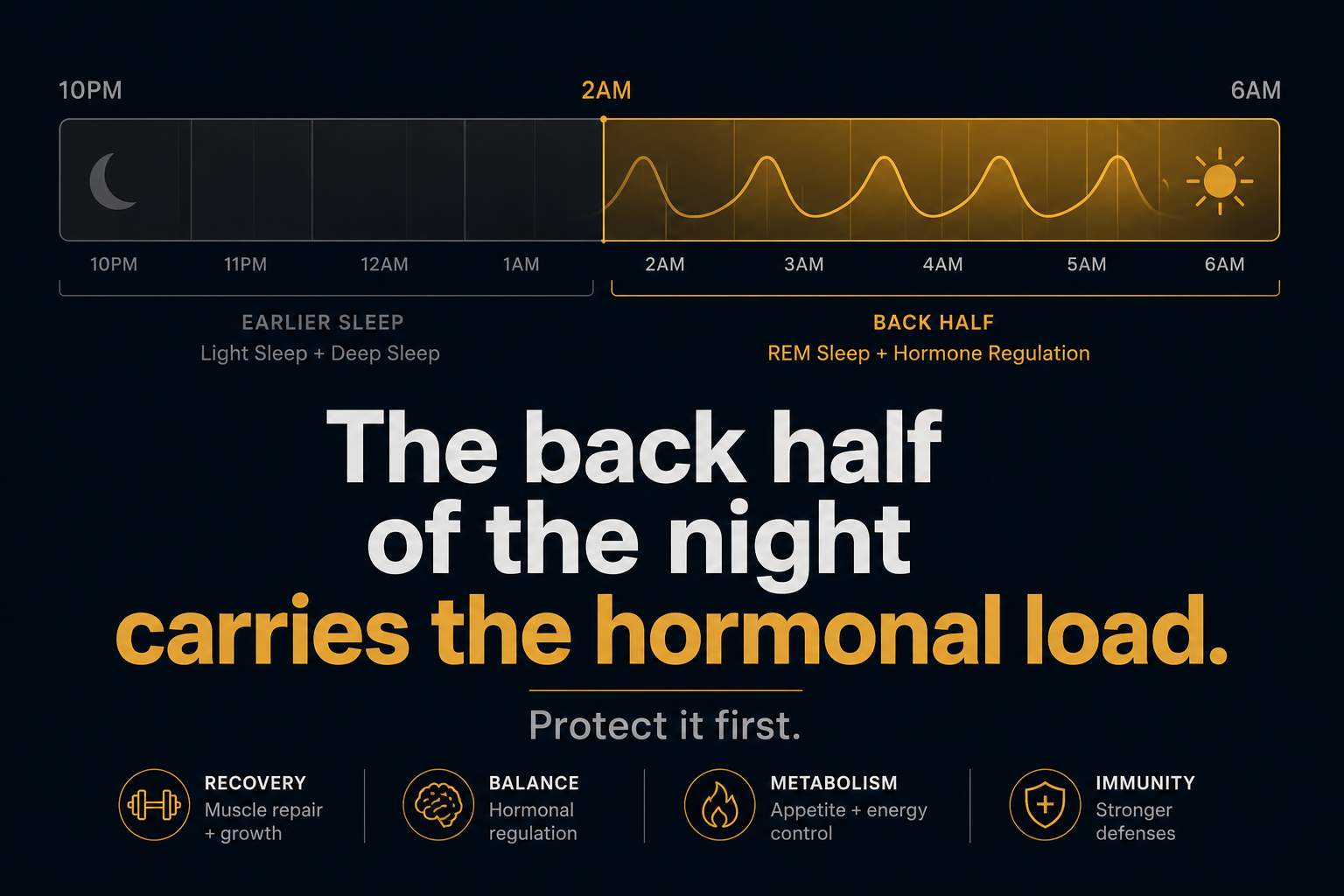
REM and slow-wave sleep concentrate in the second half of the night. So the executive who wakes at 1am and is up by 5 isn't just short on hours — he's specifically cutting the window where production peaks. His morning blood draw can still read normal. That single data point captures the peak; it says nothing about how many nights it took to get there, or how much of the day he's spending below it.
This isn't a testosterone problem in the classical sense. It's a sleep architecture problem wearing a testosterone problem's symptoms.
In women: hormonal change drives architecture
The research linking sleep to testosterone production was done almost entirely in male cohorts — it doesn't transfer as-is. The stronger, better-evidenced mechanism for women runs the other direction: estrogen and progesterone govern sleep continuity, so their decline or volatility fragments sleep independent of behavior.
This shows up earliest in perimenopause, and earlier than most people expect. Rising FSH — the pituitary's response to less responsive ovaries — correlates with sleep disruption even before hormone levels have dropped substantially or hot flashes have appeared. Perimenopause isn't a clean decline; estrogen can spike above baseline one week and drop the next, and that volatility appears to disrupt sleep as much as the average decline does. Estrogen and progesterone both support sleep continuity and slow-wave sleep, so the swings — not just the eventual lower average — are what fragment the night.
The diagnostic trap here isn't a missed hormone reading — it's a missed cause. A woman in her early-to-mid 40s with new sleep fragmentation, flat energy, and stalled recovery gets treated for insomnia as a standalone issue, sometimes years before cycles become obviously irregular enough to name what's actually happening.
The shared protocol
"Sleep more" isn't useful advice for someone whose calendar doesn't allow it, and it's the wrong advice entirely when the disruption is hormonally driven rather than behaviorally driven. The protocol has to work with the actual driver:
→ Protect the second half of the night. Alcohol, late meals, and late training load disproportionately fragment the back half of sleep — costly for men because that's the REM/production window, costly for anyone because fragmentation compounds night over night.
→ Track the right upstream data. For men, sleep-stage data alongside a single morning draw. For women, cycle or perimenopausal status alongside sleep data — treat it as an input, not an afterthought.
→ Name the mechanism before treating the symptom. Fatigue and poor recovery in a 40+ man often get treated as a testosterone problem before sleep is examined. The same symptoms in a 40+ woman often get treated as insomnia before hormonal status is examined. Both are backwards.
→ Loop in the right specialist. This is bloodwork and, where indicated, hormone-therapy territory — not something to self-manage off a wearable. I work this through in coordination with each client's physician; the coaching and the medical side need to be reading the same data.
I work through this with almost every client over 40, regardless of sex. It's almost never one intervention — usually two or three compounding factors that look minor individually and look like a hormone problem together.
DM me AUDIT if you want to start identifying which variable is failing first in your specific situation. It's free.