The Sleep Problem That Looks Like a Hormone Problem
Testosterone rises during a specific sleep window in men; in women, it's estrogen and progesterone that govern whether sleep holds together at all. After 40, both get misread as the wrong problem — a hormone issue treated as sleep, or sleep treated as a standalone issue when hormones are driving it.
The single most underrated variable in the performance equation for high-output professionals over 40 is sleep. Not because of recovery. Because of what it's doing — or failing to do — to hormonal function.
The mechanism runs in opposite directions depending on sex. In men, sleep architecture drives testosterone production. In women, hormonal change drives sleep architecture. Same entanglement, opposite arrow. Both get misdiagnosed as something else.
In men: sleep architecture drives production
Testosterone release follows a nocturnal rhythm tied specifically to sleep stage, not just time of night. The nocturnal rise consistently precedes the first REM episode by about 90 minutes, and the rate of that rise tracks REM latency — the longer it takes to reach REM, the slower testosterone climbs.
Fragment the sleep and the rhythm fragments with it. In one study, the nocturnal testosterone rise was delayed by hours under fragmented sleep, and in subjects who never reached REM during the fragmented protocol, the rise often didn't occur at all. Restrict healthy men to 5 hours of sleep for a week — lab-monitored — and daytime testosterone drops 10-15%.
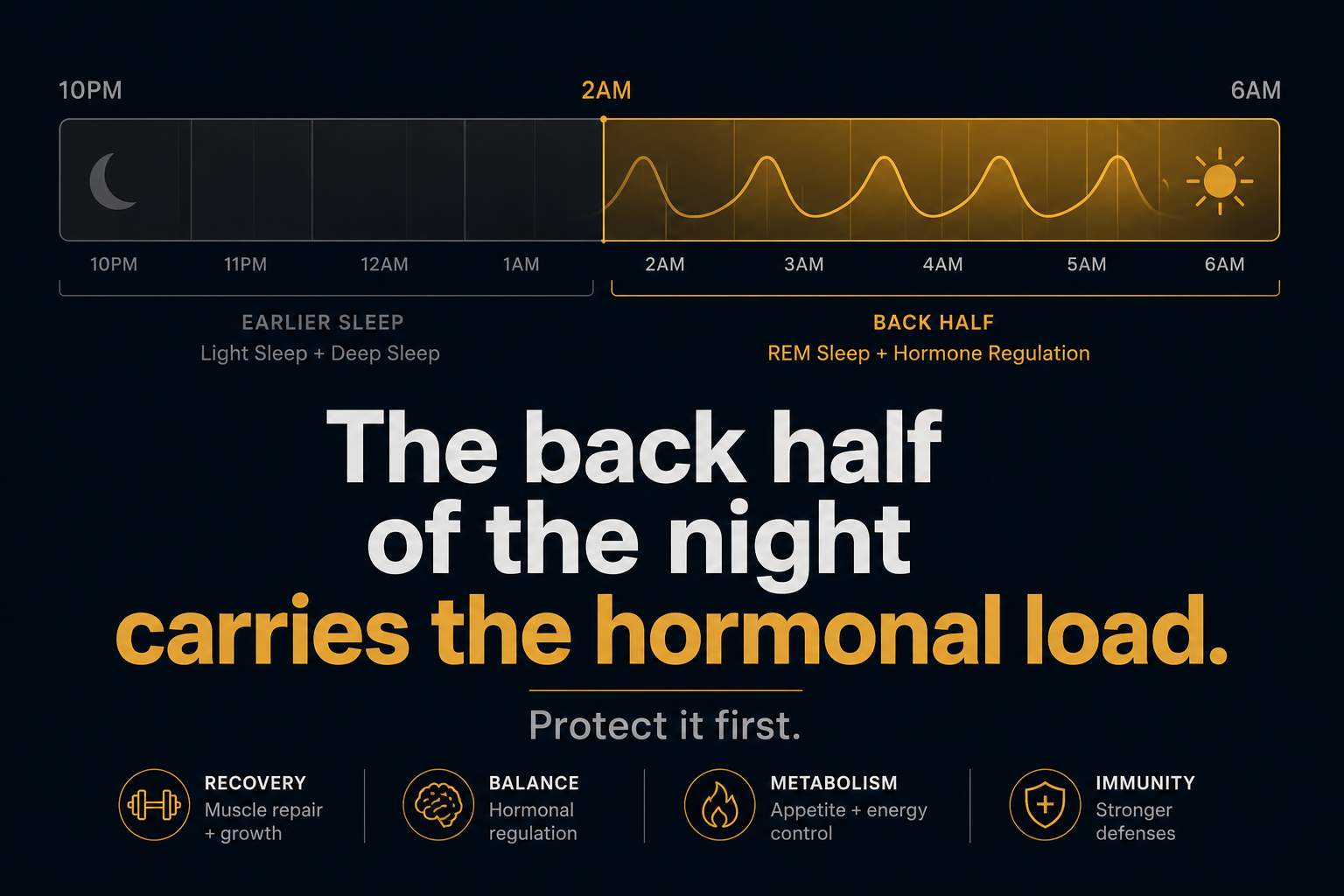
REM and slow-wave sleep concentrate in the second half of the night. So the executive who wakes at 1am and is up by 5 isn't just short on hours — he's specifically cutting the window where production peaks. His morning blood draw can still read normal. That single data point captures the peak; it says nothing about how many nights it took to get there, or how much of the day he's spending below it.
This isn't a testosterone problem in the classical sense. It's a sleep architecture problem wearing a testosterone problem's symptoms.
In women: hormonal change drives architecture
The research linking sleep to testosterone production was done almost entirely in male cohorts — it doesn't transfer as-is. The stronger, better-evidenced mechanism for women runs the other direction: estrogen and progesterone govern sleep continuity, so their decline or volatility fragments sleep independent of behavior.
This shows up earliest in perimenopause, and earlier than most people expect. Rising FSH — the pituitary's response to less responsive ovaries — correlates with sleep disruption even before hormone levels have dropped substantially or hot flashes have appeared. Perimenopause isn't a clean decline; estrogen can spike above baseline one week and drop the next, and that volatility appears to disrupt sleep as much as the average decline does. Estrogen and progesterone both support sleep continuity and slow-wave sleep, so the swings — not just the eventual lower average — are what fragment the night.
The diagnostic trap here isn't a missed hormone reading — it's a missed cause. A woman in her early-to-mid 40s with new sleep fragmentation, flat energy, and stalled recovery gets treated for insomnia as a standalone issue, sometimes years before cycles become obviously irregular enough to name what's actually happening.
The shared protocol
"Sleep more" isn't useful advice for someone whose calendar doesn't allow it, and it's the wrong advice entirely when the disruption is hormonally driven rather than behaviorally driven. The protocol has to work with the actual driver:
→ Protect the second half of the night. Alcohol, late meals, and late training load disproportionately fragment the back half of sleep — costly for men because that's the REM/production window, costly for anyone because fragmentation compounds night over night.
→ Track the right upstream data. For men, sleep-stage data alongside a single morning draw. For women, cycle or perimenopausal status alongside sleep data — treat it as an input, not an afterthought.
→ Name the mechanism before treating the symptom. Fatigue and poor recovery in a 40+ man often get treated as a testosterone problem before sleep is examined. The same symptoms in a 40+ woman often get treated as insomnia before hormonal status is examined. Both are backwards.
→ Loop in the right specialist. This is bloodwork and, where indicated, hormone-therapy territory — not something to self-manage off a wearable. I work this through in coordination with each client's physician; the coaching and the medical side need to be reading the same data.
I work through this with almost every client over 40, regardless of sex. It's almost never one intervention — usually two or three compounding factors that look minor individually and look like a hormone problem together.
DM me AUDIT if you want to start identifying which variable is failing first in your specific situation. It's free.
The Sleep Anchor: The Most Underrated Part of Your Summer Routine
Summer disrupts sleep more than most people realize, and once sleep slips, training, cravings, mood, recovery, and decision-making all get harder.
Every summer, the same pattern plays out.
Training slips. Nutrition gets inconsistent. Energy tanks. Cravings spike. Motivation disappears. And people spend the rest of the season trying to figure out what went wrong with their discipline.
Most of the time, it was not discipline. It was sleep.
Sleep is the first domino — and it is almost always the last one people look at. I have saved it for last as it will be the MOST impactful thing you can adjust, but also for most the most challenging. You can have your protein anchors dialed in, your travel plan ready, your 30-minute training templates built. But if sleep is quietly unraveling in the background, everything else gets harder than it needs to be.
Summer is uniquely good at unraveling it.
What Summer Does to Your Sleep
It starts subtly. The days are longer, so the evenings stretch. A backyard cookout runs until 10. A few drinks on a Tuesday because it feels like the weekend. The kids are out of school so the morning schedule loosens. You travel across time zones twice in six weeks. The bedroom is warmer than usual. You stay up an hour later on Friday and Saturday and then try to drag yourself back to normal on Monday.
None of these things feel like a big deal individually. But together they add up to a sleep pattern that is inconsistent, shorter than it should be, and lower quality than your body actually needs.
The result is not just feeling tired. The downstream effects are more significant than most people realize.
What Happens When Sleep Slips
Poor sleep does not just make you groggy. It systematically degrades almost every other health behavior you are trying to maintain.
Cravings increase — specifically for high-calorie, low-nutrient foods. Sleep deprivation elevates ghrelin (the hunger hormone) and suppresses leptin (the satiety hormone), which means you are hungrier, less satisfied, and reaching for the wrong things more often.
Training quality drops. Output is lower. Motivation to train at all is lower. The session that would have felt manageable on a good night's sleep feels like a grind, and the temptation to skip it wins more often.
Recovery takes longer. Muscle repair, hormonal restoration, and nervous system recovery all happen predominantly during sleep. Cut the sleep short and you are cutting the recovery short — which means the training you are doing is not producing the adaptation it should.
Decision quality suffers across the board. Prefrontal cortex function — the part of your brain responsible for impulse control, planning, and long-term thinking — is one of the first things to degrade with sleep loss. Every choice you make about food, training, and routine gets a little harder and a little worse.
Mood and irritability follow. The version of you that shows up after a week of short nights is not the version that makes good calls consistently.
The compounding effect is significant. And it usually gets blamed on everything except the actual cause.
The Sleep Anchor
Just like nutrition and training, sleep does not need to be perfect during summer. It needs anchors.
A sleep anchor is a consistent behavior that stabilizes your sleep pattern even when the surrounding schedule is variable. Here are the ones worth building in.
Consistent wake time. This is the single highest-leverage sleep anchor available, and it is the one most people overlook because they focus on bedtime instead. Your circadian rhythm is anchored primarily to when you wake up, not when you fall asleep. If you protect your wake time — even after a late night, even on weekends — your body has a stable reference point that keeps the whole system from drifting. Bedtime will regulate itself over time if the wake time is consistent.
Caffeine cutoff. Caffeine has a half-life of roughly five to six hours. That afternoon coffee at 3 p.m. still has half its stimulant effect at 8 or 9 p.m. Pick a cutoff time — noon or 1 p.m. for most people — and hold it. This is a small habit change with a disproportionate impact on sleep quality.
Alcohol boundary. Alcohol is uniquely disruptive to sleep architecture. It may help you fall asleep faster, but it suppresses REM sleep and causes fragmented rest in the second half of the night — which is when a lot of the most important recovery happens. This does not mean abstaining. It means being intentional. Finishing drinks at least two to three hours before bed and being honest about how frequency during the week is affecting how you feel.
A 30-minute wind-down. Your nervous system does not switch off on command. A short wind-down routine — something that signals the transition from the day to sleep — meaningfully improves both the time it takes to fall asleep and the quality of sleep once you do. It does not need to be elaborate. Dimming lights, stepping away from screens, reading, stretching, a short walk. The content matters less than the consistency.
A cool room. Core body temperature needs to drop slightly to initiate and maintain sleep. A warm summer bedroom works against that process. Blackout curtains, a fan, keeping the thermostat lower than feels necessary — these are not luxuries. They are functional sleep tools.
Morning sunlight. Getting outside within 30 to 60 minutes of waking — even for ten minutes — is one of the most effective ways to anchor your circadian rhythm. Morning light exposure sets your internal clock, improves alertness during the day, and makes it easier to wind down at night. It is free, it takes almost no time, and most people are not doing it.
The Performance Connection
Better sleep is not just about feeling less tired. It is a direct performance input.
When sleep is consistent, energy is more stable and predictable throughout the day. Appetite regulation improves — the cravings that derail nutrition during busy stretches are significantly reduced. Training output goes up. Recovery between sessions improves. The mental clarity required to make good decisions about food, movement, and schedule comes back online.
Everything in this summer series — the training anchors, the nutrition structure, the travel plan, the weekend routine — works better when sleep is intact underneath it. It is not one piece of the puzzle. It is the foundation the rest of the puzzle sits on.
Where to Start
Pick one anchor from the list above. Not all of them — one.
If your schedule is inconsistent, start with wake time. If you are a late-caffeine drinker, start there. If alcohol is disrupting your sleep more than you want to admit, that is your anchor.
Build it for two weeks before adding anything else. Anchors compound. One consistent sleep habit makes the next one easier to implement.
Summer does not have to be the season that costs you four months of progress. But sleep is the piece most people leave unaddressed until everything else has already started to slip.
Protect it first.
This is the final post in the summer consistency series — covering training, nutrition, travel, weekends, and now sleep. If any part of this series resonated with you and you want help building a summer plan that actually holds up in real life, that is exactly what IronLane Coaching is designed for. Let's build it together.
Sleep Better Without Overhauling Your Routine
Sleep quality often improves with small adjustments rather than complicated routines. Here are several simple tweaks that can improve recovery and help your body sleep more consistently.
Sleep is one of the most powerful recovery tools we have.
Yet when people struggle with sleep, they often assume the solution requires a complicated routine or expensive tools.
In reality, a few small adjustments can dramatically improve sleep quality.
Here are several quick tweaks that often make a meaningful difference.
For most clients I work with, sleep is always one of those topics they either actively want to improve or their experiences indicate that working on sleep quality would yield significant benefits. Like I've mentioned the past couple of posts, most often this doesn't require a complete change of habits but instead a couple of small tweaks will yield big results. I typically suggest picking one thing at a time, work on that for a couple of weeks such that you can evaluate the impact that change is making. From there you can either pick another aspect to work on or look to further improve that area.
Getting sunlight (even just 5-10 minutes) early in the day helps set your circadian rhythm such that not only will you find it easier to get moving mentally and physically in the morning, but your natural rhythm will help queue your body to sleep. Something as simple as your morning coffee, tea, or a glass of water on your porch/patio will accomplish this.
Protecting your sleep time as much as you block out your morning routine is another one that many overlook. Most people can easily walk through their mornings, but struggle to point to their plan for arguably the most important part of your day - sleep. Start by dedicated 5-10 minutes to simply wind down before going to bed by putting away electronics, and getting ready for bed. As you get better at this you can include things like journaling, meditation, stretching, etc to further help your mind and body prepare for a more restorative rest.
Cutting back on stimulants is another one that can help, and this would include caffeine but also for many sugars can cause challenges to sleep. Of all the suggestions, this is probably the most variable from person to person as some are not impacted at all by this (I fall into this bucket) others notice small amounts of caffeine even at lunch will cause challenges. So if you recognize these impact your sleep, work to move them earlier into the day.
Making your room a little cooler or darker is another shift that can be accomplished relatively simply. Changing the thermostat or fans can help with temperature as well as all sorts of other bedding options. As for darkness, curtains and other options exist but I find one of the simplest options is an eye mask.
The final one I'll mention is trying to maintain consistency with sleep time, as most people (except for the weekends) normally keep a consistent wake time. The more consistent you can keep both of these times (including the weekends) the better your sleep quality will become. Again, don't make radical shifts but try moving in 15 minute increments and this would also apply to trying to get more sleep as most can adjust the sleep time easier then their wake time.
There are lots of options out there to improve your sleep but these are some of the simplest, cheapest, and universally available ones you can try out that are proven to make a difference. Notice I didn't say these changes are easy as that's a term I try to avoid since "easy" is incredibly dependant on the person, pick whichever one you think will be easiest for you to implement and see how you feel after 2 weeks of consistency.
If improving sleep is part of your performance or health goals, start simple.
Recovery improves faster than most people expect when sleep improves first.
Building Better Sleep Habits — and Keeping Them Through the Holidays
Great sleep isn’t luck — it’s built.
Learn how to create a consistent sleep environment and routine that improves recovery, focus, and performance — even during the holidays.
The holidays bring joy, connection… and disruption.
Travel, late nights, and changing routines can throw your sleep completely off track.
But with a few intentional habits and environmental tweaks, you can stay rested and ready through the busiest season of the year.
Before I dive in too deep, let's first set the ground rules for what I tend to consider when thinking about "Sleep Hygiene:"
The Environment - light, temperature, noise, other people, pets, etc.
Your Behaviors - phone usage, caffeine, stress, etc.
Your Routine - what you do leading up to attempting to fall asleep
There's more you can look at when defining Sleep Hygiene, but these are the biggest impacts you can make. The good news is that making a few tweaks now for the Holidays, allows you to roll them into the New Year and build on that foundation for continued benefits.
For each of these three areas, there's a range of changes that can be made not only in how much of an impact they'll have for your sleep quality, but also how large of a change you'll need to make. Both of which will vary wildly from person to person and as such I typically recommend making only one or two changes at a time, prioritizing your ease of implementation and sleep impact. So let's look at each of these areas, and toss out a couple of ideas for each as well as some idea on the commitment needed to make the change:
Environment
Try to create as dark of a room as possible, with the simplest option being to use a sleep mask.
A little more of a financial commitment, but might be better if masks are not comfortable, would be blackout window coverings of some sort.
Temperature is also a massive factor in sleep quality and covers not only the temperature of the room, but that of the bed as well. There are lots of options here ranging in price from adding fans to help cool down, setting the room temperature cooler, or even looking at the various options out there to cool (and heat) your bed itself.
Behaviors
Stress is one of the more impactful factors I've listed, but it is also complex and not always obvious. A workout (productive stress) done late in the day could have a calming impact on some, or it could produce too many endorphins such that it becomes harder to fall asleep. Couple stressful days with some items in the routine area I'll get to such that you moderate those days and mitigate the detrimental effects of an excess of stress.
Caffeine varies significantly not only in the magnitude of the impact but also the duration such that everyone needs to understand for themselves what does and does not work for them.
Screen usage has been consistently shown to be damaging to sleep quality, with the simple answer being to put everything away a set period before bed. However, that's practically very challenging for many people, so an alternative would be to wear blue light blocking glasses to reduce (or negate) that impact.
Routine
A routine starts with timing, ideally one that allows for consistent bed time as well as a consistent waking time. Best practices are to keep both of these times as consistent as possible, during the week and weekends. A way to think of this is the popular shift many do over the weekends essentially is subjecting your body to jet lag every week. Now, does this require a rigid structure such that there's never any fun? Of course not, but recognize the impact a night out will have and look for other ways (like a nap) to more fully restore the body and mind.
Outside of that, look for things you can stack in the evening to help enter a calm state and prepare the body for sleep. Again, these could be all sorts of things and don't need to be overly complex - start simple and work backwards from whatever time you want to go to bed. Some options to consider:
reading, journaling, stretching, meditation, turning down the lights, and way too many more to list out.
There are two separate paths you can take to work on your sleep hygiene as the holidays approach:
Pick one or two items from the list above, work to implement them, and keep track of the impact they have on your sleep duration, quality, and how you feel the next day. Look to be as consistent as possible, but allow yourself the grace to enjoy the Holidays. The goal is progress and awareness, not creating the perfect solution.
If your schedule seems overwhelming and too chaotic to control, roll with that and keep a journal of the various things that change, how they impact your sleep, and how you feel the next day. This information you gather will then better inform you for the New Year such that you can have targeted changes that you KNOW will impact YOUR sleep in a positive way. Mentally, making changes in a way you've already proven to work are significantly easier to implement and sustain such that you'll get a massive boost to start the New Year!
A final idea to consider if you're traveling for the holidays, what parts of your sleep hygiene can you bring to carry that continuity and familiarity with you?
And as always, look for the small changes you can make that are sustainable and build momentum.
The holidays don’t have to derail your rest — they can be a chance to refine it.
Build a sleep routine that supports recovery, clarity, and energy, no matter where you are.
Start small. Be consistent. Protect your foundation.
💤 Subscribe to The Wellness Forge for more actionable wellness strategies that keep you performing at your best.