Micro-Recovery: Small Actions That Drive Big Performance Gains
Micro-recovery is about small, intentional actions that help your body and mind reset throughout the day. Learn simple tactics you can use anywhere to improve energy, focus, and recovery.
Most people think recovery requires time they don’t have.
In reality, recovery works best when it happens in small doses, often.
These micro-recovery habits can change how you feel, train, and perform — without adding anything to your calendar.
While looking at some of the big movers for recovery, things like nutrition and sleep, there's also lots to be gained from thinking small when it comes to recovery. And by small, I mean short periods of dedicated time that can have outsized benefits in both physical and mental recovery. As with other topics, I wouldn't suggest trying to implement ALL of these, but pick one or two and see if they help. Don't panic if something doesn't work for you, pick something else and keep trying. Once you find something that works, keep it consistent and try to make it part of your normal routines.
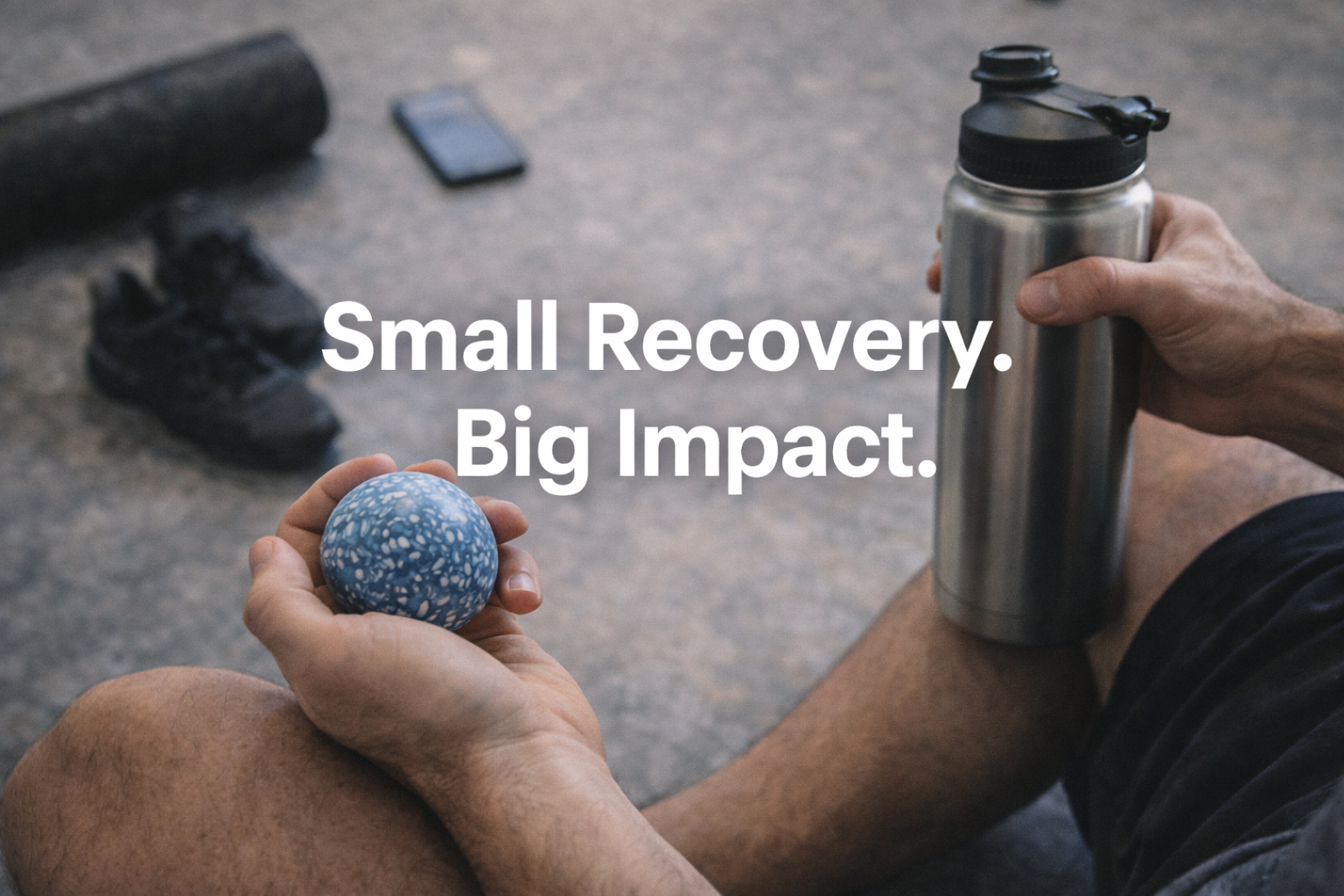
Let's start with some that are more physical in nature, with probably the simplest and lowest barrier to entry being a short walk - even just a couple of minutes provides not only muscular benefits, improves digestion, but it can be a nice mental break as well. Also in this bucket would be some sort of mobility work focusing on whatever joints or muscles that may be nagging you, either while sitting by moving through the joints' full range of motion, or coupled with a walk and making it a bit more of a dynamic stretch. Maybe even incorporate some sort of recovery tool in this process, foam rollers may be tougher in the office, but massage guns or a lacrosse ball work wonders and can travel pretty easily. The last one I'll touch on in this article would be to have some sort of a snack, sometimes the best way to break up your day is the injection of a little energy. This snack doesn't have to be large but something that can not only distract you physically (and mentally) but also provide a nice energy boost.
The other aspect of these little recovery breaks are ones that I'll put into more of a mental space or requiring little physical movement. A couple of examples of these kinds of breaks would be:
Breathing resets - think deep breaths, either structured or just a pause
Giving your eyes a rest - look away from screens, or close your eyes for a period (don't try this while driving!)
Another idea to consider in this area would be ways to shift your environment to reduce or shift the stressors in some way:
Wearing Blue light blocking glasses
Noise generator - white noise works for many, but there are different options that work better for some
Background music
If you're looking for a plan to implement a break or two into your day, pay attention to your energy levels during the day and see if you notice a period (or two) where you struggle. That's the time you'll want to apply one of these techniques, and try the same one for a couple days to see if you notice a benefit. This is also a case where having some sort of logging or journal routine will come in handy to not only find those lulls, but see what works and what doesn't. I personally use the journal function in the Whoop app to help with these kinds of trials and shoot for a handful of days with the routine and without to have a somewhat decent comparison. The actual tool used doesn't really matter, it is the process of adding that recovery tactic and monitoring how (if) it impacts your body and mentality.
Recovery doesn’t need to be dramatic to be effective.
Small, consistent recovery habits protect your energy, sharpen focus, and keep performance sustainable — especially on busy days.
Start small. Repeat often. Let recovery work with you.
🔗 Subscribe to The Wellness Forge for practical strategies that help you train, work, and live stronger — without burnout.
Recovery, Explained: How Your Body Rebuilds After Stress
Your body follows a predictable pattern when recovering from mental stress or physical training. Learn what actually happens during recovery — and how to support each phase to improve performance and resilience.
Stress shapes you. Recovery strengthens you.
Your body is constantly balancing breakdown and rebuild — and with the right inputs, you can turn stress into adaptation rather than exhaustion.
When it comes to stress, recovery, and adaptations the body treats mental and physical stressors in the same fashion with a very similar process. Knowing how this process works not only will help you as you look to make progress, but also pinpoint one of the biggest culprits in leading to plateaus. These stressors can be planned workouts, busy days at work, illness, relationships, or all of them combined and it becomes crucial to account for this when looking at how much you're trying to accomplish and what results are reasonable to expect.
The first step in this process is an immediate response to this stressor that includes things like an increase in heart rate, cortisol and adrenaline rise, mental focus increase, and an increase in blood sugar to provide more energy to meet the increased need. After the stressor has passed the body then shifts into repair mode shifting those resources to stabilize which will include things like a normalization of hormone levels, and repair of any tissue damage. Finally we get into the adaptation phase where muscle strength increases, muscular endurance improves, cognitive resilience increases, and there's a mood improvement all with the goal to better handle the next stressor that comes.
The challenge for many is balancing out the stressors such that this entire process can run from start to finish in an efficient manner. Too strong or too quick of a stressor and the body never finishes the repair mode and as such can't adapt or grow stronger. The repair process can also be delayed by other factors too, such as poor sleep, underfueling, or even relationship stress. Some indicators that you may be stuck in this cycle are consistent muscle soreness or perpetual fatigue. The flip side can also cause problems as too weak of a stressor, or ones spaced too far apart and the body never triggers an adaptation as it doesn't need to.
Unfortunately, there is no one single test that can identify either of these as the exact problem you may be facing in hitting your goals. However, if you find yourself stuck at a plateau or feel like you're just going through the motions, the first place to start would be that honest assessment of your stressors and what actions you're currently taking. If you feel like you're perhaps putting your body under too much stress, look for ways to either reduce some of that or change up your workouts by reducing the duration or intensity. Most workout programs have a built-in de-load period to help the body adjust, but depending on where you're starting from it may take longer than that. If you feel like you're on the other side of the fence, I wouldn't suggest increasing your stress (don't go out purposely to get poor sleep) but look to change up or increase your workout frequency/intensity. With either of these paths, I wouldn't look to change too many things or make a drastic change but start small and evaluate progress.
Stress is unavoidable — but recovery is intentional.
When you understand how your body repairs, resets, and rebuilds, you can train harder, handle stress better, and perform at a higher level.
Support the process. Build resilience. Keep forging forward.
🔗 Subscribe to The Wellness Forge for strategies that help you recover smarter and perform stronger.
More Than Sleep: How to Recover Physically and Mentally
Recovery is more than sleep. It’s the daily habits, movement, and mental resets that help your body and mind rebound from stress. Learn practical strategies to recover smarter anywhere.
Sleep is the foundation of recovery — but it's not the whole story.
True recovery happens through the habits, movement, and mindset strategies you use throughout your day.
Here’s how to build a recovery system that supports greater performance, resilience, and consistency.
One of the best recovery tools you can master is sleep, however that doesn't cover all aspects of recovery. Recovery isn't just a single item and it needs to be adjusted based on the specific stressors on the body and how it is handling them. A tricky part for this is that the two aren't always correlated, for example after a hard workout you may feel like you need a mental break more than a physical one. Many think of recovery as the down time between workouts, but it is a complex set of processes the body is consistently engaged in as it deals with the stressors of life. Things like eating, hydrating, watching Netflix are just some of the things that can be leveraged as recovery aids. Recovery is where all the magic happens as not only does the body heal from any damage that has been done, but it also is where the adaptations to those stressors occur. And that's the most important part, we want the body to have the time AND resources needed to make the adaptations we're training for. We don't build muscle during out strength workouts, our body builds in as it recovers and adapts such that it can be more efficient in handling those workouts in the future.
First let's talk about physical recovery, as this is what most think about when recovery comes up. This can essentially be broken into two buckets - movement and fueling. While many might think that a lack of movement (laying on the couch) is the best recovery, usually the best option is light, low impact movement to get the blood flowing to help bring nutrients to the areas of need, and pull all the bad stuff away. Think things like stretching, mobility work, walking, yoga, swimming, all are great options to consider when used appropriately and at a low intensity. That's not to say, there are times when taking time to fully "do nothing" might be the best option, but for me at least, those are usually paired with needing to mentally restore as well. Load management is also a key part in all of this, some times swapping out a strength workout for a mobility day, or changing your speed day for a Zone 2 run will also prove more beneficial in the long term. The other aspect to think of physically is refueling your body not only of the nutrients (carbs, protein, vitamins, etc.) but also hydration. While you may think that since you're taking it easier, you don't need as much fuel - remember that while you're recovering, you're also building, and to build your body needs the fuel to accomplish that task. I'm not suggesting you fuel your recovery days like your monster workout days, but you should most likely fuel more on your recovery days then you think you need to. This is also the bucket where all those fun tools/toys come into play, but that's a whole different post for another day.
Physical recovery is usually the one most people think of first, but we can't underestimate the impact of mental and emotional recovery. Those are much harder to track and monitor as we don't have great ways to quantify those aspects of our lives (yet). And yes, there is some overlap between physical and mental recovery, I myself often find exercise as a great way to let my mind wander and disconnect from the other stressors in my life - but physical exercise still is a stressor on the body. Mindfulness is one of the top ways to foster this kind of recovery and it can take lots of forms (journaling, meditation, quiet time, etc) such that you open up to the idea of acknowledging where you currently are and what paths forward are available to you. This doesn't have to be large block of time, even 5 minutes can be enough to not only provide the mental clarity but an opportunity for your brain and body to rest and reset. Another great option is to take time outside (weather permitting) maybe even combining this with some mindfulness for additive benefits. Finally, a great way to mentally recharge is to be around other people either in person or through voice, text, video chatting. The simple act of reaching out to someone else not only removes you from your stressors but opens up the possibility of connection and helping someone else through their challenges.
Recovery isn't a one size fits all process, it varies from person to person, and from day to day, so the way to improve it is through awareness and experimentation. Consciously understanding where you currently are, trying some things, and then evaluating how you feel during and afterwards. You can do this using some form of journaling, combined with a wearable, or with the help of a coach to see what works for you in various kinds of circumstances. As important as numbers and metrics are, don't discount how you feel either - ideally they will correlate, but sometimes they don't which requires further investigation. This process also applies to the holidays, you'll need to be aware of what's changing in your life, your stressors and your ability to handle them, and adapt your training and recovery appropriately to match those.
Recovery is a skill — and you can build it like any other.
You don’t need an hour, a spa day, or a perfect routine. Just a few intentional habits that help your body and mind reset.
Start small. Stay consistent. Protect your recovery.
🔗 Subscribe to The Wellness Forge for more science-backed strategies to perform better, stress less, and live stronger.