
Why Smart Snacking Can Actually Improve Your Nutrition
Snacking isn’t the enemy. In many cases, it’s the thing that helps prevent energy crashes, overeating later, and poor nutrition choices. The key is learning how to snack with purpose.
Somewhere along the way, “snacking” became synonymous with lack of discipline.
But for busy professionals, active adults, and anyone trying to stay fueled and focused, the right snack can be one of the most useful nutrition tools you have.
The main issue many have with snacks is the wrong choice, or an incomplete choice. A very common habit is to wait until hunger really kicks in, then grab whatever is handy. This is also when cravings are typically highest and as such the choices usually go towards carbs, sugars, and sweets. Those may sound great at the time, but aren't satiating and will further challenge blood sugar levels leading to an eventual energy crash. If you can relate to this, I can guarantee you're not alone!
A better option to snacking is to plan it as part of your normal daily schedule. This way not only can you prepare to have good snacks available, but you can also schedule them BEFORE you get hungry to fend off those cravings. These planned snacks not only support long term health goals but will help maintain energy and can be crucial in performance for those with ambitious workout goals. Another benefit of scheduling a snack is that it helps ensure consistency as gaps in meals can frequently grow large enough that entire meals are skipped.
Everyone has their own ideas for what works for a snack, but I tend to find the best options are those that have some level of macro balance such that they include carbs, protein, and fats. Ease and convenience should also be a consideration depending on your schedule, perhaps not as important if you work from home, but maybe more so if you are frequently on the road. I do also suggest trying to have something for a snack that's different from what you normally eat for your larger meals to help combat flavor fatigue.
One of my go to options is a measured out container of mixed nuts with dried fruit and some chocolate chips. This gives a decent enough macro balance and also enough sweet to quell my cravings - although the chocolate can be problematic in the car when it gets warm. I specifically mention measuring the nuts as you can very easily find yourself eating more then you expect and your snack has become a meal. Another of my favorites is yogurt mixed with protein powder and some fruit, or in my case frequently chocolate chips and whipped cream. This is my usual evening snack as it replaces ice cream and still gives me enough of those things I like, such that I can save ice cream for a real treat. I specifically mention these two not because I think they work for everyone, but the ideas do:
They're different from my normal meals
They're easy to measure and portion out
They're quick to prepare, or make a few servings in bulk
They're well balanced and also significant calorically
They scratch a significant craving that I know I can over-indulge if I'm not paying attention.
There are loads of options available but a good starting point would be to look for that combination of things you crave with what you know to be healthy. I will come back and talk more about bars, shakes, and drinks soon but those can also be leveraged strategically to help, but I would be careful to not solely rely on them.
Snacking is not something you need to fear.
For many people, it’s one of the simplest ways to improve consistency, manage hunger, and support better energy throughout the day. The goal isn’t to snack constantly. The goal is to use snacks intentionally so they work for you instead of against you.
What’s one snack you keep around that actually helps you feel better, more focused, or more in control?
Drop it in the comments.
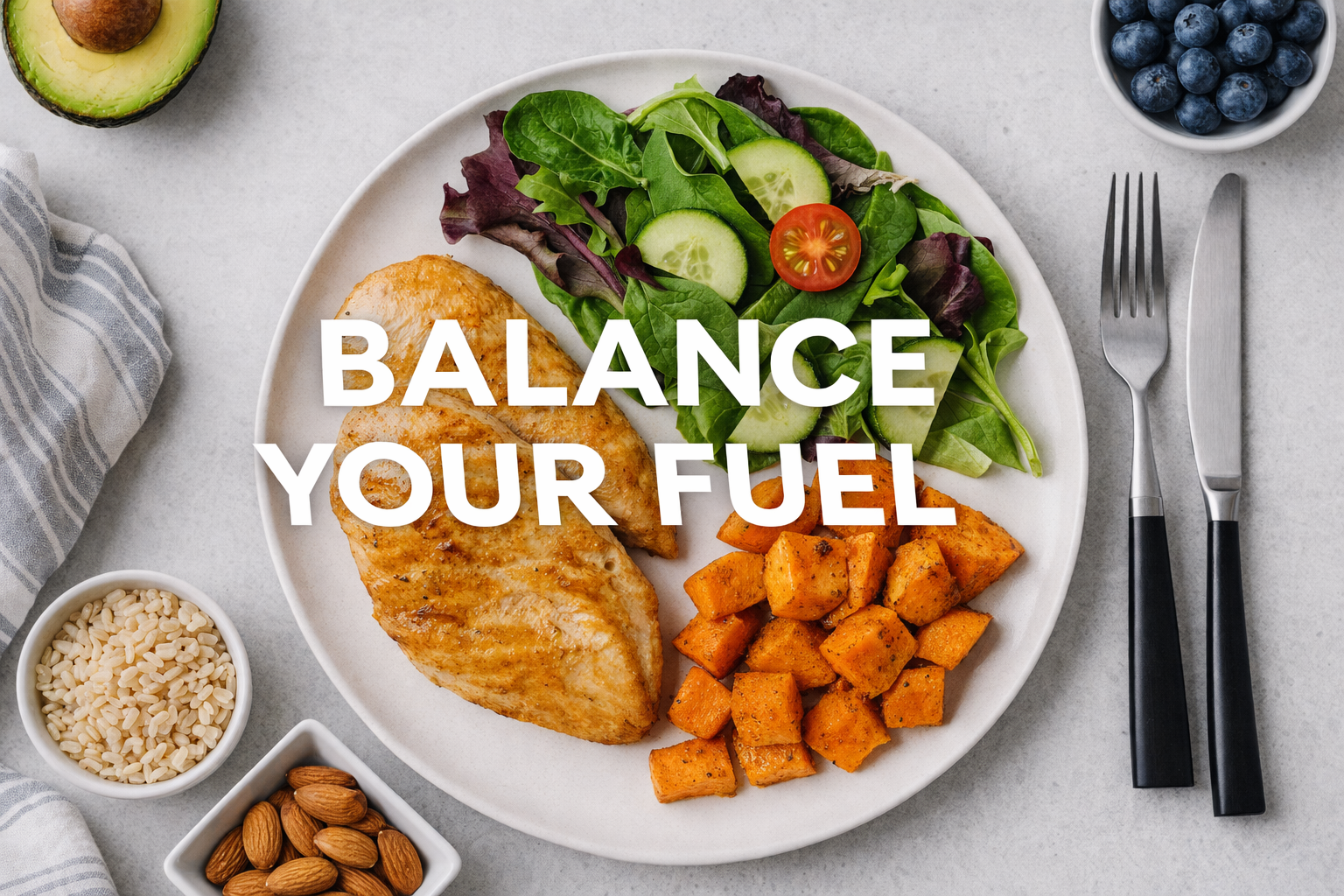
Macro Balance: How to Fuel Your Body for Real Performance
Macro balance is one of the simplest ways to improve energy, performance, and recovery. Learn what each macro does, why it matters, and how to build meals that support your goals.
Executives and athletes have something in common: they live in energy-demanding environments.
Yet most underfuel, over-restrict, or eat meals that don’t match their needs.
Macro balance is one of the simplest ways to improve daily energy, mental clarity, and training performance — without dieting.
In any given day, I'm sure you hear at least 10 different ideas of what macros (protein, carbohydrates, and fat) should be what percentage of your caloric intake. The short answer, as with most things health related, is that it depends. There is no set of ratios that works for everyone all of the time. Even for an individual, there may be times where it makes sense to shift things around based on the current life situation. Finding the right balance that works best for you and understanding how you might want to make changes as you move through different seasons of your life is a very important skill to learn. At the core, it requires not only an understanding of what you're putting in your body but also a consistent assessment of how your body is responding to that fuel.
When I start working with clients on their nutrition, I always start with protein as it is one of the easier ones mathematically and is also one that many struggle with. Protein is the primary building block and repair tool for muscles and is incredibly helpful in managing satiety and blood sugar. Because of these 2 factors it is probably the biggest (or at least near the top of the list) nutritional factor in achieving long term weight management. As an initial optimal target, I tend to use the 1 gram of protein per target weight (in pounds) since this makes the math nice and simple. Now, this is a target, not a firm rule - but in aiming high, even if falling a little short, you're still getting sufficient levels. If you're looking to get started, keep track of your current protein consumption and aim to gradually move towards your optimal target. How much additional protein you can add will vary, but start with 15 grams per day for a week and go from there.
Most of what you read will at least be in the ballpark with protein, but where the variations really come out are when it comes to fat and carbohydrates. The main role of carbohydrates is to provide fast energy to the body, muscles, and brain in the most efficient way. Yes fats and protein can be broken down to create energy, but that process takes longer and is significantly less efficient. Fats do quite a lot for the body and as such can't be ignored either as they are the building blocks for hormones, aide in nutrient absorption, brain health, and help control inflammation. There are many fads out there that suggest reducing, or eliminating, fat or carbohydrate intake will be the best option. I tend to avoid recommending the exclusion of macros or foods (unless there's a medical reason) as that withholds vital nutrients from the body and in most cases sets the individual up cravings, dietary issues, and general challenges with weight management. For most people in most situations, the best solution for the body to function optimally is some level of all 3 macro nutrients. A good starting point s to balance out the calories left over after your protein target. As an example take a 2000 daily calorie target for an individual targeting 150 pounds, such that their protein target is 150 grams. That leaves 1400 calories (2000 - 150 g * 4 calories per gram) for carbs and fat that I'd split evenly to start. That works out to 175 grams of carbs (700 calories divided be 4 calories per gram) and 78 grams of fat (700 calories divided be 9 calories per gram) as a starting point. Using these as a starting point, keep track of not only how you're hitting those numbers but also more importantly how you feel based on that, as naturally there will be some variance to the balance of fats and carbs on a day to day basis. Understanding how your body responds to those shifts in each macro will allow you to better understand how your body responds and which macros it tends to like most. For an individual, it may end up looking more like a 60/40 split or some other number, however it is important to not go below 20% of total calories from fat as that can cause some potentially significant problems for hormones and nutrient absorption.
The last "macro" I want to mention is alcohol as the body does treat it differently but it does get converted to energy with 1 gram working out to 7 calories. Many look at the health benefits of some alcohol, however many of the benefits very well could be from the associated social behaviors. There have recently been numerous studies on the disruptions alcohol has on sleep and recovery as well as other potential downsides. As with everything, the right amount for anyone may shift and change but it definitely needs to be accounted for when looking at overall intake and how the body responds to it.
I know this may sound like a lot but the good thing is that for many people this is a one time process with check-ins as necessary based on shifting life patterns. If you're starting a new training program, increasing your carbohydrates will allow you to perform better in your sessions and recover better. On the flip side, some folks notice that they feel more bloated when they eat carbs (a very natural process) and as such they may feel better with a lower percentage of carbs. There are lots of apps out there that can help with this process, you can also use a notebook, or enlist the help of a coach to keep you organized.
You don’t need a restrictive meal plan — you need balanced fuel.
Protein rebuilds. Carbs energize. Fats support. Alcohol disrupts.
When you understand what your body needs, every meal becomes an opportunity to improve performance.
🔗 Subscribe to The Wellness Forge for more practical, science-backed strategies to fuel your day and strengthen your long-term health.