Sleep Better Without Overhauling Your Routine
Sleep quality often improves with small adjustments rather than complicated routines. Here are several simple tweaks that can improve recovery and help your body sleep more consistently.
Sleep is one of the most powerful recovery tools we have.
Yet when people struggle with sleep, they often assume the solution requires a complicated routine or expensive tools.
In reality, a few small adjustments can dramatically improve sleep quality.
Here are several quick tweaks that often make a meaningful difference.
For most clients I work with, sleep is always one of those topics they either actively want to improve or their experiences indicate that working on sleep quality would yield significant benefits. Like I've mentioned the past couple of posts, most often this doesn't require a complete change of habits but instead a couple of small tweaks will yield big results. I typically suggest picking one thing at a time, work on that for a couple of weeks such that you can evaluate the impact that change is making. From there you can either pick another aspect to work on or look to further improve that area.
Getting sunlight (even just 5-10 minutes) early in the day helps set your circadian rhythm such that not only will you find it easier to get moving mentally and physically in the morning, but your natural rhythm will help queue your body to sleep. Something as simple as your morning coffee, tea, or a glass of water on your porch/patio will accomplish this.
Protecting your sleep time as much as you block out your morning routine is another one that many overlook. Most people can easily walk through their mornings, but struggle to point to their plan for arguably the most important part of your day - sleep. Start by dedicated 5-10 minutes to simply wind down before going to bed by putting away electronics, and getting ready for bed. As you get better at this you can include things like journaling, meditation, stretching, etc to further help your mind and body prepare for a more restorative rest.
Cutting back on stimulants is another one that can help, and this would include caffeine but also for many sugars can cause challenges to sleep. Of all the suggestions, this is probably the most variable from person to person as some are not impacted at all by this (I fall into this bucket) others notice small amounts of caffeine even at lunch will cause challenges. So if you recognize these impact your sleep, work to move them earlier into the day.
Making your room a little cooler or darker is another shift that can be accomplished relatively simply. Changing the thermostat or fans can help with temperature as well as all sorts of other bedding options. As for darkness, curtains and other options exist but I find one of the simplest options is an eye mask.
The final one I'll mention is trying to maintain consistency with sleep time, as most people (except for the weekends) normally keep a consistent wake time. The more consistent you can keep both of these times (including the weekends) the better your sleep quality will become. Again, don't make radical shifts but try moving in 15 minute increments and this would also apply to trying to get more sleep as most can adjust the sleep time easier then their wake time.
There are lots of options out there to improve your sleep but these are some of the simplest, cheapest, and universally available ones you can try out that are proven to make a difference. Notice I didn't say these changes are easy as that's a term I try to avoid since "easy" is incredibly dependant on the person, pick whichever one you think will be easiest for you to implement and see how you feel after 2 weeks of consistency.
If improving sleep is part of your performance or health goals, start simple.
Recovery improves faster than most people expect when sleep improves first.
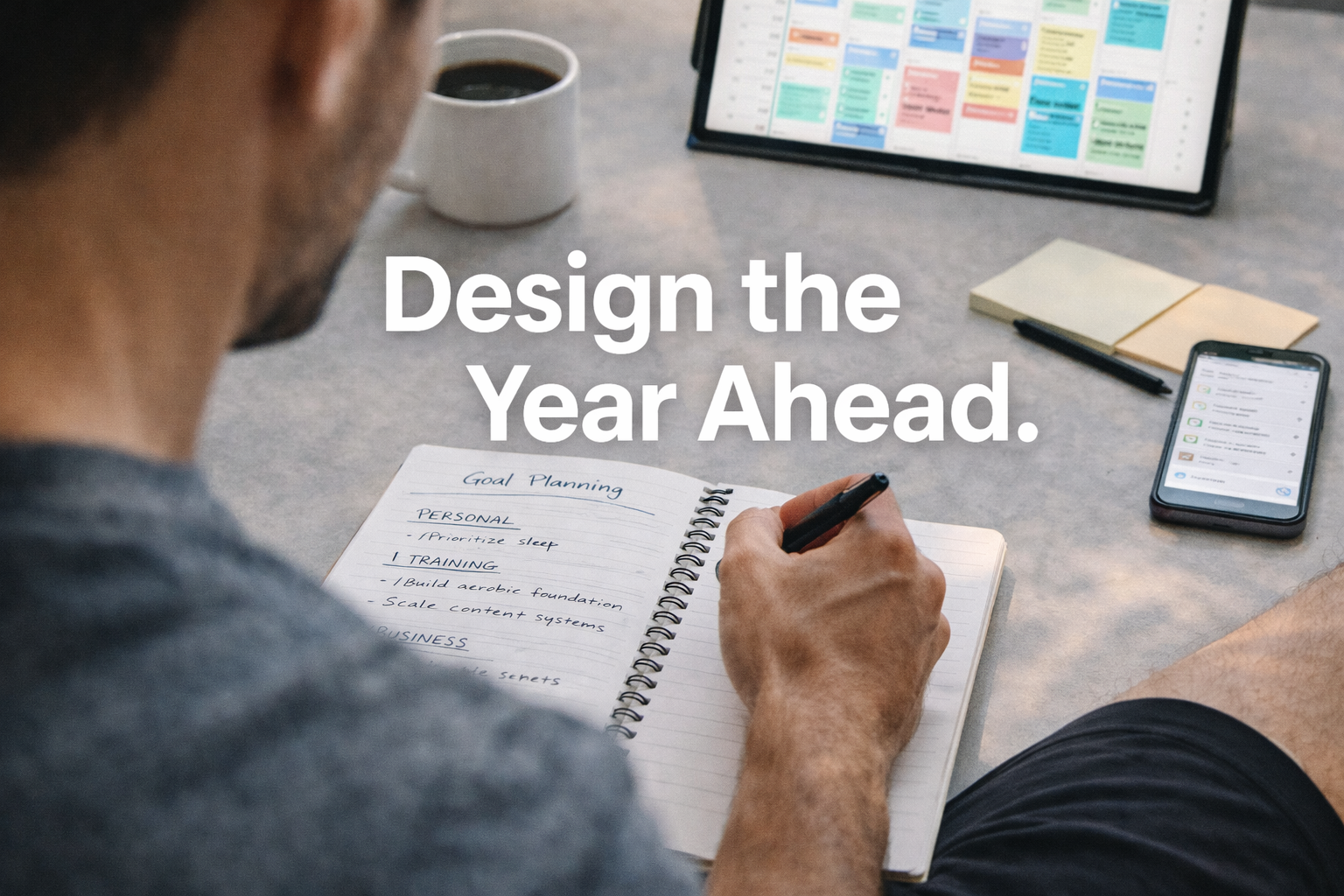
From Reflection to Direction: My New Year Process
Instead of rigid resolutions, this is the process I use to set intentional, sustainable goals across personal health, training, and business — built around energy, consistency, and long-term progress.
A strong year isn’t forged by one bold resolution — it’s shaped by consistent intention.
Before setting goals, I step back, assess the last year, and choose how I want to show up in the next one.
One of the most common traditions this time of year is some sort of resolution, change, plan, or something to do differently to start off year. Over the past few years, I have switched up towards more of a process that I also implement around any other significant event such as a race or work event. I use this as a time for reflection, looking at the things I did well in the previous year, some areas that didn't go so well and lessons learned from them, and finally a look forward to next year with a combination of incremental process goals, things I want to improve on, and then a "big scary goal" or two. I'm sharing this here for two reasons, one to walk through what I believe is a more successful concept, and two to provide myself with a level of accountability.
Looking back at last year, I didn't have any of those stand-out wins or massive highs but it definitely was a year of consistency. I feel like this consistency applies to the business side most with regards to my clients, my level of service to them, and also with my consistently looking to learn and continue to improve. I also feel like I managed to gradually work on my sleep, the most challenging part getting to bed earlier. There's still lots of room to improve but the increased awareness and small shift should help lead into this year for even more improvement. My training didn't go quite as planned as I started the year recovering from a torn labrum, and then later in the year picked up another hip injury. But I do feel like both of these injuries brought me greater awareness of my body, especially while running as I needed to make various tweaks based on my physical therapy. This awareness also helped me more smartly adhere to my training plan and also know when I needed to make shifts in the plan. The last area I wanted to call out was not only a better handle on my schedule, but also doing a better job of protecting the parts of my schedule that I needed (or wanted) to hold. While this may sound trivial, I have a habit of rearranging my schedule to fit others and while that has certain obvious advantages it does create other challenges for me and my mental outlook. Shifting just a little bit along that scale towards protecting my schedule helps me strike a better balance in my life.
As for areas that didn't go as well, I don't go into this process trying to find every issue or mistake but instead look at one or two significant aspects that were the most impactful on the year. Probably the most obvious one that jumps out to me was my consistency with strength training, which I realize might sound odd coming from someone who knows how important it is. I will firmly admit that I am one of my toughest clients, and spoiler this will be an item coming up that I plan to work on. I also recognize that I probably got a little too comfortable with my client base and didn't push as hard I as I could to grow that, or improve what I'm doing for my existing clients. This is also one of those areas where I am my worst critic as well, but I do feel like there's room for improvement there. Finally the other aspect I recognize got a bit out of control was my ability to check out for longer than I probably should. Yes there are times when I need to zone out to relax and recharge, but far too often a 30 minute mental break turned into multiple hours. This one will probably be tough to break, but I feel like one of the tweaks I made towards the end of the year will help with this and more awareness will also help reign this habit in a bit.
So what does my plan for 2026 look like? As part of this process, I look to identify a couple of processes that I want to improve, a couple of specific targets (usually with a couple levels to them), and then a "scary" goal or two. I mentioned it above, but top of the list that I need to work on is my strength training consistency and I've already addressed many of the logistical challenges with a routine - I simply need to do it. My plan to improve my consistency starts with actually scheduling the slot on my calendar, as only having it on my training plan doesn't seem to work. I will also make the mental shift that these workouts are my most important ones of the week, and need to happen before I "reward" myself with my long run. I also want to work on keeping my schedule more in control, satisfying my clients but also leaving room for myself. I've made strides this year, but feel like there's a gap between the day to day scheduling and longer term stuff. I'm recently starting using a tool called Notion (just the free version at this time) to help better organize and visualize my longer term projects and that coupled with my existing calendar should help improve this situation. I do have some specific business goals with regards to numbers I want to hit and the success of a new program I will be launching (👀SOON! 👀) but the scheduling improvement I mentioned will also have a significant positive impact on my business. I'm taking a break this year from setting a specific financial target but I will gauge this success based on my comfort level with additional expenditures, primarily vacation and travel. I know that may sound vague but it has a very specific and real meaning to me, which is the important part. As for my "scary" goals, technically I have two of them but they're related and based on how the year starts off with my injury may collapse to one. But I have some relatively lofty goals that I want to hit with regards to my marathon time, and full distance Ironman Triathlon. But before I can really narrow in on these, I need to see how the next couple weeks of training goes as that will drive whether I can tackle both of them, or if I need to focus on just one.
The New Year isn’t about doing everything — it’s about doing the right things with intention.
When your personal health, training, and business goals align, progress becomes sustainable and meaningful.
This year, to summarize my outlook, I’m focused on clarity, consistency, and energy — and helping others do the same.
🔗 Subscribe to The Wellness Forge for weekly insights on building strength, resilience, and sustainable performance.
Building Better Sleep Habits — and Keeping Them Through the Holidays
Great sleep isn’t luck — it’s built.
Learn how to create a consistent sleep environment and routine that improves recovery, focus, and performance — even during the holidays.
The holidays bring joy, connection… and disruption.
Travel, late nights, and changing routines can throw your sleep completely off track.
But with a few intentional habits and environmental tweaks, you can stay rested and ready through the busiest season of the year.
Before I dive in too deep, let's first set the ground rules for what I tend to consider when thinking about "Sleep Hygiene:"
The Environment - light, temperature, noise, other people, pets, etc.
Your Behaviors - phone usage, caffeine, stress, etc.
Your Routine - what you do leading up to attempting to fall asleep
There's more you can look at when defining Sleep Hygiene, but these are the biggest impacts you can make. The good news is that making a few tweaks now for the Holidays, allows you to roll them into the New Year and build on that foundation for continued benefits.
For each of these three areas, there's a range of changes that can be made not only in how much of an impact they'll have for your sleep quality, but also how large of a change you'll need to make. Both of which will vary wildly from person to person and as such I typically recommend making only one or two changes at a time, prioritizing your ease of implementation and sleep impact. So let's look at each of these areas, and toss out a couple of ideas for each as well as some idea on the commitment needed to make the change:
Environment
Try to create as dark of a room as possible, with the simplest option being to use a sleep mask.
A little more of a financial commitment, but might be better if masks are not comfortable, would be blackout window coverings of some sort.
Temperature is also a massive factor in sleep quality and covers not only the temperature of the room, but that of the bed as well. There are lots of options here ranging in price from adding fans to help cool down, setting the room temperature cooler, or even looking at the various options out there to cool (and heat) your bed itself.
Behaviors
Stress is one of the more impactful factors I've listed, but it is also complex and not always obvious. A workout (productive stress) done late in the day could have a calming impact on some, or it could produce too many endorphins such that it becomes harder to fall asleep. Couple stressful days with some items in the routine area I'll get to such that you moderate those days and mitigate the detrimental effects of an excess of stress.
Caffeine varies significantly not only in the magnitude of the impact but also the duration such that everyone needs to understand for themselves what does and does not work for them.
Screen usage has been consistently shown to be damaging to sleep quality, with the simple answer being to put everything away a set period before bed. However, that's practically very challenging for many people, so an alternative would be to wear blue light blocking glasses to reduce (or negate) that impact.
Routine
A routine starts with timing, ideally one that allows for consistent bed time as well as a consistent waking time. Best practices are to keep both of these times as consistent as possible, during the week and weekends. A way to think of this is the popular shift many do over the weekends essentially is subjecting your body to jet lag every week. Now, does this require a rigid structure such that there's never any fun? Of course not, but recognize the impact a night out will have and look for other ways (like a nap) to more fully restore the body and mind.
Outside of that, look for things you can stack in the evening to help enter a calm state and prepare the body for sleep. Again, these could be all sorts of things and don't need to be overly complex - start simple and work backwards from whatever time you want to go to bed. Some options to consider:
reading, journaling, stretching, meditation, turning down the lights, and way too many more to list out.
There are two separate paths you can take to work on your sleep hygiene as the holidays approach:
Pick one or two items from the list above, work to implement them, and keep track of the impact they have on your sleep duration, quality, and how you feel the next day. Look to be as consistent as possible, but allow yourself the grace to enjoy the Holidays. The goal is progress and awareness, not creating the perfect solution.
If your schedule seems overwhelming and too chaotic to control, roll with that and keep a journal of the various things that change, how they impact your sleep, and how you feel the next day. This information you gather will then better inform you for the New Year such that you can have targeted changes that you KNOW will impact YOUR sleep in a positive way. Mentally, making changes in a way you've already proven to work are significantly easier to implement and sustain such that you'll get a massive boost to start the New Year!
A final idea to consider if you're traveling for the holidays, what parts of your sleep hygiene can you bring to carry that continuity and familiarity with you?
And as always, look for the small changes you can make that are sustainable and build momentum.
The holidays don’t have to derail your rest — they can be a chance to refine it.
Build a sleep routine that supports recovery, clarity, and energy, no matter where you are.
Start small. Be consistent. Protect your foundation.
💤 Subscribe to The Wellness Forge for more actionable wellness strategies that keep you performing at your best.

The Most Underrated Performance Tool: Sleep
Sleep isn’t just rest—it’s recovery. From sharper focus to faster training gains, even small improvements in sleep can fuel measurable performance benefits. Here’s how to sleep smarter.
Sleep is the highest ROI habit in health.
One extra hour can boost focus, regulate hormones, and even improve training outcomes.
Here’s how to start improving your sleep tonight — and what happens when you don’t.
Most people I work with have an understanding or a desire to improve either their sleep quality or the amount of sleep they get, but struggle to effectively make a change. Like I mentioned in my previous post on Nutrition, awareness is the key first step. Start a sleep log - paper, electronic, or via an app, doesn't matter at this stage, and start to look for trends to target. But, something you can start tonight that will make a difference and build towards better sleep hygiene - before you try to go to sleep, take 5 minutes for the following:
Put your phone/tablet/laptop down for the night
Focus on your breathing, taking deep controlled breaths
Reflect on your day, focus on the good things of the day to help calm the nervous system and relax
Think about 1 thing you want to do tomorrow. This isn't about creating your to-do list, or run through your calendar, but 1 tangible thing you want to do better tomorrow. Maybe this is walking more during the day, taking the stairs, drinking more water, picking fruit for a snack and not the candy, or whatever small tangible step seems plausible to accomplish. And then check in on your progress with that the next night.
What does this 5 minutes get you? It starts you on the path to establishing a night time ritual that you can build on that doesn't have to be overly complex. It simply needs to be a series of things you do (ideally around the same time each night) that helps you signal your body that it is time to sleep. As you progress on the journey towards better sleep, there are lots of other things you can look to change, but for now, start small and build momentum. Another simple (not necessarily easy though) step to take that you can implement immediately, start reframing sleep from something you need to do to prevent the negative impacts, towards an attitude that embraces the restorative and supercharging benefits more productive sleep provides.
I know many live by the "I'll sleep when I'm dead" mantra, and I lived that way for a while too, but at some point that lack of sleep will come back around. Lack of sleep is one of the biggest stressors you can subject your body to, so it will dramatically limit your ability to perform as well as fight off any illnesses or injuries. The mental impact sometimes is hard to recognize as so often we've gotten used to the feelings and don't really appreciate it until we start getting CONSISTENT good sleep. Also it is hard to compare the impact on our body as there isn't a great way to quantitatively compare what it could be if we were getting better sleep. Some wearables can help address this and provide some insights, I personally have been using Whoop for almost 5 years now and have a pretty good feel how impactful sleep is on my mental and physical performance. However, there are numerous studies that look at exactly that - the dramatic impacts poor sleep has on your mental performance and capacity, as well as your physical performance. Physically it is even more damaging as the lack of sleep not only diminishes your performance but it will also prevent you from absorbing the same amount of your training such that you see reduced gains from your daily (or however frequently you work out) efforts. I could go on talking about the negative aspects, but honestly that list is VERY long!
Not only will you see the opposite of the above problems when you start getting consistently solid sleep, but you will also start to notice long term trends as well. The big health metrics - things like body fat percentage, blood pressure, and metabolism will all trend better as you work on your sleep quality. This is not only due to the short term impacts, but while we sleep the body has the opportunity to recover and repair itself. This recovery and repairing then compounds with your training load to create a very powerful healthy stress, recover, and adapt cycle that allows your brain and body to best leverage the hard work you're doing.
To summarize the last two paragraphs simply - progressing towards healthier sleep is the single best way to supercharge your tomorrow. It is one of the harder changes to make, but the benefits can be life changing.
Sleep is the foundation — not the reward — for your hard work.
You don’t earn it after performing; you build everything from it.
Small changes tonight can create measurable improvements in your energy, focus, and recovery tomorrow.
💡 Subscribe to The Wellness Forge for more practical, evidence-based strategies to perform better, recover faster, and live stronger.