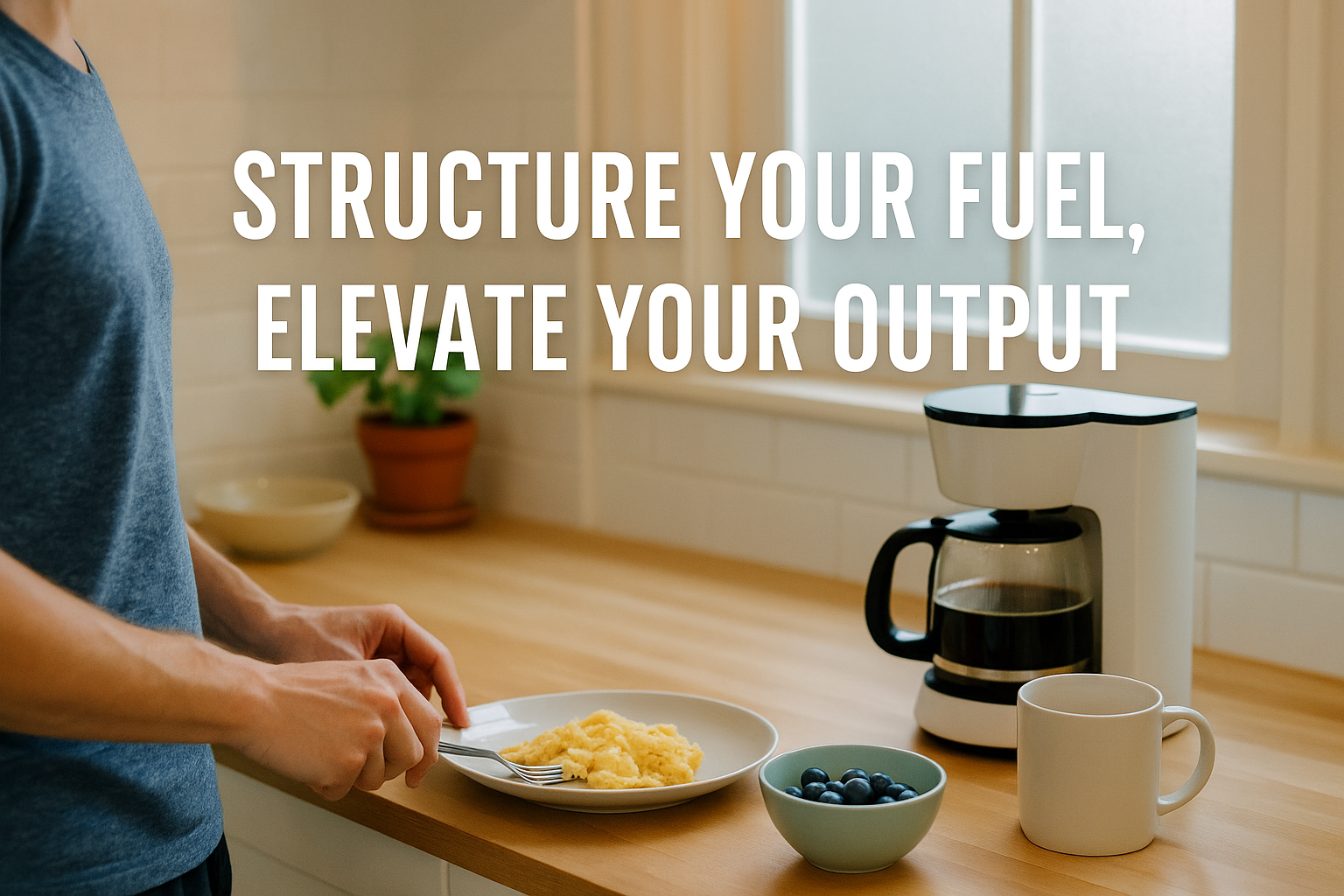
How to Structure Your Eating for Better Energy & Performance
Meal timing plays a major role in energy, appetite, and performance. Here’s how to build a simple structured eating schedule — and where intermittent fasting fits in.
Many people know what to eat…
But fewer know when to eat.
Some people experiment with intermittent fasting to simplify their routines — and it can work for the right person.
But for many, structure beats restriction.
Over the years there have been lots of ideas and fads surrounding the topic of when is the best time to eat. And like most everything in the Wellness space, the optimal timing will vary wildly from person to person. The key to figuring out what works best, like I've mentioned before, is the awareness of what you're currently doing and paying attention to the signals your body and mind are already sending you. If you think that meal timing might be a challenge for you, the key things to pay attention are your hunger cues, energy levels, and mental acuity. Based on that information, you can start to piece together where sliding a meal might help, or adding in an additional meal or snack would curb the cravings and eliminate energy crashes. The goal of meal timing is to stabilize and even out not only your hunger but also keep your energy levels consistent such that you don't have any of those dreaded nose dives.
What does this look like in application? Typically for most people this ends up as 3 spaced meals with some sort of an afternoon snack mixed in there, or possibly a fourth meal. Of course, this will all vary based on training loads and work schedules but that is the general pattern that seems to benefit most people. Having a loose structure like this during that day not only stabilizes hunger and energy, but it also keeps insulin levels more consistent and helps limit over-eating. This also allows for more consistently hitting macro targets, especially protein, as you're not struggling to catch up late in the day. You'll also want to adjust this based not only your logistical schedule but any sort of training needs and can vary on a daily basis.
One concept that comes up frequently with meal timing is centered around not eating too late in the evening, or too close to going to sleep. For most people, this is a pretty decent guideline to follow - but like everything, there are possible exceptions. The main idea is that digesting food while trying to sleep doesn't lead to as productive sleep, however there is some variance here. So, if your schedule lines up or seems to work out that you're eating late - pay attention to how you sleep and feel, and try running your own test to see what differences you notice when you do or don't eat late. Personally, eating late does not bother me, but I know others that it can absolutely tank their sleep.
Another frequent comment I hear from people is that they struggle to eat breakfast or aren't hungry until later in the day. This is usually a more involved conversation but typically I do recommend people having something close to when they first wake up in the morning. A couple options if you really struggle eating in the mornings would be to include some protein powder with your morning coffee, or sliding your meals such that your snack comes during the typical breakfast time. I will do a complete post on this as I do feel strongly that breakfast is very helpful and also has more nuance then I can cover in a paragraph.
Intermittent Fasting (IF) is another common trend these days and many swear by it as a way to lose weight. IF centers around the idea of only eating during certain periods of the day, and if you think about it almost all of us naturally do this due to our sleep patterns. The main benefit of IF is that it is a simple way to reduce caloric intake, and that is the main driver with any sort of weight loss. However, as with all restrictive habits, it can lead to over eating as well as creating a more adversarial relationship with food, as opposed to eating to support and nourish your body. IF can be a useful tool, but should be used sparingly and with consistent awareness to best understand how your body is responding to the changes.
Meal timing doesn’t have to be complicated.
Build consistency. Fuel earlier. Match intake to your day.
IF can be a tool — but the real goal is finding a rhythm that supports how you live, train, and perform.
🔗 Subscribe to The Wellness Forge for more data-driven wellness guidance.

You Don’t Need Another Fitness Plan — You Need a Coach
Why should you consider a health coach, and what to look for in a coach you hire.
I'm sure you've been under a barrage of emails, ads, reels, threads, and videos all telling you what is lacking in your diet, what you're eating too much of, what one time hack will change your life, how to get that elusive 8 hours of sleep a night, or how this exercise plan is guaranteed to drop 10 pounds in a week. All of that information has value, but it way is too much to handle and the majority of it doesn't apply to your exact lifestyle and situation.
That is why a Health Coach could be the solution to the goal that has been eluding you for longer than you want to admit. A coach will act as a guide, empowering you to change your life not only in an effective way, but in a sustainable way such that it becomes your new normal. Probably the most important benefit is filtering the noise down to what matters and a sounding board for those items that sound interesting.
A few other way a health coach will help you hit new levels:
The accountability of someone else (outside of your family and friends) who can not only keep track of your wins, but also help you gain insight from your struggles.
Your coach will tailor everything based on your unique situation to find not only the productive steps, but the steps you are willing AND able to take.
The ability to combine raw data (calories, heart rate metrics, food intake, etc) with logistical factors (travel, commute, working hours, etc) as well as all the emotional aspects (relationships, passions, goals, etc.) to form a more complete and flexible strategy for success.
A good health coach will look at multiple aspects of your life, and not just focus on a specific thing. How do you need to modify your fueling based on your strength training, how should both of those be shifted during higher stress loads at work or while travelling, or how (and when) to double down on a sleep routine to maximize performance?
Because of the above (and others) working with a health coach will result in consistent success and not the massive fluctuations so many struggle with. Sure there will be ups and downs, but honest communication with your coach will level those out such that they're smaller in magnitude and less frequent.
If this all sounds like something you might be missing, the next question is what to look for in a health coach?
By far the most important aspect is a personality that you feel comfortable with and meshes well with your own. Coaching is only as successful as the communication between the coach and the client. If you don't feel comfortable sharing your struggles, that's not the right coach for you.
That coach needs to meet you where you are:
Technology for communication
in person
some form of video conference
phone calls
text
Meeting frequency and availability
Expectations on you
logging or tracking
communication
commitment
Price
You also will want to understand the experience and credentials of the coach, and you'll want a mix of both. I'm sure you know the booksmart but not street savy people, and the opposite as well - you'll want something in the middle. Someone who understands the details, but has enough experience to be able to tailor it for you specifically.
At the end of the day, lasting change doesn’t come from hacks or quick fixes — it comes from having the right structure, support, and accountability. If you’re ready to build momentum and start feeling your best, working with a coach might be the step that makes it stick.
If you like what I have to say, follow here, my email newsletter, or reach out and we can chat in more detail.