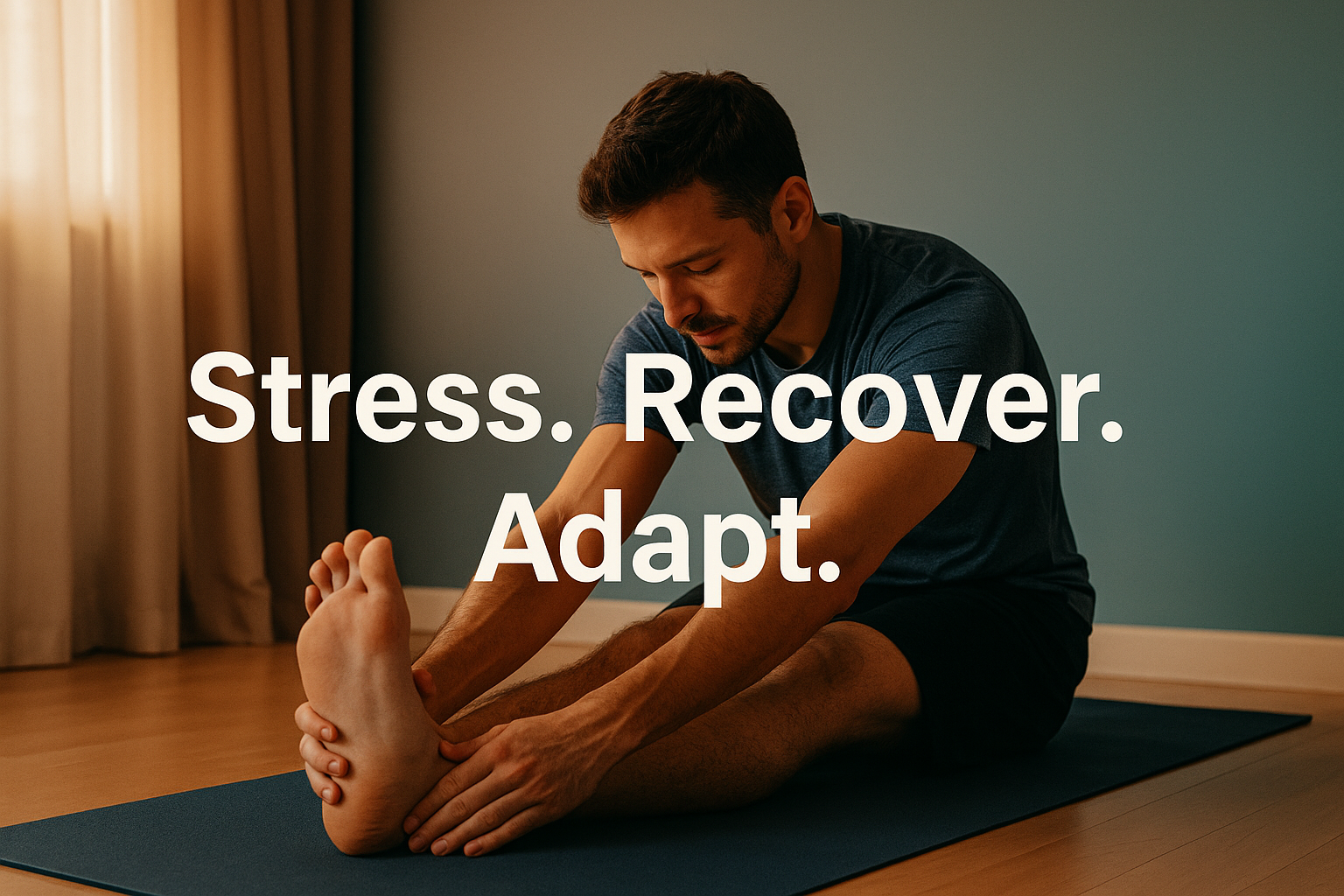
Recovery, Explained: How Your Body Rebuilds After Stress
Your body follows a predictable pattern when recovering from mental stress or physical training. Learn what actually happens during recovery — and how to support each phase to improve performance and resilience.
Stress shapes you. Recovery strengthens you.
Your body is constantly balancing breakdown and rebuild — and with the right inputs, you can turn stress into adaptation rather than exhaustion.
When it comes to stress, recovery, and adaptations the body treats mental and physical stressors in the same fashion with a very similar process. Knowing how this process works not only will help you as you look to make progress, but also pinpoint one of the biggest culprits in leading to plateaus. These stressors can be planned workouts, busy days at work, illness, relationships, or all of them combined and it becomes crucial to account for this when looking at how much you're trying to accomplish and what results are reasonable to expect.
The first step in this process is an immediate response to this stressor that includes things like an increase in heart rate, cortisol and adrenaline rise, mental focus increase, and an increase in blood sugar to provide more energy to meet the increased need. After the stressor has passed the body then shifts into repair mode shifting those resources to stabilize which will include things like a normalization of hormone levels, and repair of any tissue damage. Finally we get into the adaptation phase where muscle strength increases, muscular endurance improves, cognitive resilience increases, and there's a mood improvement all with the goal to better handle the next stressor that comes.
The challenge for many is balancing out the stressors such that this entire process can run from start to finish in an efficient manner. Too strong or too quick of a stressor and the body never finishes the repair mode and as such can't adapt or grow stronger. The repair process can also be delayed by other factors too, such as poor sleep, underfueling, or even relationship stress. Some indicators that you may be stuck in this cycle are consistent muscle soreness or perpetual fatigue. The flip side can also cause problems as too weak of a stressor, or ones spaced too far apart and the body never triggers an adaptation as it doesn't need to.
Unfortunately, there is no one single test that can identify either of these as the exact problem you may be facing in hitting your goals. However, if you find yourself stuck at a plateau or feel like you're just going through the motions, the first place to start would be that honest assessment of your stressors and what actions you're currently taking. If you feel like you're perhaps putting your body under too much stress, look for ways to either reduce some of that or change up your workouts by reducing the duration or intensity. Most workout programs have a built-in de-load period to help the body adjust, but depending on where you're starting from it may take longer than that. If you feel like you're on the other side of the fence, I wouldn't suggest increasing your stress (don't go out purposely to get poor sleep) but look to change up or increase your workout frequency/intensity. With either of these paths, I wouldn't look to change too many things or make a drastic change but start small and evaluate progress.
Stress is unavoidable — but recovery is intentional.
When you understand how your body repairs, resets, and rebuilds, you can train harder, handle stress better, and perform at a higher level.
Support the process. Build resilience. Keep forging forward.
🔗 Subscribe to The Wellness Forge for strategies that help you recover smarter and perform stronger.

You Don’t Need Another Fitness Plan — You Need a Coach
Why should you consider a health coach, and what to look for in a coach you hire.
I'm sure you've been under a barrage of emails, ads, reels, threads, and videos all telling you what is lacking in your diet, what you're eating too much of, what one time hack will change your life, how to get that elusive 8 hours of sleep a night, or how this exercise plan is guaranteed to drop 10 pounds in a week. All of that information has value, but it way is too much to handle and the majority of it doesn't apply to your exact lifestyle and situation.
That is why a Health Coach could be the solution to the goal that has been eluding you for longer than you want to admit. A coach will act as a guide, empowering you to change your life not only in an effective way, but in a sustainable way such that it becomes your new normal. Probably the most important benefit is filtering the noise down to what matters and a sounding board for those items that sound interesting.
A few other way a health coach will help you hit new levels:
The accountability of someone else (outside of your family and friends) who can not only keep track of your wins, but also help you gain insight from your struggles.
Your coach will tailor everything based on your unique situation to find not only the productive steps, but the steps you are willing AND able to take.
The ability to combine raw data (calories, heart rate metrics, food intake, etc) with logistical factors (travel, commute, working hours, etc) as well as all the emotional aspects (relationships, passions, goals, etc.) to form a more complete and flexible strategy for success.
A good health coach will look at multiple aspects of your life, and not just focus on a specific thing. How do you need to modify your fueling based on your strength training, how should both of those be shifted during higher stress loads at work or while travelling, or how (and when) to double down on a sleep routine to maximize performance?
Because of the above (and others) working with a health coach will result in consistent success and not the massive fluctuations so many struggle with. Sure there will be ups and downs, but honest communication with your coach will level those out such that they're smaller in magnitude and less frequent.
If this all sounds like something you might be missing, the next question is what to look for in a health coach?
By far the most important aspect is a personality that you feel comfortable with and meshes well with your own. Coaching is only as successful as the communication between the coach and the client. If you don't feel comfortable sharing your struggles, that's not the right coach for you.
That coach needs to meet you where you are:
Technology for communication
in person
some form of video conference
phone calls
text
Meeting frequency and availability
Expectations on you
logging or tracking
communication
commitment
Price
You also will want to understand the experience and credentials of the coach, and you'll want a mix of both. I'm sure you know the booksmart but not street savy people, and the opposite as well - you'll want something in the middle. Someone who understands the details, but has enough experience to be able to tailor it for you specifically.
At the end of the day, lasting change doesn’t come from hacks or quick fixes — it comes from having the right structure, support, and accountability. If you’re ready to build momentum and start feeling your best, working with a coach might be the step that makes it stick.
If you like what I have to say, follow here, my email newsletter, or reach out and we can chat in more detail.