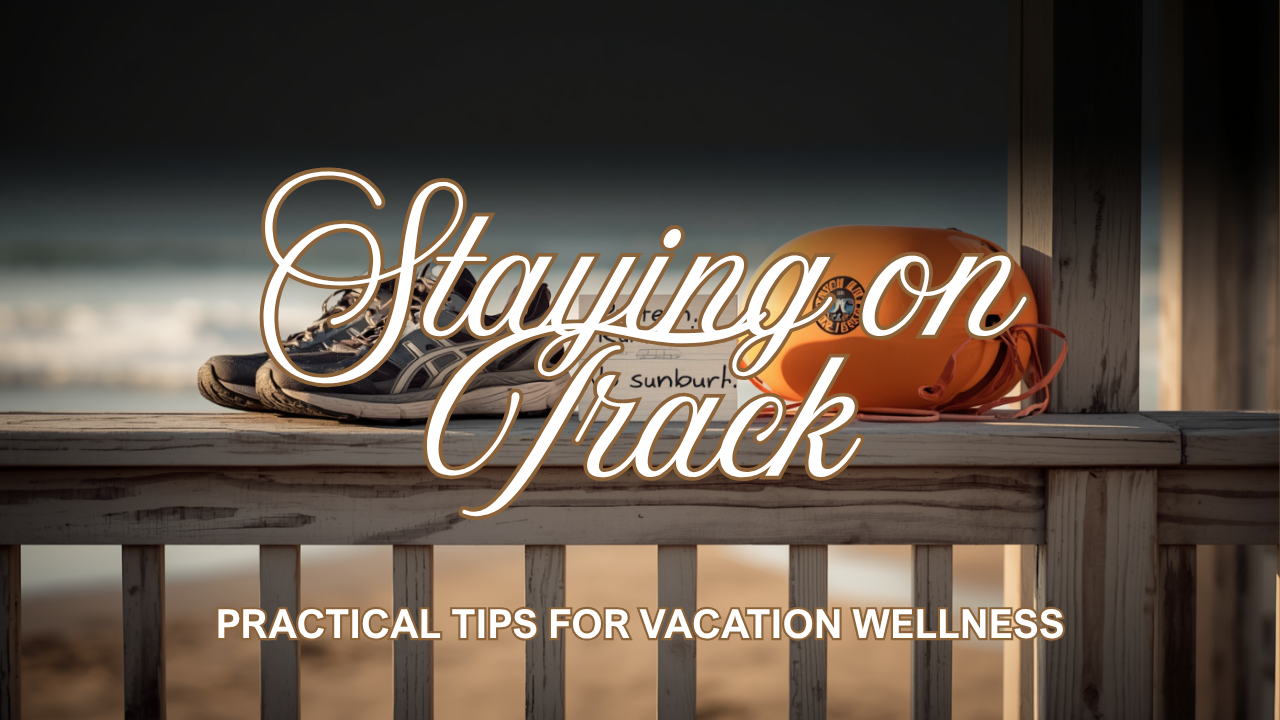
How I Stayed on Track Without Following My Normal Routine
I recently had the opportunity to put my Summer Baseline framework to the test during a trip. The routine wasn't perfect, but that wasn't the goal. Here's what actually helped me stay consistent—and why having a travel version of your plan makes all the difference.
I've been writing this past month about summer challenges and tips for travel, so it seemed natural for me to recap my most recent summer vacation and talk through how I planned things out, what worked, and what didn't.
A little context for the trip first, I was going to be gone for 10 days, with my family, and planning for a laid back, relaxing trip hoping to take the time to just enjoy the company. But I still wanted to continue the momentum I had built up, without having to stress about all the little things.
My main anchor points for the trip were breakfast, my running, swimming, and probably the most important, not getting sunburnt.
I pre-made the dry ingredients for my overnight oats knowing that we were grocery shopping and I could get milk and yogurt to finish it off for my big training days. And then milk, bagels, and eggs would work on the lighter days for some good variety.
I brought my running gear with me and looked ahead of time to get a feel for the area, map out some routes, and understand what the options were. I also knew that schedule wise, I would be up, out, back, and cleaned up before most of the group was even up such that I wouldn't miss much of the family time.
Being out in the ocean, I wanted to be cautious so I brought my buoyancy shorts as well as my inflatable buoy for visibility and extra safety. I wasn't intending to get in anything especially long, more to keep up my swim consistency and get back into some open water.
As for the sun, I brought a couple of rash-guard shirts to protect, sun-screen, hats, and then the house had great patios such that I could be outside and enjoy everything, without being in the sun.
All of these anchors worked perfectly, I managed to feel good and strong on my runs, swam twice, and didn't get burnt one bit! I then was able to pretty much eat and enjoy whatever we were doing for lunch and dinners, and add in the occasional treats. My training volume took a bit of a hit as I wasn't biking, but that just didn't make enough sense for me to try and worry about a solution.
Now of course, no trip is perfect so there were a couple of things I could have done better, but honestly they were more "nice to haves" so I wasn't overly worried about them.
I brought my suspension trainer with me, but there wasn't a good place to anchor it. One week without strength training isn't going to make a huge difference, but it would have given me a fun opportunity to show some different options for my family.
I did a pretty good job making sure I was properly hydrated, but I'm pretty confident I was low on total calories, or at least not as many as I typically have at home. Lunch was the main "challenge" meal of the day although I probably didn't do as bad as I think as there were many days that I had multiple snacks - which probably equaled one lunch.
Probably the biggest aspect I "struggled" with was sleep as my mornings were pretty set but I didn't get to bed as early as I should have. Again, this was a trade-off I was happy to make to spend time with my family.
The takeaway is not that I did everything right. It is that I decided in advance what mattered and let go of the rest without guilt.
Biking was not realistic. The suspension trainer did not have a home. Sleep was a trade-off I made with my eyes open. None of that felt like failure because none of it was unplanned. It was just the trip being the trip.
That is the whole point of the anchor system. You are not trying to replicate your home routine in a different location. You are trying to protect the things that matter most and give yourself permission to release the rest.
If you have been following this series and want help figuring out which anchors actually matter for your summer — whether that is training, nutrition, sleep, or travel — that is exactly the kind of planning I do with coaching clients. Let's map it out before your next trip.
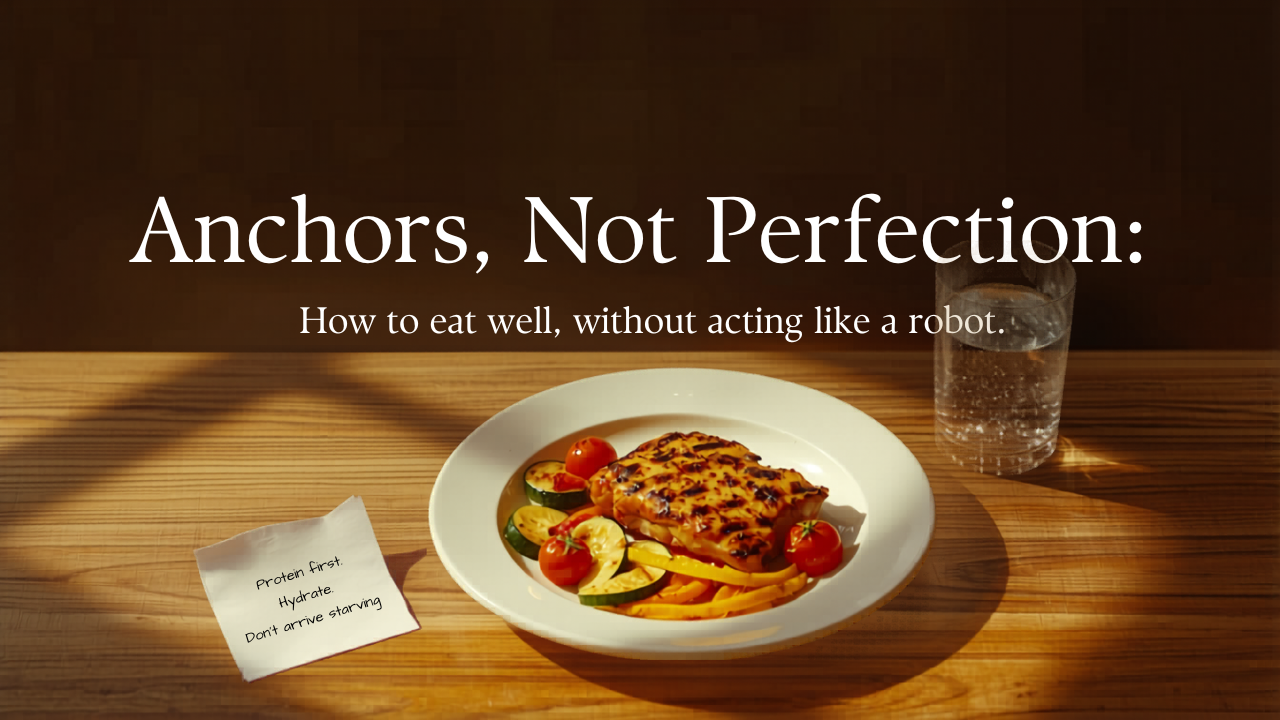
Summer Eating Needs Anchors, Not Perfection
Summer eating often falls apart when people swing between rigid control and no structure at all. A few clear nutrition anchors can make the season much easier to navigate.
Let me paint the picture.
Cookout Friday. Birthday dinner Saturday. Road trip Sunday. Breakfast was a protein bar in the car. Lunch happened at your desk around 2 p.m. Dinner is whatever is fast because the kids have practice.
This is not a discipline failure. This is just summer.
And this is exactly where most people's nutrition goes one of two directions — neither of which actually works.
The Two Traps
The first is trying to be perfect. Locked-in meal plan, macros tracked, every deviation a setback. You white-knuckle your way through the cookout and feel vaguely miserable while everyone else is just living their life. Then one vacation weekend unravels the whole thing, because the plan had no flexibility built in.
The second is abandoning structure entirely. Every social event becomes a free-for-all. Breakfast gets skipped. Hydration is an afterthought. You tell yourself you will get back on track in September — and by August you are not feeling great, your training is suffering, and the gap is wider than when summer started.
Most people cycle between these two every single year. There is a better approach, and it does not require eating perfectly.
Nutrition Anchors
An anchor is not a rule. Rules are rigid. Rules break.
An anchor is a stable point you return to regardless of what is happening around it. For nutrition, anchors are the two or three habits that, when kept, prevent everything else from spiraling. They do not require a perfect week. They just require consistency on a small number of high-leverage behaviors.
Here are the ones worth keeping this summer.
Protein at your first meal. Thirty to forty grams early sets the tone for the day, reduces hunger, and supports muscle maintenance. Eggs, Greek yogurt, cottage cheese, a shake alongside something real. Front-load your intake so you are not playing catch-up by dinner.
A daily protein target. Pick a number — somewhere around 0.7 to 1 gram per pound of bodyweight is a reasonable range — and take a rough aim at it. You do not need to hit it perfectly. But having a target means you are making intentional choices at restaurants and on travel days instead of just winging it.
A hydration floor. Dehydration is one of the most common drivers of low energy, poor mood, and reduced training performance in summer — and it is completely fixable. A glass of water before coffee, water with every meal, something before you add alcohol at social events. Simple and non-negotiable.
Produce once or twice a day. Not a full vegetable overhaul. Just a commitment to get it on the plate. A handful of berries at breakfast. A salad at lunch. Vegetables on the grill. This handles fiber, micronutrients, and satiety — and it quietly reinforces the identity of someone who is eating well, which matters more than people give it credit for.
Plan alcohol intentionally. Pretending it does not exist is not a strategy. Decide in advance which events you will drink at, roughly how many, and what you will do around them. Planned drinking fits into a healthy summer. Reactive, untracked drinking is usually where things go sideways.
Do not show up starving. A small snack before a cookout or restaurant changes everything. When you arrive genuinely hungry, appetite drives the next twenty minutes — not intention. A piece of fruit, some nuts, a protein bar. That is it.
The Anchor Meal
Beyond the daily habits, there is one structural concept worth adding: the anchor meal.
One meal per day — usually breakfast or lunch — that you keep consistent no matter what else is happening. When dinner is a cookout or a vacation restaurant, the anchor meal has already done its job. Protein is in. Produce is in. Hydration is managed. The variable meal at the end of the day has a lot less power to derail you.
One consistent meal per day is enough to prevent a chaotic summer from becoming a chaotic summer of eating. It also reduces decision fatigue significantly — which, as I have written about in the training context, is one of the most underrated parts of staying consistent when life is busy.
Why This Goes Beyond the Scale
Consistent protein and hydration means more stable energy. Regular produce means better mood and gut function. Showing up to training sessions actually fueled means better performance and recovery. Not swinging between restriction and chaos means a healthier long-term relationship with food.
These things are connected. Nutrition anchors are not just a food strategy. They are a performance and wellbeing strategy that happens to involve food.
One side note worth naming: some of you are working with GLP-1 medications or hormone protocols as part of your health picture. Those tools can be genuinely helpful. But they produce the most durable results when lifestyle structure is present underneath them. Reduced appetite does not automatically mean better protein intake. Optimized hormones do not compensate for chronic under-fueling. The anchors matter regardless of what else is in the stack.
The Shift
You do not need a rigid plan you will abandon by the Fourth of July. You do not need to track every meal or avoid every social event.
You need a small number of anchors that are clear, manageable, and consistent enough to keep the overall picture stable. Pick two or three from above — the ones that feel most natural to maintain even during your busiest weeks — and start there before the chaos hits.
That is not a compromise. That is what sustainable nutrition actually looks like.
What is the easiest nutrition anchor for you to keep this summer — even during the most chaotic weeks? That is where you start.