
The best travel plan is not your full home routine. It is the version that works on the road and keeps the important pieces alive.
You land Monday morning. By Wednesday you have skipped three workouts, eaten airport food twice, slept poorly two nights in a row, and you are telling yourself you will reset when you get home.
Sound familiar?
Travel is the number one routine killer I hear about from clients — and honestly, it is a legitimate challenge. Not an excuse. A real one. But the solution most people try — white-knuckling it through the trip or just giving up entirely — misses the actual problem.
The problem is not that you traveled. It is that you tried to bring your home routine with you. And that never works.
What Travel Actually Does to Your Body
Before we talk solutions, let's be honest about what you are dealing with. Travel does not just disrupt your schedule. It disrupts your physiology.
Sleep takes a hit from time zone shifts, unfamiliar beds, and late nights. Hydration tanks on flights and long drives. Meal timing goes out the window when you are at the mercy of someone else's agenda. Training access is unpredictable. Your daily step count drops when you are sitting in airports, conference rooms, and cars. And recovery — the thing that makes all of your training and nutrition actually work — takes the biggest hit of all.
That is a real accumulation of stress on your body. Pretending it is not there does not help. But catastrophizing it does not either.
The Mindset Shift That Actually Works
Stop trying to replicate your home routine on the road. That is the trap.
Your home routine was built for your home environment — your gym, your kitchen, your sleep schedule, your commute. None of that travels with you. When you try to force it anyway, you either fail and feel like you blew it, or you exhaust yourself trying to hold something together that was never designed for where you are.
The better move is to build a travel version of your routine before you leave. A simplified, portable, realistic plan that fits the actual conditions of travel — not the ideal conditions of your normal life.
This is not lowering your standards. It is matching your plan to your environment. That is just good programming.
The Travel Routine Checklist
These are the things worth deciding before you get on the plane — not improvising at 6 a.m. in a hotel room.
Pack protein options. Bars, single-serve packets, jerky, individual Greek yogurts if you have a cooler. The goal is to have something you control in a bag, so airport food and minibar snacks are not your only options when hunger hits at a bad time.
Choose your hotel with intention when possible. Walkability and gym access are worth factoring in if you have any control over where you stay. A hotel with a decent gym or located near a running path removes a barrier that stops a lot of people before they even start.
Schedule movement before the day gets away. Travel days have a way of filling every available hour. If movement is not on the calendar with a specific time, it usually does not happen. Even 20 minutes in the morning before meetings start is enough to change how you feel for the rest of the day.
Hydrate aggressively on travel days. Cabin pressure and recycled air dehydrate you faster than most people realize. Target at least 16 ounces of water before your flight, and match every alcoholic or caffeinated drink with an equal amount of water. This alone has a significant impact on how you feel when you land.
Walk after meals. This is one of the highest-leverage habits you can build on the road. It helps digestion, blunts blood sugar spikes, adds steps without requiring a workout, and gives you a few minutes away from the table or the screen. Five to ten minutes is enough.
Have a first day back plan. This is the one most people skip and one of the most important. Decide before you leave what the first 24 hours home looks like — what you will eat, whether you will train, how you will prioritize sleep. Without a re-entry plan, the travel hangover extends for days longer than it needs to.
Training Options That Actually Work on the Road
The goal on travel days is not to crush a PR. It is to maintain the habit and keep the engine running. Here is a realistic menu of options depending on what you have access to.
Hotel gym lift. Squat or hinge, push, pull, core carry. Three rounds, 30 minutes. Done. (If you missed last week's post on the 30-minute template, that one is worth going back to.)
30-minute run or walk. Get outside if the city allows it. This doubles as mental reset time, which is often what you need most after a long travel day or a packed conference schedule.
Band workout in your room. A single resistance band covers rows, pulls, hip work, and shoulder stability. Pack one. They weigh nothing and turn any hotel room into a training space.
Mobility reset. On the days when energy is genuinely low and sleep was rough, a 20-minute mobility session is not giving up — it is smart management. Hips, thoracic spine, ankles. You will feel better for the rest of the day and protect your training quality when you get home.
Airport walking. Stop circling the gate and start moving. A 45-minute layover with intentional walking is real movement. It counts.
Nutrition on the Road
You are not going to eat perfectly on a work trip or a family vacation. That is not the goal. The goal is to keep a few anchors in place so the wheels do not come off entirely.
Protein-first ordering. At every restaurant, start with the protein and build from there. Steak, chicken, fish, eggs — whatever is on the menu. This keeps your intake from defaulting to carbohydrate-heavy travel meals that leave you hungry two hours later.
Make a grocery stop. If you are somewhere for more than two days, a 15-minute stop at a grocery store pays dividends all week. Greek yogurt, fruit, protein bars, nuts, deli meat. Having real food in the room changes how the week goes.
Control breakfast. Dinner is often out of your hands — a work dinner, a restaurant with the family, a catered event. Breakfast usually is not. Own that meal. High protein, real food, intentional. Let the rest of the day have some flexibility because you started with a solid foundation.
Set a hydration target and track it. On travel days especially, water does not happen unless you make it happen. Pick a number — 80 to 100 ounces is a reasonable floor — and work toward it deliberately.
The Bigger Picture
The people who stay consistent through travel are not the ones with the most willpower. They are the ones with the simplest, most portable version of their routine — built in advance and practiced enough that it does not require a lot of decision-making in the moment.
That is what coaching actually helps with. Not just building the training plan and the nutrition structure for your normal life, but building the compressed, travel-ready version that keeps you from losing two weeks of progress every time you get on a plane.
Your home routine is your full version. Your travel routine is the version that keeps everything intact until you get back to it.
Build both before you need either one.
One Action Before Your Next Trip
Before you pack your bag, take five minutes to write down your travel version of your routine. What will you eat for breakfast? What does your 30-minute training option look like? When will you move? What will you have in your bag for protein?
That five minutes of planning is the difference between a trip that sets you back two weeks and one you walk away from feeling like you held the line.
Where are you traveling this summer — and what is the one part of your routine that tends to fall apart first when you are on the road? Drop it in the comments. I read every one.

Summer Eating Needs Anchors, Not Perfection
Summer eating often falls apart when people swing between rigid control and no structure at all. A few clear nutrition anchors can make the season much easier to navigate.
Let me paint the picture.
Cookout Friday. Birthday dinner Saturday. Road trip Sunday. Breakfast was a protein bar in the car. Lunch happened at your desk around 2 p.m. Dinner is whatever is fast because the kids have practice.
This is not a discipline failure. This is just summer.
And this is exactly where most people's nutrition goes one of two directions — neither of which actually works.
The Two Traps
The first is trying to be perfect. Locked-in meal plan, macros tracked, every deviation a setback. You white-knuckle your way through the cookout and feel vaguely miserable while everyone else is just living their life. Then one vacation weekend unravels the whole thing, because the plan had no flexibility built in.
The second is abandoning structure entirely. Every social event becomes a free-for-all. Breakfast gets skipped. Hydration is an afterthought. You tell yourself you will get back on track in September — and by August you are not feeling great, your training is suffering, and the gap is wider than when summer started.
Most people cycle between these two every single year. There is a better approach, and it does not require eating perfectly.
Nutrition Anchors
An anchor is not a rule. Rules are rigid. Rules break.
An anchor is a stable point you return to regardless of what is happening around it. For nutrition, anchors are the two or three habits that, when kept, prevent everything else from spiraling. They do not require a perfect week. They just require consistency on a small number of high-leverage behaviors.
Here are the ones worth keeping this summer.
Protein at your first meal. Thirty to forty grams early sets the tone for the day, reduces hunger, and supports muscle maintenance. Eggs, Greek yogurt, cottage cheese, a shake alongside something real. Front-load your intake so you are not playing catch-up by dinner.
A daily protein target. Pick a number — somewhere around 0.7 to 1 gram per pound of bodyweight is a reasonable range — and take a rough aim at it. You do not need to hit it perfectly. But having a target means you are making intentional choices at restaurants and on travel days instead of just winging it.
A hydration floor. Dehydration is one of the most common drivers of low energy, poor mood, and reduced training performance in summer — and it is completely fixable. A glass of water before coffee, water with every meal, something before you add alcohol at social events. Simple and non-negotiable.
Produce once or twice a day. Not a full vegetable overhaul. Just a commitment to get it on the plate. A handful of berries at breakfast. A salad at lunch. Vegetables on the grill. This handles fiber, micronutrients, and satiety — and it quietly reinforces the identity of someone who is eating well, which matters more than people give it credit for.
Plan alcohol intentionally. Pretending it does not exist is not a strategy. Decide in advance which events you will drink at, roughly how many, and what you will do around them. Planned drinking fits into a healthy summer. Reactive, untracked drinking is usually where things go sideways.
Do not show up starving. A small snack before a cookout or restaurant changes everything. When you arrive genuinely hungry, appetite drives the next twenty minutes — not intention. A piece of fruit, some nuts, a protein bar. That is it.
The Anchor Meal
Beyond the daily habits, there is one structural concept worth adding: the anchor meal.
One meal per day — usually breakfast or lunch — that you keep consistent no matter what else is happening. When dinner is a cookout or a vacation restaurant, the anchor meal has already done its job. Protein is in. Produce is in. Hydration is managed. The variable meal at the end of the day has a lot less power to derail you.
One consistent meal per day is enough to prevent a chaotic summer from becoming a chaotic summer of eating. It also reduces decision fatigue significantly — which, as I have written about in the training context, is one of the most underrated parts of staying consistent when life is busy.
Why This Goes Beyond the Scale
Consistent protein and hydration means more stable energy. Regular produce means better mood and gut function. Showing up to training sessions actually fueled means better performance and recovery. Not swinging between restriction and chaos means a healthier long-term relationship with food.
These things are connected. Nutrition anchors are not just a food strategy. They are a performance and wellbeing strategy that happens to involve food.
One side note worth naming: some of you are working with GLP-1 medications or hormone protocols as part of your health picture. Those tools can be genuinely helpful. But they produce the most durable results when lifestyle structure is present underneath them. Reduced appetite does not automatically mean better protein intake. Optimized hormones do not compensate for chronic under-fueling. The anchors matter regardless of what else is in the stack.
The Shift
You do not need a rigid plan you will abandon by the Fourth of July. You do not need to track every meal or avoid every social event.
You need a small number of anchors that are clear, manageable, and consistent enough to keep the overall picture stable. Pick two or three from above — the ones that feel most natural to maintain even during your busiest weeks — and start there before the chaos hits.
That is not a compromise. That is what sustainable nutrition actually looks like.
What is the easiest nutrition anchor for you to keep this summer — even during the most chaotic weeks? That is where you start.
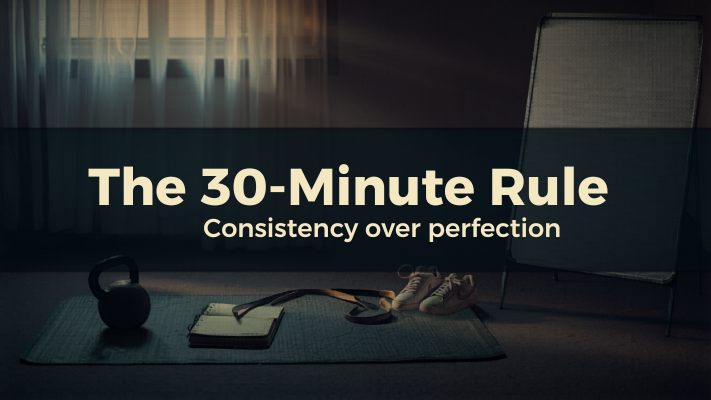
The 30-Minute Rule: How to Keep Training Alive During Busy Seasons
Short workouts are not a compromise when programmed correctly. They are one of the most effective tools for staying consistent when life gets busy.
There is a belief a lot of people carry around without ever questioning it: if you cannot get a full workout in, it is not worth doing.
Sixty minutes, minimum. Ninety if you are being serious about it. Anything less and you might as well not bother.
But here is the thing: that belief is costing a lot of people consistency, and consistency is the only thing that actually produces results over time.
This summer, I want to challenge that mindset directly. Because when you understand what a well-designed 30-minute session can actually accomplish, you stop seeing it as a compromise. You start seeing it as one of the most powerful tools in your training arsenal. The goal is to protect everything you have already built — the strength, the aerobic base, the habit, the identity.
Here is what a well-programmed 30-minute workout can do.
Maintain strength. Strength is more durable than most people think. Research consistently shows that training volume can be reduced significantly (up to 1/7th) before meaningful muscle or strength loss occurs — as long as intensity is preserved. A focused 30-minute strength session, hitting the major movement patterns with appropriate load, is enough to maintain what you have earned.
Preserve aerobic fitness. The cardiovascular system adapts quickly, but it also holds on reasonably well with reduced training loads. A 20-minute conditioning block — done with real effort — maintains more fitness than people expect. The key is not duration; it is intensity. Your aerobic engine does not need to run for an hour. It needs to work.
Reduce stress. Exercise is one of the most well-documented tools for managing cortisol and improving mood. That benefit does not require a long session. Even a short workout that elevates your heart rate and gets you out of your head for 30 minutes can have a measurable impact on how you feel for the rest of the day. In a high-stress season, this alone makes it worth doing.
Reinforce your identity. This is the one most people overlook. Every time you follow through on training — even when it is short, even when it is not perfect — you send yourself a signal: I am someone who does not quit on this. That identity reinforcement compounds over time. Skipping weeks to wait for the "right" conditions erodes it. Thirty minutes of showing up builds it.
When you have only 30 minutes and you walk into the gym without a plan, half of that time disappears while you figure out what to do. Decision fatigue is real, and it is particularly brutal when you are already running short on bandwidth.
The solution is simple: build your templates now, before life gets chaotic. Then when the busy week hits, you are not starting from scratch. You are just executing.
Here are three templates I use with clients.
Template 1: Strength (30 Minutes)
Squat or Hinge — Goblet squat, trap bar deadlift, Romanian deadlift, barbell squat. Pick one. 3 sets.
Push — Dumbbell press, pushups with added load, barbell bench or overhead. 3 sets.
Pull — Rows, pulldowns, chin-ups, cable rows. 3 sets.
Core or Carry — Farmer carry, suitcase carry, Pallof press, dead bug. 1–2 sets. Keep it brief.
How to run it: Use 60–75 second rest periods. Do not exceed 4 sets per movement. Keep the weights honest — this is maintenance training, not a PR attempt. The goal is stimulus, not destruction.
You will not have time for accessories. That is fine. Compound lifts are doing the work that matters.
Template 2: Conditioning (30 Minutes)
Warm-up (5 minutes) — Light movement to elevate heart rate. A few minutes on the bike or rower, dynamic stretching, maybe a short activation drill. This is not optional — going straight into high-intensity work is how people get hurt.
Intervals (20 minutes) — This is where the real work happens. Options: bike, rower, ski erg, assault bike, track. Structure can vary: 20 seconds on/40 seconds off, 1:1 work-to-rest, 30-second all-outs with 90 seconds easy. The format matters less than the effort. You should be breathing hard during the work periods.
Cooldown (5 minutes) — Easy movement to bring the heart rate down. A short walk, some light stretching. This is how you recover faster for the next session.
This template is not glamorous. But done consistently, it preserves aerobic capacity and is one of the most effective stress management tools you have access to.
Template 3: Travel / Hotel (30 Minutes, No Equipment)
Circuit (3–4 rounds) — Squat variation (goblet squat with a bag, split squat, Bulgarian split squat), pushup variation (standard, close grip, elevated), hinge variation (single-leg RDL, hip hinge with band if available), row variation (band rows, face pulls, door frame row if you can find one), core (plank, hollow hold, bear crawl).
Cardio block (10 minutes) — Treadmill intervals, stair climbing, or jump rope if you have one. Even marching in place during intervals works in a pinch.
Travel workouts feel awkward until you have done a few of them. Keep a light resistance band in your bag and know your circuit in advance. The hotel gym does not need to be impressive for this to work.
I have said this before and I will keep saying it: structure prevents the spiral.
When you have a prebuilt plan, the decision is already made. You do not have to negotiate with yourself about what to do or whether it is worth it. You just execute the plan. That cognitive offloading is underrated, especially in a season when your bandwidth is already stretched.
Build your templates now, during a normal week when you have the time and mental space to think clearly. Test them once or twice so you know they work and how they feel. Then when the travel week or the packed project hits, you are not improvising. You are just following the plan you already built for yourself.
A 30-minute session executed consistently for six weeks beats a perfect program you followed for two weeks and then abandoned. Every time. Train with that in mind.
That is how consistency survives the summer.
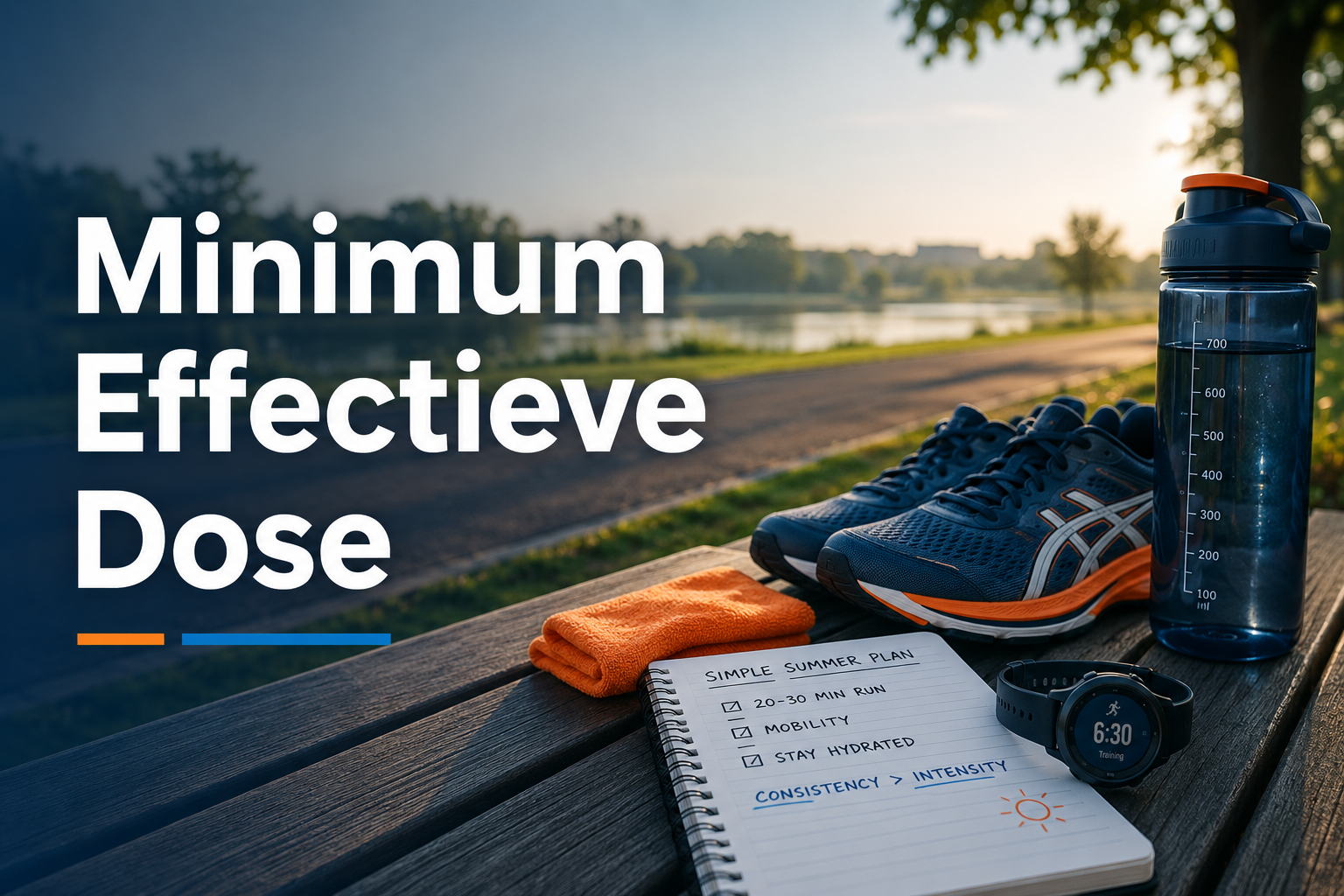
Your Summer Training Plan Needs a Minimum Effective Dose
During chaotic seasons, the smartest training plan is often not the biggest one. It is the minimum effective dose that preserves momentum, muscle, conditioning, and confidence.
When life gets chaotic, a lot of people make the same mistake: they keep trying to run an “ideal” training plan in a very non-ideal season.
That usually ends one of two ways: frustration or inconsistency.
When summer (or any busy time of year hits) it is a natural reaction to want to continue your existing training plan or even push for something bigger, but it is important to recognize that might not always be possible. Sure you might have weeks where that will work, but others will absolutely kick your butt. And if you force it, that week could derail the next and start a downward spiral of frustration, inconsistency, or both. There is a better way to not only continue to push forward and make progress but to preserve your rest and recovery such that you don't burn out due to a busier schedule. The most important part of this process is to maintain not only the momentum but keep your mental outlook high.
The first question to ask yourself is "What is the minimal dose of exercise that will preserve momentum and confidence?" This should look similar to the audits I've suggested before, but in this case you're looking to think about what kind of workouts really invigorate you and boost your mental state. Some variables you can work with might include:
reducing your workout duration (cut your workout in half)
reducing the workout intensity (lighter weights, smooth run instead of a speed workout)
swapping in a mobility workout
swapping a workout for a walk outside with the family, dog, friend, podcast, audio book, etc.
opting for a different modality of workout - swapping in a swim, bike ride, hike, etc.
Having this information in hand, you can start to create your backup plan. Whether you want to make it a full weekly shift, or allow for some day to day flexibility, that's up to you. Personally, I suggest using this process as part of that weekly assessment not only looking back, but looking forward as well. The more you can plan and structure through the busy times, the better you'll handle them. You'll feel so much better crushing your "drop" week then constantly trying to make adjustments. Best case, if things don't go as busy as you anticipated, you can always ramp back up one of your workouts later in the week. But the important thing is to not look at this as a lost week, the goal is to continue the momentum.
How this looks in practice is up for you to decide, but I recommend having at least one option for your week, and possibly even two. You could have your ideal plan, a slightly scaled back one for a busy week, and then a third that truly is the minimal dose for when things threaten to go off the rails. Then use that weekly review time to see what adjustments need to be made - for the first couple of passes at this, I suggest erring on the side of caution since it is WAY easier to add to you week then dig out of an over-exertion week.
If summer tends to throw off your training, the answer is not to expect perfection. It is to define the minimum effective dose that keeps you moving, maintaining, and mentally engaged. A plan that preserves momentum in a chaotic season is far more valuable than a perfect plan you cannot follow.
You do not need maximum training to stay on track. You need enough consistency to preserve what matters.

Find the Weak Points Before Summer Does
Summer often exposes the routines that were already fragile. A quick self-audit can help you identify what is most likely to break first.
Before summer chaos hits, do not ask whether you are motivated.
Ask where your routine is fragile.
Because that is usually where things start to slide.
One of the best ways to prepare for any upcoming change is to do an audit of where you currently stand and then make adjustments from there. And preparing for summer is no different, as no matter what your situation is, summer will bring some sort of change. And if you practice this habit now, it will be available to you during any other periods of change - new job, new relationship, additional (or first) kid, etc. Summer, just like any of these is a stress test, and those always reveal the problems in any system
So what does this look like in practice? The main idea to look for those areas where you feel least confident they will hold if something changes or goes slightly off normal. From there, you're going to target ONE to strengthen and then set boundaries as I mentioned before to help create your "stressed" gameplan. This becomes the gameplan you can fall back to that will still allow you to progress when life gets challenging. Looking at each of the following areas, you'll want to honestly understand your strengths and weaknesses.
Strength training
Do your workouts improve your mentality or drain it?
Do you look forward to your workouts, or struggle to fit them in?
Nutrition and Fueling
When stressed, do you find you eat more or less?
Do you end up skipping meals entirely?
Sleep
Can you maintain a consistent schedule, or does stress cause you to either stay up too late, or sleep in?
How much does one poor night of sleep through you off?
Recovery/Stress
Do you have a recovery plan/go-to?
How quickly can you identify when your stress level is rising?
Mindset
Do you think in all or nothing terms?
Do you need ideal circumstances to feel confident in success?
There are more questions you could ask yourself, but hopefully this gives you a good idea of the concept and allows you to figure out which of these areas is most likely to slip when under stress. Once you have identified the weakest point, look to pick something simple that you feel confident you can maintain in a stressful situation, that will improve from where you currently are. For example, lets say you recognize that getting in your strength training will be hardest for you as you just don't like to work out when you're not at your best. I'm not going to claim that you're magically going to always love working out, however you CAN make your workouts more enjoyable. A couple suggestions:
add music or tv shows while you workout
trim down your workout to include only exercises you really like.
workout with a friend, family member, etc.
focus the entire session on improving your form on one lift
Then take the time now to incorporate that change into your routine BEFORE you need it such that it just feels natural. Only when this first change feels like second nature would I look to take on something else, and that may take a matter of months, not days.
If summer tends to knock you off track, do not wait until it happens to start paying attention.
Audit the weak points now.
Because the habit that breaks first is usually the one that pulls everything else down with it. And once you know where your routine is fragile, you can strengthen it before summer puts it under pressure.
You do not need to fix everything. Just find the weak point most likely to derail you and start there.

The Right Dose Matters
One of the biggest mistakes in health is assuming that if something works, more of it must work better. In reality, better outcomes usually come from the right dose.
I’ve had a personal reminder lately that the right dose matters.
And while the lesson started with peptide use, it applies just as easily to training, food, sleep, recovery, and stress management.
This past weekend I ended up experiencing a mild flare up of my most recent hip injury, no where near where it was earlier in the year but enough to catch my attention. This is also during a time where I have increased my mileage, intensity, and incorporated some hills back into my training, coupled with all the other stressors in my life the exposing of a weakness wasn't that much of a surprise. I reached out to my doctor about a temporary increase in my dose of the BPC-157 peptide I'm currently taking to help tamp things down but also swapped out a workout for a rest day, and decreased my mileage. The end result was feeling almost 100% this morning, and that reminded me how powerful the appropriate dose can be in various aspects of our lives.
The challenging part for all of this is that there is no single answer for what is the appropriate dose at any given time, there are lots of variables to consider:
Stress - too much can lead to burnout or illness, while too little decreases performance
Calories - too many leads to weight gain, but too few leads to injuries and illness
Sleep - too little leads to illness and performance issues, and too much, well for most too much probably doesn't exist 🤣
Exercise - too much leads to injuries, and too little doesn't create a strong enough stimulus to obtain results.
Medications including peptides - while consulting with your doctor, monitoring the impact of the medication versus any side effects should drive the discussion around the proper dose. For example, many of the common GLP side effects come from too high of a dose.
I could go on with loads of other examples, but you get the idea - choosing the appropriate dose isn't just a long term decision but a daily one to match the current demands and expectations. Blindly copying yesterdays (or last weeks, months, etc.) plan each day is a guaranteed recipe for a best frustration, or at worst an injury or illness. Now of course, we don't always have full control of these choices each day, but there are always ways to make modifications to balance out.
A few good questions to get in the habit of asking yourself:
Am I doing too little, or am I doing too much?
Have I asked anyone else for feedback?
Is this approach helping, or just making me feel like I’m trying hard?
Can I recover from what I’m asking my body to do?
Is this sustainable?
In my case, there were aspects that I increased and also some that I decreased, all in the pursuit of an performance as part of a larger plan. It is important to remember that in many cases, more is not always better and having advisors in your life can provide invaluable feedback.
What area of your health might improve if you focused on the right dose instead of just more?

The Smarter Way to Begin Any Nutrition Shift
High performers don’t need more diet plans — they need clarity. Awareness turns mindless habits into intentional choices, setting the stage for sustainable nutrition change.
The most important part of any successful, healthy diet isn't the macro distribution or what foods are added or removed, the magic is in the awareness of what you're trying to accomplish, how you feel about the food you're eating, and how your body responds to those foods. That awareness will allow you to more accurately monitor whatever phase of life you want to shift towards, losing weight for that summer vacation, building muscle to compete with your buddies, or fuel your next endurance event.
To start this process, you'll want to add to your daily routine a few questions around each meal or snack you eat. You don't need to over think these, just a word or two is fine:
What did you eat, don't worry about measuring or weighing (yet). Pictures are fine.
A general idea of the time (or reference the time stamp on your picture)
How you felt before you ate, what you were feeling while you eat, and how you felt afterward. Again, this doesn't need to be a long dissertation, just a sentence or so for each.
Where you ate is also important as well as the other things that may have been present. This would include watching TV, scrolling on your phone, out with friends, at the table with family, or other such locations and events could be applicable here.
Keep up this log for 3-5 days and it is best if you can span a weekend as most people usually have a variance in their weekend and weekday routines. Keep this record in whatever medium makes the most sense for you. This could be a notebook, a blank email, text app, or using one of the many tracking apps available on your phone. At this stage of the process, the specific tracking mechanism isn't as important as the insights you gleam. If you decide to continue this process for a longer period of time, it may make sense to move to something more tailored to your goals.
Based on your observations, there may be some trends you can pull out into some actions. Start with making one change and working to sustain that for a couple of weeks before looking to change anything further. Think about what change you feel 90% confident you'll be able to implement on a daily basis for the next 2 weeks. This is important for 3 reasons:
making a single change is easier in practice and for the brain to accept. It also makes sustaining that change easier going forward.
With only a single change, you can track what works and what doesn't. If you make 10 changes all at once it becomes almost impossible to understand what is helping and what might be making things worse.
Picking something you feel confident in not only will allow you to build momentum, but typically after 2 weeks of doing a specific task, it becomes a habit.
Some examples of actions based on what you observed:
If there's a particular meal you're struggling with, one option is to add some calories to a drink - protein in your coffee might be something to try.
Another suggestion is to think about meal prepping something specific for a meal. This might be some sort of bulk breakfast like overnight oats, casserole, or muffins, or a larger portion of a protein, like chicken, beef, or pork that you could quickly add to a rice bowl or wrap for lunches and/or dinners.
If you notice you have energy dips, pay attention to the meal preceding that dip. You could add in a snack if there's a large time gap, or see if there's something missing from that previous meal. Look to maybe add some carbs for energy to a larger protein meal, or some protein (even some fat) to a pure carb meal.
If you notice that you're hungry late at night, or first thing in the morning then take a look at your dinner. Perhaps adding in some more filling calories like protein or fat or more fiber to boost the satiation of the meal.
This will also give you a idea around your general daily calorie intake as you may notice it is either significantly higher then you expected or lower which could be a factor in either struggles with weight management or energy levels.
Whatever change you end up deciding on, stick with that for at least a week, aware of the same questions you were before, but also pay attention to things like your mood, sleep, and energy levels such that you can better understand if this change helped and in what ways. This process can be repeated as frequently as you feel makes sense for where you are and where you what your goals are. It will also make sense to have a sustaining period where you keep everything the same, this allows you to verify that the changes you've made are showing the results you expect and want.
If you feel like having someone guide you through this process, this is exactly what I do for my clients and the process looks very similar if we decide to tackle something besides nutrition like your strength training, sleep habits, or stress management.
And remember, sustainable change doesn’t start with restriction. It starts with awareness.
See the patterns. Make one shift. Build momentum
If you like what I have to say, follow here, my email newsletter, or reach out and we can chat in more detail.