Building Better Sleep Habits — and Keeping Them Through the Holidays
Great sleep isn’t luck — it’s built.
Learn how to create a consistent sleep environment and routine that improves recovery, focus, and performance — even during the holidays.
The holidays bring joy, connection… and disruption.
Travel, late nights, and changing routines can throw your sleep completely off track.
But with a few intentional habits and environmental tweaks, you can stay rested and ready through the busiest season of the year.
Before I dive in too deep, let's first set the ground rules for what I tend to consider when thinking about "Sleep Hygiene:"
The Environment - light, temperature, noise, other people, pets, etc.
Your Behaviors - phone usage, caffeine, stress, etc.
Your Routine - what you do leading up to attempting to fall asleep
There's more you can look at when defining Sleep Hygiene, but these are the biggest impacts you can make. The good news is that making a few tweaks now for the Holidays, allows you to roll them into the New Year and build on that foundation for continued benefits.
For each of these three areas, there's a range of changes that can be made not only in how much of an impact they'll have for your sleep quality, but also how large of a change you'll need to make. Both of which will vary wildly from person to person and as such I typically recommend making only one or two changes at a time, prioritizing your ease of implementation and sleep impact. So let's look at each of these areas, and toss out a couple of ideas for each as well as some idea on the commitment needed to make the change:
Environment
Try to create as dark of a room as possible, with the simplest option being to use a sleep mask.
A little more of a financial commitment, but might be better if masks are not comfortable, would be blackout window coverings of some sort.
Temperature is also a massive factor in sleep quality and covers not only the temperature of the room, but that of the bed as well. There are lots of options here ranging in price from adding fans to help cool down, setting the room temperature cooler, or even looking at the various options out there to cool (and heat) your bed itself.
Behaviors
Stress is one of the more impactful factors I've listed, but it is also complex and not always obvious. A workout (productive stress) done late in the day could have a calming impact on some, or it could produce too many endorphins such that it becomes harder to fall asleep. Couple stressful days with some items in the routine area I'll get to such that you moderate those days and mitigate the detrimental effects of an excess of stress.
Caffeine varies significantly not only in the magnitude of the impact but also the duration such that everyone needs to understand for themselves what does and does not work for them.
Screen usage has been consistently shown to be damaging to sleep quality, with the simple answer being to put everything away a set period before bed. However, that's practically very challenging for many people, so an alternative would be to wear blue light blocking glasses to reduce (or negate) that impact.
Routine
A routine starts with timing, ideally one that allows for consistent bed time as well as a consistent waking time. Best practices are to keep both of these times as consistent as possible, during the week and weekends. A way to think of this is the popular shift many do over the weekends essentially is subjecting your body to jet lag every week. Now, does this require a rigid structure such that there's never any fun? Of course not, but recognize the impact a night out will have and look for other ways (like a nap) to more fully restore the body and mind.
Outside of that, look for things you can stack in the evening to help enter a calm state and prepare the body for sleep. Again, these could be all sorts of things and don't need to be overly complex - start simple and work backwards from whatever time you want to go to bed. Some options to consider:
reading, journaling, stretching, meditation, turning down the lights, and way too many more to list out.
There are two separate paths you can take to work on your sleep hygiene as the holidays approach:
Pick one or two items from the list above, work to implement them, and keep track of the impact they have on your sleep duration, quality, and how you feel the next day. Look to be as consistent as possible, but allow yourself the grace to enjoy the Holidays. The goal is progress and awareness, not creating the perfect solution.
If your schedule seems overwhelming and too chaotic to control, roll with that and keep a journal of the various things that change, how they impact your sleep, and how you feel the next day. This information you gather will then better inform you for the New Year such that you can have targeted changes that you KNOW will impact YOUR sleep in a positive way. Mentally, making changes in a way you've already proven to work are significantly easier to implement and sustain such that you'll get a massive boost to start the New Year!
A final idea to consider if you're traveling for the holidays, what parts of your sleep hygiene can you bring to carry that continuity and familiarity with you?
And as always, look for the small changes you can make that are sustainable and build momentum.
The holidays don’t have to derail your rest — they can be a chance to refine it.
Build a sleep routine that supports recovery, clarity, and energy, no matter where you are.
Start small. Be consistent. Protect your foundation.
💤 Subscribe to The Wellness Forge for more actionable wellness strategies that keep you performing at your best.
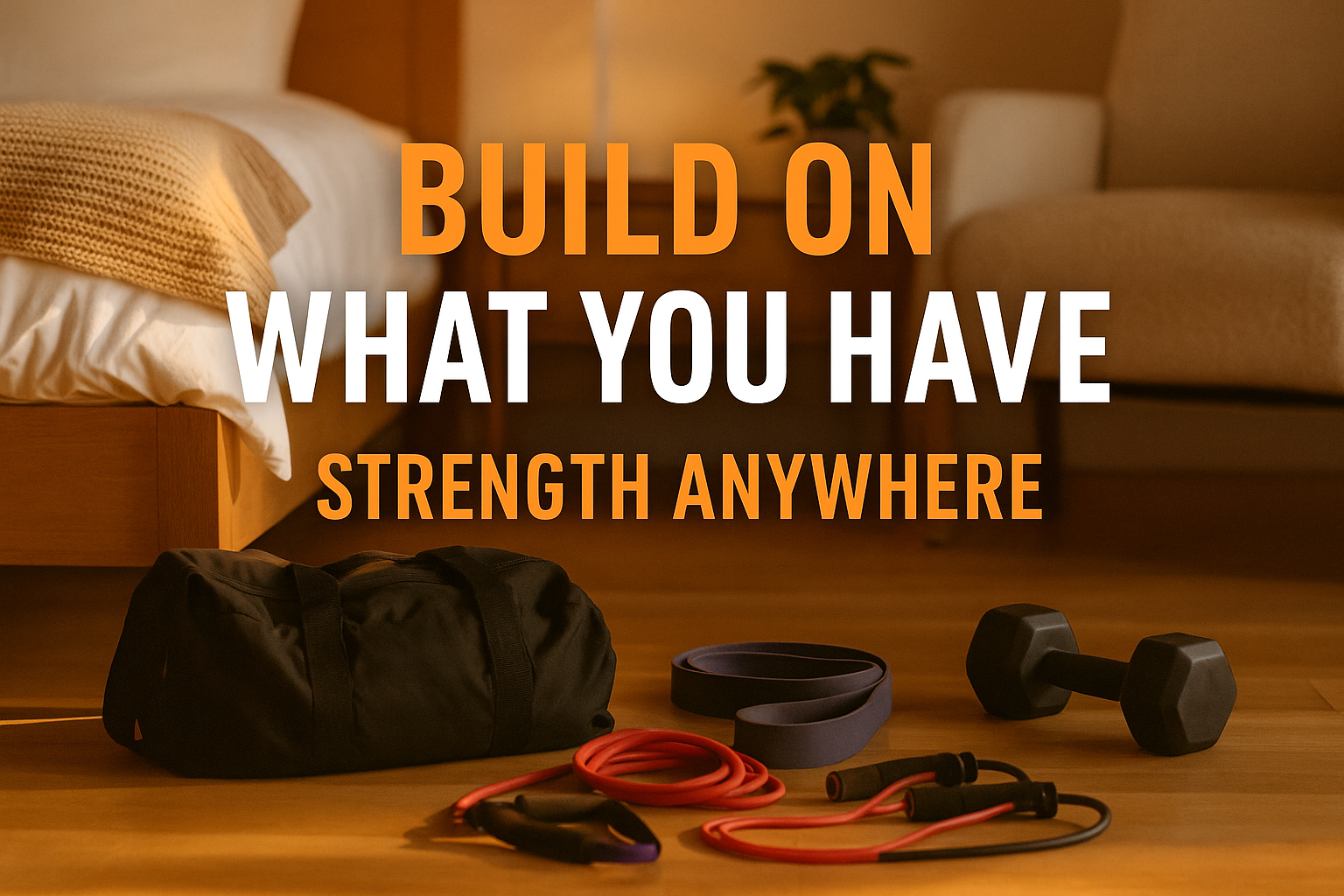
Strength Training Anywhere: Build on What You Already Have
Strength training doesn’t require a gym — it requires consistency.
Learn how to stay strong through home workouts and holiday travel using what you already have.
Strength doesn’t live in the gym — it lives in your habits.
Whether you’re training from home, a hotel, or halfway across the country visiting family, you can still build on the foundation you’ve created.
This season is about consistency, not perfection. Here’s how to make it happen.
In my earlier post on strength training I provided some ideas for getting started, as well as some ways to progress what you're currently doing. Another key aspect of consistent strength training is pivoting when your situations change, and the holiday season is right around the corner. So what kinds of options should we look at to continue our training during a busy travel and gathering time period?
The first conversation to have with yourself is the duration of the travel or holiday window you're working with. Missing one workout over a long weekend really won't have much of an impact, but a week or two starts to slide into the period where it might matter physically and definitely has a mental impact. Also consider your current stress levels and how the holidays and/or travel will impact that, taking some time off or scaling back might be the best long term answer. And then of course, think about your goals and how those align with your timing. Personally for me, I typically travel between Christmas and New Year's, and then have the Houston Half-marathon in early January, such that training is important for me. But I also know that trip is very restorative for me and I can handle the training load.
So what does it look like to strength train through this period? I would look at 3 main options that are not only scalable for anyone of any level but very portable:
Body weight exercises, think squats, step ups, core work, and pushups all provide value and can be progressed reasonably well.
Resistance bands easily fit into a suitcase and can scale to pretty much any difficulty level and provide a full body workout.
A Suspension Trainer is another very portable option that does require a mount point (tree, bar, outward opening door) but allows another option for a full body workout and most likely a different stimulus.
I would then think about shortening your workout time and pivot towards more workouts. For example, instead of two hour long workouts, think of four thirty minute workouts. You can look at either mimicking your current exercises with these tools, or maybe take advantage of the novelty and try some new movements. All of the above tools allow for lots of variations of angles and pivot points which can significantly change the stimulus that exercise provides. This unfamiliarity will not only help with your training, but also mentally it will allow you to focus on the experience and not get caught up in trying to compare numbers.
The holidays don’t have to be a setback — they’re an opportunity to stay grounded and keep your momentum.
You don’t need a perfect plan, just a flexible one.
Build on what you already have, adapt when life gets messy, and keep forging forward.
💪 Subscribe to The Wellness Forge for practical, adaptable training strategies you can take anywhere.
How to Structure Your Eating for Better Energy & Performance
Meal timing plays a major role in energy, appetite, and performance. Here’s how to build a simple structured eating schedule — and where intermittent fasting fits in.
Many people know what to eat…
But fewer know when to eat.
Some people experiment with intermittent fasting to simplify their routines — and it can work for the right person.
But for many, structure beats restriction.
Over the years there have been lots of ideas and fads surrounding the topic of when is the best time to eat. And like most everything in the Wellness space, the optimal timing will vary wildly from person to person. The key to figuring out what works best, like I've mentioned before, is the awareness of what you're currently doing and paying attention to the signals your body and mind are already sending you. If you think that meal timing might be a challenge for you, the key things to pay attention are your hunger cues, energy levels, and mental acuity. Based on that information, you can start to piece together where sliding a meal might help, or adding in an additional meal or snack would curb the cravings and eliminate energy crashes. The goal of meal timing is to stabilize and even out not only your hunger but also keep your energy levels consistent such that you don't have any of those dreaded nose dives.
What does this look like in application? Typically for most people this ends up as 3 spaced meals with some sort of an afternoon snack mixed in there, or possibly a fourth meal. Of course, this will all vary based on training loads and work schedules but that is the general pattern that seems to benefit most people. Having a loose structure like this during that day not only stabilizes hunger and energy, but it also keeps insulin levels more consistent and helps limit over-eating. This also allows for more consistently hitting macro targets, especially protein, as you're not struggling to catch up late in the day. You'll also want to adjust this based not only your logistical schedule but any sort of training needs and can vary on a daily basis.
One concept that comes up frequently with meal timing is centered around not eating too late in the evening, or too close to going to sleep. For most people, this is a pretty decent guideline to follow - but like everything, there are possible exceptions. The main idea is that digesting food while trying to sleep doesn't lead to as productive sleep, however there is some variance here. So, if your schedule lines up or seems to work out that you're eating late - pay attention to how you sleep and feel, and try running your own test to see what differences you notice when you do or don't eat late. Personally, eating late does not bother me, but I know others that it can absolutely tank their sleep.
Another frequent comment I hear from people is that they struggle to eat breakfast or aren't hungry until later in the day. This is usually a more involved conversation but typically I do recommend people having something close to when they first wake up in the morning. A couple options if you really struggle eating in the mornings would be to include some protein powder with your morning coffee, or sliding your meals such that your snack comes during the typical breakfast time. I will do a complete post on this as I do feel strongly that breakfast is very helpful and also has more nuance then I can cover in a paragraph.
Intermittent Fasting (IF) is another common trend these days and many swear by it as a way to lose weight. IF centers around the idea of only eating during certain periods of the day, and if you think about it almost all of us naturally do this due to our sleep patterns. The main benefit of IF is that it is a simple way to reduce caloric intake, and that is the main driver with any sort of weight loss. However, as with all restrictive habits, it can lead to over eating as well as creating a more adversarial relationship with food, as opposed to eating to support and nourish your body. IF can be a useful tool, but should be used sparingly and with consistent awareness to best understand how your body is responding to the changes.
Meal timing doesn’t have to be complicated.
Build consistency. Fuel earlier. Match intake to your day.
IF can be a tool — but the real goal is finding a rhythm that supports how you live, train, and perform.
🔗 Subscribe to The Wellness Forge for more data-driven wellness guidance.
The Most Underrated Performance Tool: Sleep
Sleep isn’t just rest—it’s recovery. From sharper focus to faster training gains, even small improvements in sleep can fuel measurable performance benefits. Here’s how to sleep smarter.
Sleep is the highest ROI habit in health.
One extra hour can boost focus, regulate hormones, and even improve training outcomes.
Here’s how to start improving your sleep tonight — and what happens when you don’t.
Most people I work with have an understanding or a desire to improve either their sleep quality or the amount of sleep they get, but struggle to effectively make a change. Like I mentioned in my previous post on Nutrition, awareness is the key first step. Start a sleep log - paper, electronic, or via an app, doesn't matter at this stage, and start to look for trends to target. But, something you can start tonight that will make a difference and build towards better sleep hygiene - before you try to go to sleep, take 5 minutes for the following:
Put your phone/tablet/laptop down for the night
Focus on your breathing, taking deep controlled breaths
Reflect on your day, focus on the good things of the day to help calm the nervous system and relax
Think about 1 thing you want to do tomorrow. This isn't about creating your to-do list, or run through your calendar, but 1 tangible thing you want to do better tomorrow. Maybe this is walking more during the day, taking the stairs, drinking more water, picking fruit for a snack and not the candy, or whatever small tangible step seems plausible to accomplish. And then check in on your progress with that the next night.
What does this 5 minutes get you? It starts you on the path to establishing a night time ritual that you can build on that doesn't have to be overly complex. It simply needs to be a series of things you do (ideally around the same time each night) that helps you signal your body that it is time to sleep. As you progress on the journey towards better sleep, there are lots of other things you can look to change, but for now, start small and build momentum. Another simple (not necessarily easy though) step to take that you can implement immediately, start reframing sleep from something you need to do to prevent the negative impacts, towards an attitude that embraces the restorative and supercharging benefits more productive sleep provides.
I know many live by the "I'll sleep when I'm dead" mantra, and I lived that way for a while too, but at some point that lack of sleep will come back around. Lack of sleep is one of the biggest stressors you can subject your body to, so it will dramatically limit your ability to perform as well as fight off any illnesses or injuries. The mental impact sometimes is hard to recognize as so often we've gotten used to the feelings and don't really appreciate it until we start getting CONSISTENT good sleep. Also it is hard to compare the impact on our body as there isn't a great way to quantitatively compare what it could be if we were getting better sleep. Some wearables can help address this and provide some insights, I personally have been using Whoop for almost 5 years now and have a pretty good feel how impactful sleep is on my mental and physical performance. However, there are numerous studies that look at exactly that - the dramatic impacts poor sleep has on your mental performance and capacity, as well as your physical performance. Physically it is even more damaging as the lack of sleep not only diminishes your performance but it will also prevent you from absorbing the same amount of your training such that you see reduced gains from your daily (or however frequently you work out) efforts. I could go on talking about the negative aspects, but honestly that list is VERY long!
Not only will you see the opposite of the above problems when you start getting consistently solid sleep, but you will also start to notice long term trends as well. The big health metrics - things like body fat percentage, blood pressure, and metabolism will all trend better as you work on your sleep quality. This is not only due to the short term impacts, but while we sleep the body has the opportunity to recover and repair itself. This recovery and repairing then compounds with your training load to create a very powerful healthy stress, recover, and adapt cycle that allows your brain and body to best leverage the hard work you're doing.
To summarize the last two paragraphs simply - progressing towards healthier sleep is the single best way to supercharge your tomorrow. It is one of the harder changes to make, but the benefits can be life changing.
Sleep is the foundation — not the reward — for your hard work.
You don’t earn it after performing; you build everything from it.
Small changes tonight can create measurable improvements in your energy, focus, and recovery tomorrow.
💡 Subscribe to The Wellness Forge for more practical, evidence-based strategies to perform better, recover faster, and live stronger.
You Can’t Outperform Stress — But You Can Learn to Recover From It
Every athlete, executive, and high performer faces stress — the difference lies in how they recover.
You can’t grind your way out of chronic stress.
Recovery isn’t weakness — it’s the process that makes progress possible.
Here’s how to manage stress better and optimize recovery 👇
Even iron needs time to cool before it can be forged again.
Your body and mind are no different.
Today, we’ll explore the balance between stress and recovery — and how to strengthen both.
Stress is a part of all of our lives and what complicates the challenge is that stress is required for the exact kind of healthy adaptations we all strive for, that's the good stress. Most people think of stress as a bad thing, and in many cases it is, but the majority of stress actually has a positive impact on the body. Where stress becomes a problem is when there is too much of it for the body to handle, the classic too much of a good thing problem. Let's start with something you can implement today that will have an immediate impact on how your body handles stress. Like I've mentioned before, awareness is where I start with all my clients - but I'll admit, that process takes time (a few days) so today take at least one 5 minute break during the day to pause, reset, and get ready to tackle the next task. Maybe even take part of that 5 minutes to practice awareness of your stressors.
Taking a deeper look at stress, it typically can be divided into 6 buckets:
Physical - exercise or injury would be examples.
Mental - think learning tasks or prepping for a meeting.
Environmental - outside noise, pollution, temperature, and allergens fall into this bucket.
Emotional - general mood and happiness
Existential - why are we here and what is our purpose?
Relation - friends, family, and coworkers would fall here.
Inside of these buckets there are good stressors and bad ones, which are usually rather obvious, but there are some good stressors that can become bad if done at the wrong time or at too high of an intensity. For example, strength training when done appropriately is a great form of exercise. However, lifting too hard for what your body can handle that day will most likely lead to soreness and potential injury with long term impacts if consistently overused. This is where that self awareness comes into play, having a feel for your body and knowing when it is a day to push, when to pull back, and understanding that when you have to over-reach because of a deadline or race, you will need extra recovery on the other side. Using wearables can be a help in this area to monitor the body's response to stress and help give some quantitative measurements on things like Heart Rate Variability and Resting Heart Rate which are both good indicators of overall stress and how primed your body is to handle more. The best approach is a mixture of the numbers and the knowledge of your body to form that complete picture.
What does recovery look like then from all these different kind of stressors? As you've probably guessed, that first step in a awareness or audit of your primary stressors and then looking for ways to handle them. Some may have immediate simple solutions, for example an air filter in your office to help remove allergens and other contaminates if that's an area you struggle with. Others are more complicated and 100% might require some outside assistance to help work towards resolving. And some are constant parts of life and need continual work to manage. Inside each of those stress buckets are also recovery techniques that you can apply, here are some examples:
Physical - sleep, stretching, low intensity exercise
Mental - reading, preparation, planning
Environmental - air filters, blankets for warmth, air conditioning
Emotional - honest communication, mental exercises such as reframing
Existential - prayer or meditation
Relation - that supportive friend or family member
This isn't to say that the best way to recover from a stressor in one area is recovery in that same area, sometimes it is, sometimes it isn't. You've probably noticed that you have great ideas when taking a long hot shower - that physical recovery technique can not only relive physical stress, but open you up to recovering from pretty much all the other types of stress too. You will notice over time, what recovery techniques work for you and which ones work best for specific stressors you face. My two most consistent tools I use for recovery are my sauna blanket and reaching out to friends and/or family. These 2 not only hit multiple buckets but also are examples of a daily routine and a more tactical tool to handle the stress spikes we all go through. The way to become adept at managing your stress is to develop a full tool chest of recovery options that you know work for you, can be pulled out when needed, and used as backups when your first choice doesn't yield the results you're looking for.
Stress isn’t the enemy — it’s the signal. Recovery is the response.
You can’t eliminate stress, but you can build systems that help you handle it better and bounce back stronger.
🔗 Subscribe to The Wellness Forge for more actionable tools to help you perform, recover, and thrive — without burning out.
Strength Training 101: A Foundation for Health and Performance
Strength training isn’t just for athletes — it’s one of the most powerful tools for improving health, performance, and longevity. Learn what it is, why it matters, and how to get started with simple, sustainable steps.
Most people chase fitness trends, but few invest in what actually moves the needle: strength.
Whether your goal is longevity, performance, or simply feeling better in your body, strength training is the foundation.
Here’s how to get started — and why it matters more than you think.
When it comes to starting any new routine, you must understand where you're starting from and adjust accordingly. If you're completely new it would be prudent to verify with your health professional that there are no underlying issues you need to be aware of, and consulting with some sort of advisor through this process might help reduce your ramp up time. Assuming you've progressed past that point, whether you're brand new or have lifted for years and have just taken a break, always start with less then what you think is needed. It is way easier and more productive to add more to your routine than struggle because you went too hard that first session and can't move for 3 days because you're too sore. I'll go into more details in future emails, but a good starting point would be a routine you feel 95% certain is maintainable, the goal is consistency, not hammering yourself from the start. Even 1 workout a week can yield results! Another key aspect to consider is where to workout as both gyms and home have advantages and disadvantages. This is one of those honest discussions you need to have with yourself to understand if working out with other people with all the equipment you could ever want helps you, or if you'd be better served by the time flexibility and comfort of working out in your house. Neither is necessarily better than the other, but their effectiveness is highly dependant on the individual. The last suggestion I'll make, at this time, is that if you are going to go the home gym route, start small and incrementally add as you go. Don't go and spend thousands on what could become expensive hangers if you come to find out there are too many distractions at home for a consistent workout.
Let's step back and define what strength training is, and what forms don't provide the same kind of results. By definition, strength training is movement with resistance, which would include using your own body weight, bands, dumbbells, barbells, or anything else you might have lying around. The key to reaping all the benefits is to lift as if you're trying to get stronger which means you'll want to chose a weight that is challenging for you to complete 5-15 repetitions, keeping good form. To continue to see the benefits you also need make sure to progress to higher weight when those reps become too easy. Another key component to strength training, resting in between sets, should range from at least a minute to upwards of 5 minutes depending on what you're doing. Resting allows for your muscles to recover their energy stores and be ready to exert maximal effort again. The exercises themselves are not what provides the benefits, it is the body's reaction (building muscle) to those exercises as it adapts to the increased demands. This means not only do you need rest intervals during your workout, but days off between workouts such that your body has time to recover AND adapt to these stimuli. Each session should provide as different of a stimulus as possible from your normal daily routine to maximize the benefits. Because of this, "lower" repetition amounts with "heavier" weight shows far better results than lots (anything over 30) of repetitions with lighter weights.
I've mentioned the results and benefits of strength training, without any further context. Here are just some of the ways in which strength training has a positive impact on your body:
The obvious one, you get stronger. But that's not just your muscles, your tendons and ligaments which support those muscles and movements get stronger. And all of those pieces attach to your bones that then also getting stronger. Not only will this help with many daily activities and tasks (as well as any sort of performance venture) it can also help reverse or prevent bone issues like Osteoporosis and Osteopenia.
Some of the muscles that will be strengthened are the stabilizing muscles which will in turn help with balance. Not only will this help with performance, but it will dramatically increase your injury resilience. Certainly losing balance could result in falls which are a major health risk as we age, but also the majority of soft tissue injuries (think ligament tears - ACL, MCL, Achilles, etc) result from those tendons filling in the gaps for weak muscles.
Another important aspect of building more muscle is that it is one of the primary locations the body stores glucose (think sugar or carbs) which not only means that there's more energy available for the body but it is actually better at managing the energy levels. This then translates into a better insulin response which helps drive down many of the factors that leads to ailments like diabetes.
Muscle requires more energy to sustain itself than fat does, even at rest, which means that your body will naturally burn more calories because of the additional muscle mass. This allows for an increased level of metabolic flexibility since the body consumes more calories it becomes easier to either increase the amount of food you enable more muscle growth, or reduce calories to lose weight.
These are just a few of the benefits, but are some of the most impactful.
Strength training isn’t just about building muscle — it’s about building capability, confidence, and longevity.
Start small, stay consistent, and give yourself credit for each rep of progress.
Ready to build your foundation? Join The Wellness Forge and get clear, actionable guidance to help you move, perform, and live stronger.
The Smarter Way to Begin Any Nutrition Shift
High performers don’t need more diet plans — they need clarity. Awareness turns mindless habits into intentional choices, setting the stage for sustainable nutrition change.
The most important part of any successful, healthy diet isn't the macro distribution or what foods are added or removed, the magic is in the awareness of what you're trying to accomplish, how you feel about the food you're eating, and how your body responds to those foods. That awareness will allow you to more accurately monitor whatever phase of life you want to shift towards, losing weight for that summer vacation, building muscle to compete with your buddies, or fuel your next endurance event.
To start this process, you'll want to add to your daily routine a few questions around each meal or snack you eat. You don't need to over think these, just a word or two is fine:
What did you eat, don't worry about measuring or weighing (yet). Pictures are fine.
A general idea of the time (or reference the time stamp on your picture)
How you felt before you ate, what you were feeling while you eat, and how you felt afterward. Again, this doesn't need to be a long dissertation, just a sentence or so for each.
Where you ate is also important as well as the other things that may have been present. This would include watching TV, scrolling on your phone, out with friends, at the table with family, or other such locations and events could be applicable here.
Keep up this log for 3-5 days and it is best if you can span a weekend as most people usually have a variance in their weekend and weekday routines. Keep this record in whatever medium makes the most sense for you. This could be a notebook, a blank email, text app, or using one of the many tracking apps available on your phone. At this stage of the process, the specific tracking mechanism isn't as important as the insights you gleam. If you decide to continue this process for a longer period of time, it may make sense to move to something more tailored to your goals.
Based on your observations, there may be some trends you can pull out into some actions. Start with making one change and working to sustain that for a couple of weeks before looking to change anything further. Think about what change you feel 90% confident you'll be able to implement on a daily basis for the next 2 weeks. This is important for 3 reasons:
making a single change is easier in practice and for the brain to accept. It also makes sustaining that change easier going forward.
With only a single change, you can track what works and what doesn't. If you make 10 changes all at once it becomes almost impossible to understand what is helping and what might be making things worse.
Picking something you feel confident in not only will allow you to build momentum, but typically after 2 weeks of doing a specific task, it becomes a habit.
Some examples of actions based on what you observed:
If there's a particular meal you're struggling with, one option is to add some calories to a drink - protein in your coffee might be something to try.
Another suggestion is to think about meal prepping something specific for a meal. This might be some sort of bulk breakfast like overnight oats, casserole, or muffins, or a larger portion of a protein, like chicken, beef, or pork that you could quickly add to a rice bowl or wrap for lunches and/or dinners.
If you notice you have energy dips, pay attention to the meal preceding that dip. You could add in a snack if there's a large time gap, or see if there's something missing from that previous meal. Look to maybe add some carbs for energy to a larger protein meal, or some protein (even some fat) to a pure carb meal.
If you notice that you're hungry late at night, or first thing in the morning then take a look at your dinner. Perhaps adding in some more filling calories like protein or fat or more fiber to boost the satiation of the meal.
This will also give you a idea around your general daily calorie intake as you may notice it is either significantly higher then you expected or lower which could be a factor in either struggles with weight management or energy levels.
Whatever change you end up deciding on, stick with that for at least a week, aware of the same questions you were before, but also pay attention to things like your mood, sleep, and energy levels such that you can better understand if this change helped and in what ways. This process can be repeated as frequently as you feel makes sense for where you are and where you what your goals are. It will also make sense to have a sustaining period where you keep everything the same, this allows you to verify that the changes you've made are showing the results you expect and want.
If you feel like having someone guide you through this process, this is exactly what I do for my clients and the process looks very similar if we decide to tackle something besides nutrition like your strength training, sleep habits, or stress management.
And remember, sustainable change doesn’t start with restriction. It starts with awareness.
See the patterns. Make one shift. Build momentum
If you like what I have to say, follow here, my email newsletter, or reach out and we can chat in more detail.