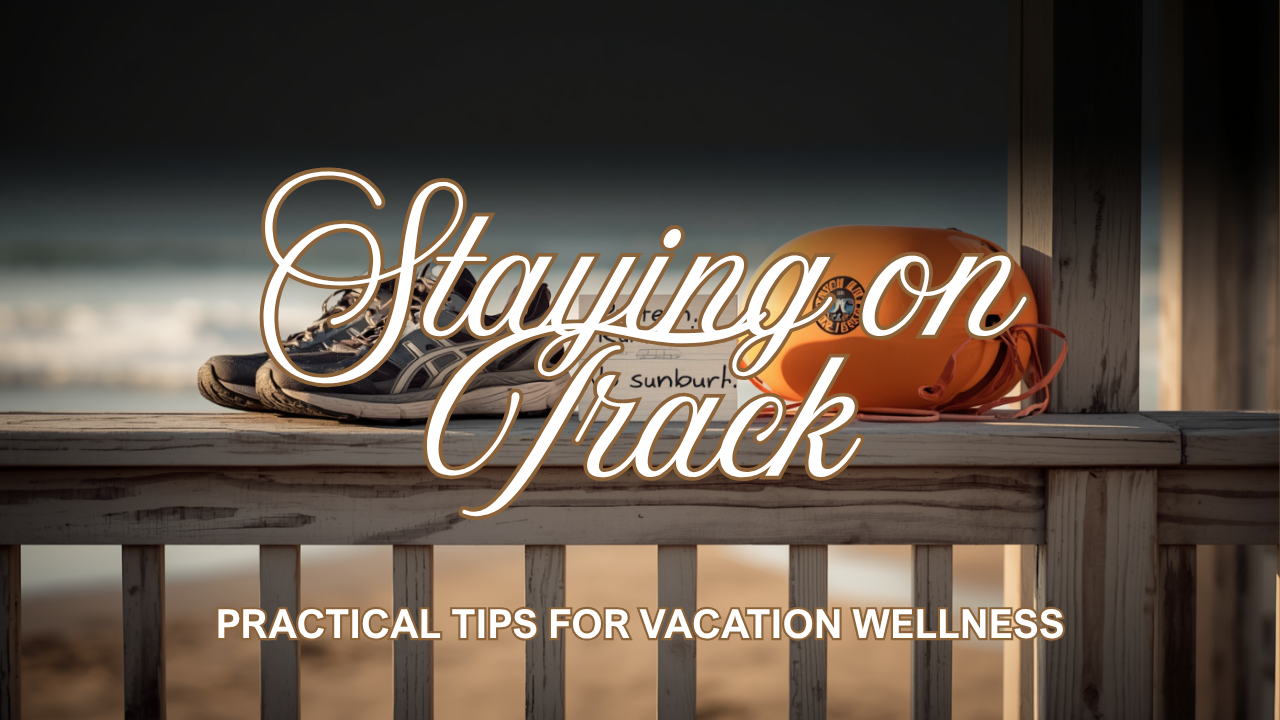
How I Stayed on Track Without Following My Normal Routine
I recently had the opportunity to put my Summer Baseline framework to the test during a trip. The routine wasn't perfect, but that wasn't the goal. Here's what actually helped me stay consistent—and why having a travel version of your plan makes all the difference.
I've been writing this past month about summer challenges and tips for travel, so it seemed natural for me to recap my most recent summer vacation and talk through how I planned things out, what worked, and what didn't.
A little context for the trip first, I was going to be gone for 10 days, with my family, and planning for a laid back, relaxing trip hoping to take the time to just enjoy the company. But I still wanted to continue the momentum I had built up, without having to stress about all the little things.
My main anchor points for the trip were breakfast, my running, swimming, and probably the most important, not getting sunburnt.
I pre-made the dry ingredients for my overnight oats knowing that we were grocery shopping and I could get milk and yogurt to finish it off for my big training days. And then milk, bagels, and eggs would work on the lighter days for some good variety.
I brought my running gear with me and looked ahead of time to get a feel for the area, map out some routes, and understand what the options were. I also knew that schedule wise, I would be up, out, back, and cleaned up before most of the group was even up such that I wouldn't miss much of the family time.
Being out in the ocean, I wanted to be cautious so I brought my buoyancy shorts as well as my inflatable buoy for visibility and extra safety. I wasn't intending to get in anything especially long, more to keep up my swim consistency and get back into some open water.
As for the sun, I brought a couple of rash-guard shirts to protect, sun-screen, hats, and then the house had great patios such that I could be outside and enjoy everything, without being in the sun.
All of these anchors worked perfectly, I managed to feel good and strong on my runs, swam twice, and didn't get burnt one bit! I then was able to pretty much eat and enjoy whatever we were doing for lunch and dinners, and add in the occasional treats. My training volume took a bit of a hit as I wasn't biking, but that just didn't make enough sense for me to try and worry about a solution.
Now of course, no trip is perfect so there were a couple of things I could have done better, but honestly they were more "nice to haves" so I wasn't overly worried about them.
I brought my suspension trainer with me, but there wasn't a good place to anchor it. One week without strength training isn't going to make a huge difference, but it would have given me a fun opportunity to show some different options for my family.
I did a pretty good job making sure I was properly hydrated, but I'm pretty confident I was low on total calories, or at least not as many as I typically have at home. Lunch was the main "challenge" meal of the day although I probably didn't do as bad as I think as there were many days that I had multiple snacks - which probably equaled one lunch.
Probably the biggest aspect I "struggled" with was sleep as my mornings were pretty set but I didn't get to bed as early as I should have. Again, this was a trade-off I was happy to make to spend time with my family.
The takeaway is not that I did everything right. It is that I decided in advance what mattered and let go of the rest without guilt.
Biking was not realistic. The suspension trainer did not have a home. Sleep was a trade-off I made with my eyes open. None of that felt like failure because none of it was unplanned. It was just the trip being the trip.
That is the whole point of the anchor system. You are not trying to replicate your home routine in a different location. You are trying to protect the things that matter most and give yourself permission to release the rest.
If you have been following this series and want help figuring out which anchors actually matter for your summer — whether that is training, nutrition, sleep, or travel — that is exactly the kind of planning I do with coaching clients. Let's map it out before your next trip.
The Sleep Anchor: The Most Underrated Part of Your Summer Routine
Summer disrupts sleep more than most people realize, and once sleep slips, training, cravings, mood, recovery, and decision-making all get harder.
Every summer, the same pattern plays out.
Training slips. Nutrition gets inconsistent. Energy tanks. Cravings spike. Motivation disappears. And people spend the rest of the season trying to figure out what went wrong with their discipline.
Most of the time, it was not discipline. It was sleep.
Sleep is the first domino — and it is almost always the last one people look at. I have saved it for last as it will be the MOST impactful thing you can adjust, but also for most the most challenging. You can have your protein anchors dialed in, your travel plan ready, your 30-minute training templates built. But if sleep is quietly unraveling in the background, everything else gets harder than it needs to be.
Summer is uniquely good at unraveling it.
What Summer Does to Your Sleep
It starts subtly. The days are longer, so the evenings stretch. A backyard cookout runs until 10. A few drinks on a Tuesday because it feels like the weekend. The kids are out of school so the morning schedule loosens. You travel across time zones twice in six weeks. The bedroom is warmer than usual. You stay up an hour later on Friday and Saturday and then try to drag yourself back to normal on Monday.
None of these things feel like a big deal individually. But together they add up to a sleep pattern that is inconsistent, shorter than it should be, and lower quality than your body actually needs.
The result is not just feeling tired. The downstream effects are more significant than most people realize.
What Happens When Sleep Slips
Poor sleep does not just make you groggy. It systematically degrades almost every other health behavior you are trying to maintain.
Cravings increase — specifically for high-calorie, low-nutrient foods. Sleep deprivation elevates ghrelin (the hunger hormone) and suppresses leptin (the satiety hormone), which means you are hungrier, less satisfied, and reaching for the wrong things more often.
Training quality drops. Output is lower. Motivation to train at all is lower. The session that would have felt manageable on a good night's sleep feels like a grind, and the temptation to skip it wins more often.
Recovery takes longer. Muscle repair, hormonal restoration, and nervous system recovery all happen predominantly during sleep. Cut the sleep short and you are cutting the recovery short — which means the training you are doing is not producing the adaptation it should.
Decision quality suffers across the board. Prefrontal cortex function — the part of your brain responsible for impulse control, planning, and long-term thinking — is one of the first things to degrade with sleep loss. Every choice you make about food, training, and routine gets a little harder and a little worse.
Mood and irritability follow. The version of you that shows up after a week of short nights is not the version that makes good calls consistently.
The compounding effect is significant. And it usually gets blamed on everything except the actual cause.
The Sleep Anchor
Just like nutrition and training, sleep does not need to be perfect during summer. It needs anchors.
A sleep anchor is a consistent behavior that stabilizes your sleep pattern even when the surrounding schedule is variable. Here are the ones worth building in.
Consistent wake time. This is the single highest-leverage sleep anchor available, and it is the one most people overlook because they focus on bedtime instead. Your circadian rhythm is anchored primarily to when you wake up, not when you fall asleep. If you protect your wake time — even after a late night, even on weekends — your body has a stable reference point that keeps the whole system from drifting. Bedtime will regulate itself over time if the wake time is consistent.
Caffeine cutoff. Caffeine has a half-life of roughly five to six hours. That afternoon coffee at 3 p.m. still has half its stimulant effect at 8 or 9 p.m. Pick a cutoff time — noon or 1 p.m. for most people — and hold it. This is a small habit change with a disproportionate impact on sleep quality.
Alcohol boundary. Alcohol is uniquely disruptive to sleep architecture. It may help you fall asleep faster, but it suppresses REM sleep and causes fragmented rest in the second half of the night — which is when a lot of the most important recovery happens. This does not mean abstaining. It means being intentional. Finishing drinks at least two to three hours before bed and being honest about how frequency during the week is affecting how you feel.
A 30-minute wind-down. Your nervous system does not switch off on command. A short wind-down routine — something that signals the transition from the day to sleep — meaningfully improves both the time it takes to fall asleep and the quality of sleep once you do. It does not need to be elaborate. Dimming lights, stepping away from screens, reading, stretching, a short walk. The content matters less than the consistency.
A cool room. Core body temperature needs to drop slightly to initiate and maintain sleep. A warm summer bedroom works against that process. Blackout curtains, a fan, keeping the thermostat lower than feels necessary — these are not luxuries. They are functional sleep tools.
Morning sunlight. Getting outside within 30 to 60 minutes of waking — even for ten minutes — is one of the most effective ways to anchor your circadian rhythm. Morning light exposure sets your internal clock, improves alertness during the day, and makes it easier to wind down at night. It is free, it takes almost no time, and most people are not doing it.
The Performance Connection
Better sleep is not just about feeling less tired. It is a direct performance input.
When sleep is consistent, energy is more stable and predictable throughout the day. Appetite regulation improves — the cravings that derail nutrition during busy stretches are significantly reduced. Training output goes up. Recovery between sessions improves. The mental clarity required to make good decisions about food, movement, and schedule comes back online.
Everything in this summer series — the training anchors, the nutrition structure, the travel plan, the weekend routine — works better when sleep is intact underneath it. It is not one piece of the puzzle. It is the foundation the rest of the puzzle sits on.
Where to Start
Pick one anchor from the list above. Not all of them — one.
If your schedule is inconsistent, start with wake time. If you are a late-caffeine drinker, start there. If alcohol is disrupting your sleep more than you want to admit, that is your anchor.
Build it for two weeks before adding anything else. Anchors compound. One consistent sleep habit makes the next one easier to implement.
Summer does not have to be the season that costs you four months of progress. But sleep is the piece most people leave unaddressed until everything else has already started to slip.
Protect it first.
This is the final post in the summer consistency series — covering training, nutrition, travel, weekends, and now sleep. If any part of this series resonated with you and you want help building a summer plan that actually holds up in real life, that is exactly what IronLane Coaching is designed for. Let's build it together.

Find the Weak Points Before Summer Does
Summer often exposes the routines that were already fragile. A quick self-audit can help you identify what is most likely to break first.
Before summer chaos hits, do not ask whether you are motivated.
Ask where your routine is fragile.
Because that is usually where things start to slide.
One of the best ways to prepare for any upcoming change is to do an audit of where you currently stand and then make adjustments from there. And preparing for summer is no different, as no matter what your situation is, summer will bring some sort of change. And if you practice this habit now, it will be available to you during any other periods of change - new job, new relationship, additional (or first) kid, etc. Summer, just like any of these is a stress test, and those always reveal the problems in any system
So what does this look like in practice? The main idea to look for those areas where you feel least confident they will hold if something changes or goes slightly off normal. From there, you're going to target ONE to strengthen and then set boundaries as I mentioned before to help create your "stressed" gameplan. This becomes the gameplan you can fall back to that will still allow you to progress when life gets challenging. Looking at each of the following areas, you'll want to honestly understand your strengths and weaknesses.
Strength training
Do your workouts improve your mentality or drain it?
Do you look forward to your workouts, or struggle to fit them in?
Nutrition and Fueling
When stressed, do you find you eat more or less?
Do you end up skipping meals entirely?
Sleep
Can you maintain a consistent schedule, or does stress cause you to either stay up too late, or sleep in?
How much does one poor night of sleep through you off?
Recovery/Stress
Do you have a recovery plan/go-to?
How quickly can you identify when your stress level is rising?
Mindset
Do you think in all or nothing terms?
Do you need ideal circumstances to feel confident in success?
There are more questions you could ask yourself, but hopefully this gives you a good idea of the concept and allows you to figure out which of these areas is most likely to slip when under stress. Once you have identified the weakest point, look to pick something simple that you feel confident you can maintain in a stressful situation, that will improve from where you currently are. For example, lets say you recognize that getting in your strength training will be hardest for you as you just don't like to work out when you're not at your best. I'm not going to claim that you're magically going to always love working out, however you CAN make your workouts more enjoyable. A couple suggestions:
add music or tv shows while you workout
trim down your workout to include only exercises you really like.
workout with a friend, family member, etc.
focus the entire session on improving your form on one lift
Then take the time now to incorporate that change into your routine BEFORE you need it such that it just feels natural. Only when this first change feels like second nature would I look to take on something else, and that may take a matter of months, not days.
If summer tends to knock you off track, do not wait until it happens to start paying attention.
Audit the weak points now.
Because the habit that breaks first is usually the one that pulls everything else down with it. And once you know where your routine is fragile, you can strengthen it before summer puts it under pressure.
You do not need to fix everything. Just find the weak point most likely to derail you and start there.

You’re Ignoring One of the Most Important Forms of Data
Calories, heart rate, sleep scores, and weight can all be useful, but they do not tell the whole story. How you feel day to day may be the missing piece of data that helps you make better decisions.
We live in a world obsessed with measurable data. Calories. Macros. Sleep scores. Pace. Heart rate. Weight. HRV.
But one of the most important data points in your entire health and performance picture is often the one people dismiss first:
How you actually feel.
I've talked about this previously, but it continues to be something I work with my clients as most either don't have the connection to how they feel or tend to minimize it. Part of the challenge is the dramatic increase in the availability of just about any kind of data on our phones and watches, or at a deeper level with bloodwork and genetic testing. While these pieces are important, they only tell one part of the story and usually only at a particular point in time. So let's dive into the two areas you can start now to build a better picture of how you're performing.
The first area I'll mention is during your workouts which is a great way to boost the quality of your workouts, especially while lifting weights. The more in touch you can be with where you feel each rep you can target specific areas, better identify any form issues, and better understand when it is time to either increase the reps or weight. This same concept applies to any cardio workout too, paying attention to your breathing, how quickly you recover from any efforts, and how the rest of your body feels as you progress through the workout helps you better understand how your body is responding to the efforts. In both cases, how you feel should also drive your intensity of that particular workout. I'm not suggesting you cut all your workouts short, or power through them, but having a better gauge on when you should do one more rep, or perhaps drop the intensity will benefit greatly in the long run.
The other aspect that I suggest this kind of self check on how you feel is a way to bookend your day. Take a couple of minutes (maybe even less than that) in the morning when you wake up, and in the evening before you go to bed to assess how you're doing. A few things you might think about:
energy level
cognitive level
any particular aches/pains
general mood
feel free to add more if you like
You can either make this an "informal" check-in with yourself, or you can add it to some sort of a journal process either written or electronic. If you're adding this to your routine, I suggest some sort of physical accountability to help reinforce the habit as well as provide a mechanism to compare.
The goal is not to replace hard data. The goal is to stop pretending that your lived experience does not count as data too.
Because if your numbers look good but your body, mind, and day-to-day function are telling a different story, that matters.
In many cases, how you feel is not a distraction from the data.
It is the missing piece.
Better decisions come from better data — and that includes the signals your body is already giving you.
When was the last time you tracked how you actually felt with the same consistency you track your numbers?
Sleep Better Without Overhauling Your Routine
Sleep quality often improves with small adjustments rather than complicated routines. Here are several simple tweaks that can improve recovery and help your body sleep more consistently.
Sleep is one of the most powerful recovery tools we have.
Yet when people struggle with sleep, they often assume the solution requires a complicated routine or expensive tools.
In reality, a few small adjustments can dramatically improve sleep quality.
Here are several quick tweaks that often make a meaningful difference.
For most clients I work with, sleep is always one of those topics they either actively want to improve or their experiences indicate that working on sleep quality would yield significant benefits. Like I've mentioned the past couple of posts, most often this doesn't require a complete change of habits but instead a couple of small tweaks will yield big results. I typically suggest picking one thing at a time, work on that for a couple of weeks such that you can evaluate the impact that change is making. From there you can either pick another aspect to work on or look to further improve that area.
Getting sunlight (even just 5-10 minutes) early in the day helps set your circadian rhythm such that not only will you find it easier to get moving mentally and physically in the morning, but your natural rhythm will help queue your body to sleep. Something as simple as your morning coffee, tea, or a glass of water on your porch/patio will accomplish this.
Protecting your sleep time as much as you block out your morning routine is another one that many overlook. Most people can easily walk through their mornings, but struggle to point to their plan for arguably the most important part of your day - sleep. Start by dedicated 5-10 minutes to simply wind down before going to bed by putting away electronics, and getting ready for bed. As you get better at this you can include things like journaling, meditation, stretching, etc to further help your mind and body prepare for a more restorative rest.
Cutting back on stimulants is another one that can help, and this would include caffeine but also for many sugars can cause challenges to sleep. Of all the suggestions, this is probably the most variable from person to person as some are not impacted at all by this (I fall into this bucket) others notice small amounts of caffeine even at lunch will cause challenges. So if you recognize these impact your sleep, work to move them earlier into the day.
Making your room a little cooler or darker is another shift that can be accomplished relatively simply. Changing the thermostat or fans can help with temperature as well as all sorts of other bedding options. As for darkness, curtains and other options exist but I find one of the simplest options is an eye mask.
The final one I'll mention is trying to maintain consistency with sleep time, as most people (except for the weekends) normally keep a consistent wake time. The more consistent you can keep both of these times (including the weekends) the better your sleep quality will become. Again, don't make radical shifts but try moving in 15 minute increments and this would also apply to trying to get more sleep as most can adjust the sleep time easier then their wake time.
There are lots of options out there to improve your sleep but these are some of the simplest, cheapest, and universally available ones you can try out that are proven to make a difference. Notice I didn't say these changes are easy as that's a term I try to avoid since "easy" is incredibly dependant on the person, pick whichever one you think will be easiest for you to implement and see how you feel after 2 weeks of consistency.
If improving sleep is part of your performance or health goals, start simple.
Recovery improves faster than most people expect when sleep improves first.

Tools, Not Shortcuts: My Approach to Supplements & Peptides
Supplements and peptides can be powerful tools — but only when layered on top of strong fundamentals. Here’s my personal perspective on what’s worth it, what’s situational, and what gets overhyped.
As part of my coaching philosophy, I make sure to consistently re-evaluate my views and recommendations based on the information available but also how it works in the real world. One of the most frequently asked questions I get surrounds supplements and similarly peptides. One thing that hasn't changed is that neither of these are magic nor will they solve all your problems. They are tools that under the right guidance and circumstances can provide added benefits when incorporated on TOP of an already existing stable platform. I thought it would be helpful to not only walk through my thought process on them but also share what I'm currently taking and why.
Starting with supplements, probably my biggest shift has come with regards to the idea of a daily multivitamin. I still recommend blood work (I aim for every 6 months myself but at least once a year) to help understand any deficiencies as supplementing that WILL make a significant difference. I view the idea of a multivitamin as something of an insurance policy to help fill in the gaps when nutrition slips a bit, or when stress levels are higher. Another shift has been in the data surrounding Creatine as it has widely been used in the muscle building space, but now it has a much broader application as the new studies are showing cognitive benefits as well. I also believe that most people (including myself) benefit from boosting their Omega3's but this is diet dependent in that some can get enough of this through their normal diet. Outside of these 3 that I think are broadly applicable, these are the others that I'm currently taking:
Reds and Greens as a way to bulk up my fruits and veggies intake as I don't always do a great job of getting them in.
Magnesium for the sleep and recovery boosts.
Ashwagandha for the mental impacts.
With all of these quality is important and especially looking for ones that are 3rd party tested as unfortunately supplements are not regulated in the US and as such there's a possibility of not getting what you're paying for. I also suggest getting the purest form of that supplement and not it mixed in with a bunch of other things. While not crucial, again this helps with quality, but it also helps to better understand how these supplements are actually helping. It is harder to know what's helping if you're taking something that's combined with 15 other items, or the flip side that specific item might be helping but the others are hurting.
When it comes to peptides (yes Creatine is technically one, but is now considered a supplement) my opinions have shifted quite a bit. When GLPs first came onto the scene I was very skeptical and saw a number of people in my circle take them without any other lifestyle changes. I'm pretty sure this is what clouded my judgement on them, as for a good long while I didn't consider them viable for sustained success. Then I started working with clients who were on them, and the combination of GLPs, coaching, and strength training created some massive results that I couldn't ignore. While not pushing them, I became more open to the appropriate usage of them under the right guidance. Then I suffered 2 significant hip injuries (opposite hips) with the first one (torn labrum) painful enough that walking was a real challenge and I found myself taking more OTC pain medication then one should. Surgery was on the table, but given the tough recovery and uncertain outcomes, my physical therapist and I decided to go all in on a non-surgical plan. At this point I was looking for ways to help regain the use of that leg and improve recovery. Having known peptides existed, I consulted a number of medical professionals and started with BPC-157 about a month after the symptoms first started. Since this was a new injury to me, I honestly don't have a reference or comparable to know exactly how much it helped. The combination of that, continued therapy, consistent strength work, and fueling my recovery allowed me to get back into running shape within 2 months. Then when the second injury came on (torn hip flexor) I immediately started on BPC-157 and more recently, as I'm almost fully recovered, I have switched over to a combination of CJC-1295 and Ipamorelin to really help my body recover and get stronger as I continue back to my full training load. This combination I have a better comparison for as I have gone through many build phases after taking "time off" or an off-season such that I know what it feels like when I start incorporating long speed intervals, long runs, and increased weight on my lifts. Again, I'm also focusing on my nutrition and strength training as well as being much more protective of my sleep so there definitely is a cascading effect going on here that's accelerating this process. This build period for me has been one of the smoothest and quickest ramps I have done, maybe not ever, but definitely since I graduated from college.
I've now expanded my team of experts to include a medical staff such that when combined with my knowledge and experiences I have put together a combination of tools and processes to empower clients (and myself) to hit their targets and goals.
I don’t see supplements or peptides as hacks. I see them as tools — powerful when used appropriately, irrelevant when misused.
The foundation always matters more than the enhancement.
If you’re thinking about supplements or peptides, start with clarity — not hype.
Build the base. Then layer intelligently.
👉 If you’d like help evaluating what makes sense for your goals, or understanding where these tools fit in your plan, I’m always open to a conversation.
Important: This post is for educational purposes and is not medical advice. Peptide therapies are not appropriate for everyone. Eligibility, risks, and potential side effects are determined by the licensed medical provider during consultation.

Why High Performers Burn Out Quietly
Always being “on” feels productive, but over time it quietly erodes energy, recovery, and performance. This post breaks down the hidden cost of chronic stress — and how high performers can manage it without lowering standards.
If you’re productive, motivated, and capable, people assume you’re fine.
Even when you’re running on fumes.
That’s the cost of always being “on.”
What does always being "on" look like? It doesn't necessarily mean the same for everyone, but you will notice certain of these statements ring true for you:
consistently mentally engaged
quick to react emotionally
consistently physically tired
always reachable
trouble falling asleep as you can't turn your brain off
Now I've used some significant qualifiers there, words like "always" and "consistently" don't take those literally, but do some self reflection on how often those are the case. And maybe you're in the group that runs this way during the week, and then uses the weekend to recharge. That method can work, but typically the weekends aren't long enough, or turned down enough to truly recover from the built up stress of the week.
What this habit of living in this "on" state creates is the situation of chronic stress, and that's important to differentiate from acute stress. Acute stress is the stress we want as that's short term and recoverable stress that our body (and mind) will be able to adapt to better handle in the future. This doesn't mean they have to be the intense kinds of workouts I mentioned earlier, but any sort of event that pushes the body past its level of normalcy is a stressor. In contrast, chronic stress builds over time and indicates that the body doesn't have the capacity to recover such that the stress starts compounding. This can lead to all sorts of physical and mental challenges that take orders of magnitude longer to recover from, REDS (Relative Energy Deficiency in Sports) and stress fractures being two common examples. Chronic stress with have a significant impact on your physical performance as well as mental capacity and motivation levels that far outweigh the downtime needed to prevent this buildup. High performers are especially at risk for these behaviors as they're generally more adept at tolerating stress for longer periods and will normalize any levels of fatigue as they'll "sleep when they're dead." This class of personality is also more likely to dismiss any of the warning signs and push any sort of recovery to the weekend, next week, or once this project ends.
So how does one maximize their performance without falling into a stress cycle they can't get out of? The first step, like with many other processes I've suggested, is an awareness of the patterns. If anything I've mentioned above rings a little true, it would be worthwhile to start paying more attention to your energy levels, mental acuity, sleep habits, and emotional states to understand how they fluctuate. If you notice a couple of these are trending in the directions you don't want, then you'll want to look for ways to help create more of an energy wave, and not an energy straight line. You can still have those peaks, but you need to also create some valleys. This can be done on any timeline you want, but a great place to start would be daily - aim for at least 2 peaks and valleys (to start) during the course of the day. These don't need to be long periods of time, but even carving out a block of time for a walk, phone call with a friend or loved one, or a TV show will help create those valleys. Once you get a handle on how effective this is, you can then look to see if perhaps a full recovery day might be helpful - whether that's on a weekly basis or more spread out. And for those longer more sustained periods of stress (large work project, major presentation, goal race, etc) you should plan for at least a day of recovery after the event to mentally and physically wind down. As you work to incorporate this approach, you'll notice your peaks can become longer and higher with the valleys becoming more natural.
Being “on” isn’t the same as being effective.
Performance is built on cycles — not constant pressure.
The goal isn’t to do less — it’s to recover better.
🔗 Subscribe to The Wellness Forge for strategies that help you perform without burning out.
Micro-Recovery: Small Actions That Drive Big Performance Gains
Micro-recovery is about small, intentional actions that help your body and mind reset throughout the day. Learn simple tactics you can use anywhere to improve energy, focus, and recovery.
Most people think recovery requires time they don’t have.
In reality, recovery works best when it happens in small doses, often.
These micro-recovery habits can change how you feel, train, and perform — without adding anything to your calendar.
While looking at some of the big movers for recovery, things like nutrition and sleep, there's also lots to be gained from thinking small when it comes to recovery. And by small, I mean short periods of dedicated time that can have outsized benefits in both physical and mental recovery. As with other topics, I wouldn't suggest trying to implement ALL of these, but pick one or two and see if they help. Don't panic if something doesn't work for you, pick something else and keep trying. Once you find something that works, keep it consistent and try to make it part of your normal routines.
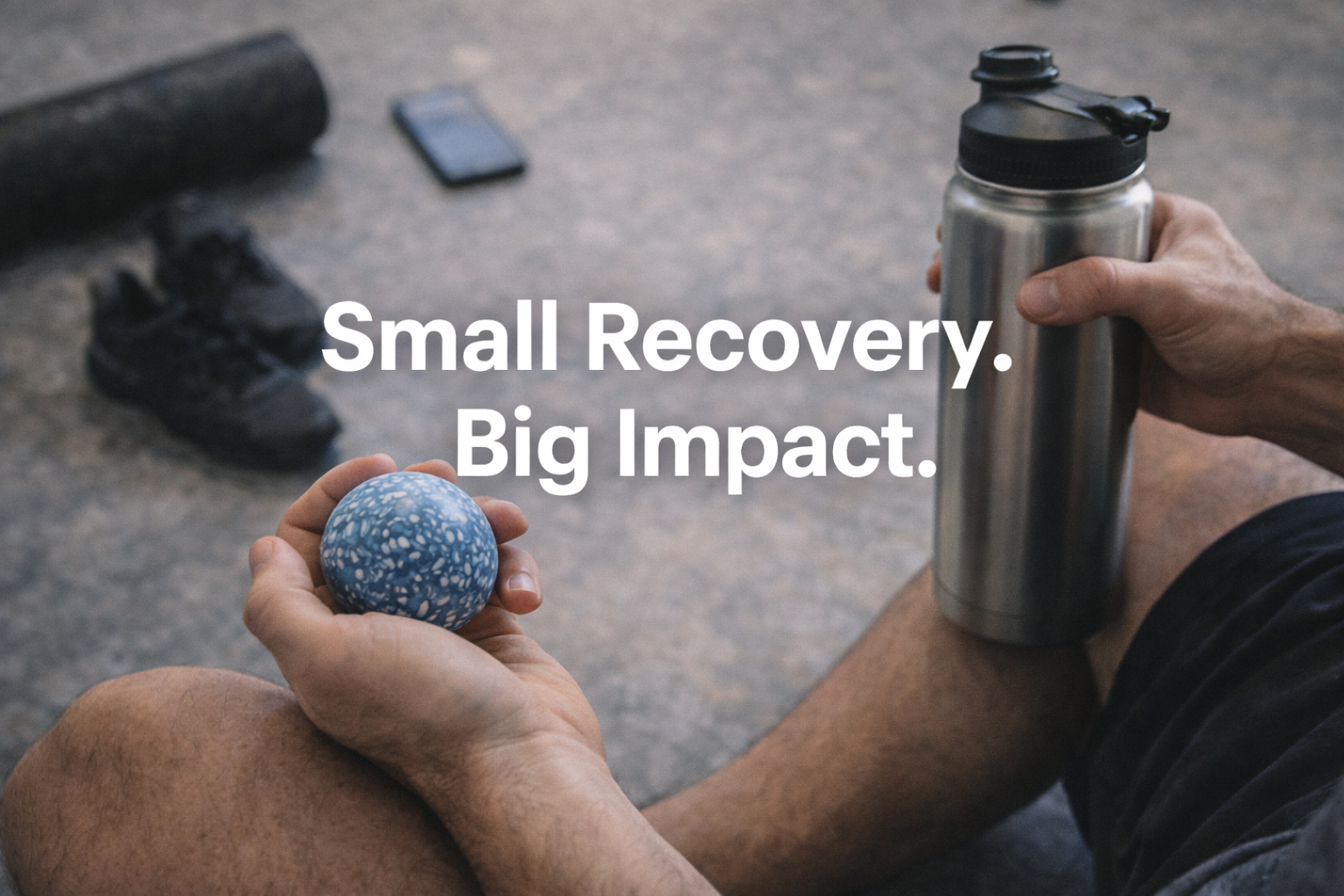
Let's start with some that are more physical in nature, with probably the simplest and lowest barrier to entry being a short walk - even just a couple of minutes provides not only muscular benefits, improves digestion, but it can be a nice mental break as well. Also in this bucket would be some sort of mobility work focusing on whatever joints or muscles that may be nagging you, either while sitting by moving through the joints' full range of motion, or coupled with a walk and making it a bit more of a dynamic stretch. Maybe even incorporate some sort of recovery tool in this process, foam rollers may be tougher in the office, but massage guns or a lacrosse ball work wonders and can travel pretty easily. The last one I'll touch on in this article would be to have some sort of a snack, sometimes the best way to break up your day is the injection of a little energy. This snack doesn't have to be large but something that can not only distract you physically (and mentally) but also provide a nice energy boost.
The other aspect of these little recovery breaks are ones that I'll put into more of a mental space or requiring little physical movement. A couple of examples of these kinds of breaks would be:
Breathing resets - think deep breaths, either structured or just a pause
Giving your eyes a rest - look away from screens, or close your eyes for a period (don't try this while driving!)
Another idea to consider in this area would be ways to shift your environment to reduce or shift the stressors in some way:
Wearing Blue light blocking glasses
Noise generator - white noise works for many, but there are different options that work better for some
Background music
If you're looking for a plan to implement a break or two into your day, pay attention to your energy levels during the day and see if you notice a period (or two) where you struggle. That's the time you'll want to apply one of these techniques, and try the same one for a couple days to see if you notice a benefit. This is also a case where having some sort of logging or journal routine will come in handy to not only find those lulls, but see what works and what doesn't. I personally use the journal function in the Whoop app to help with these kinds of trials and shoot for a handful of days with the routine and without to have a somewhat decent comparison. The actual tool used doesn't really matter, it is the process of adding that recovery tactic and monitoring how (if) it impacts your body and mentality.
Recovery doesn’t need to be dramatic to be effective.
Small, consistent recovery habits protect your energy, sharpen focus, and keep performance sustainable — especially on busy days.
Start small. Repeat often. Let recovery work with you.
🔗 Subscribe to The Wellness Forge for practical strategies that help you train, work, and live stronger — without burnout.
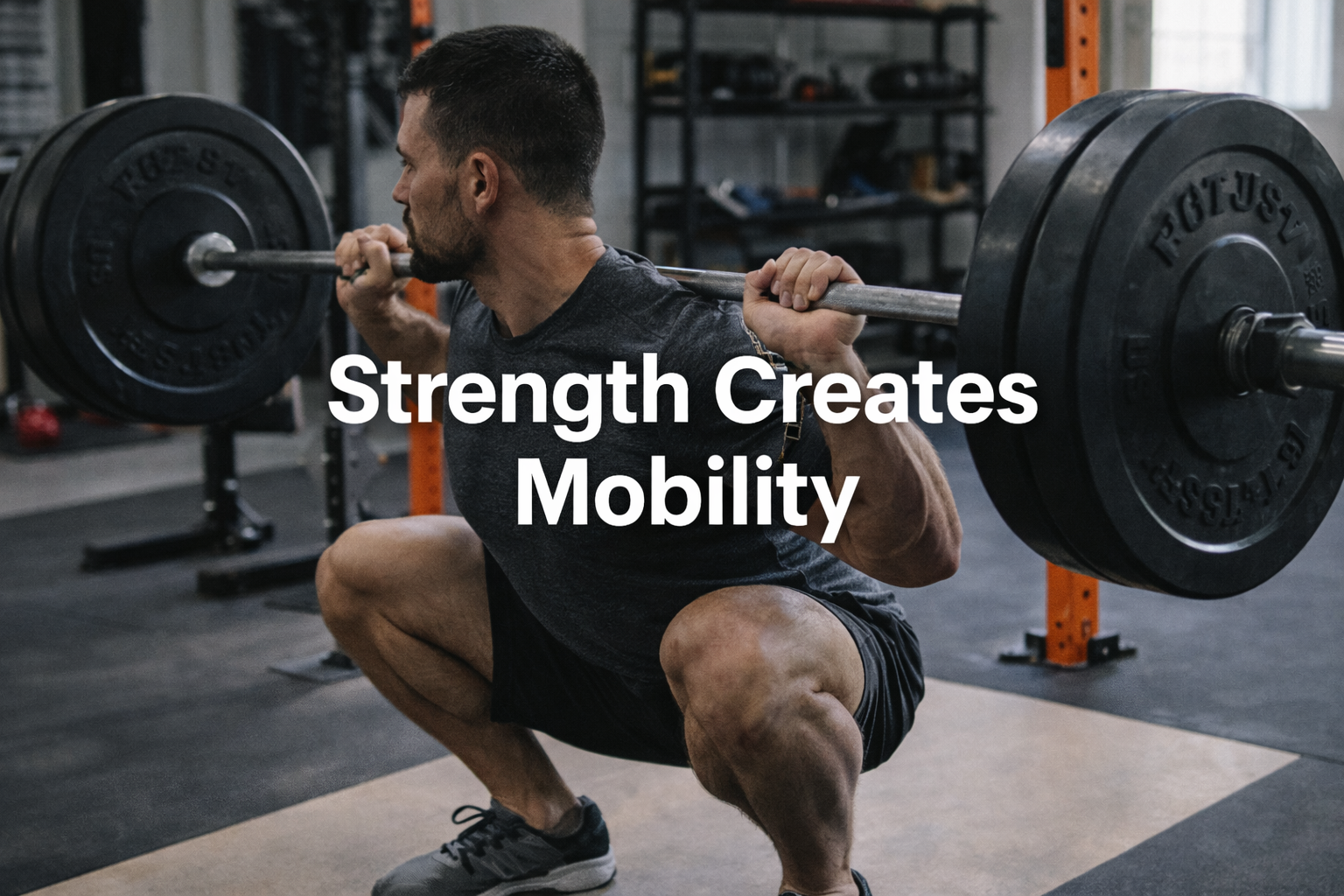
Stretching Isn’t the Fix: Strength & Movement Are
If you feel tight or stiff, stretching alone may not be the answer. Learn why strength and movement create lasting mobility — and how to use stretching effectively without overdoing it.
If you feel stiff, sore, or restricted, your first instinct is probably to stretch more.
But for most people, tightness isn’t a flexibility problem — it’s a capacity problem.
Strength and movement solve far more issues than endless stretching ever will.
I've had many clients initially tell me they wanted to be more flexible and I appreciate that we all have goals however I believe there are better goals to strive for than flexibility out of the gate. One quick test is a standing squat, notice the depth you can achieve and then perform that same squat using a door frame, bar, squat rack, anything for support and notice the depth again. For most people, there is a significant difference which shows the issue isn't flexibility (at least in legs) but in strength for your body to get into and out of that position. Now if you're one of the few that those 2 exercises have similar depths, than yes perhaps mobility is an issue. However, the second question I then ask is what everyday activities are restricted by this "lack of mobility" and usually there aren't any. Again, if something comes up that should be addressed but for most they would be better served to chase strength, especially at the edges of their range of motion than spending time on stretching.
The first thing to look at when working on mobility and flexibility, and that is to maximize the range of motion with your exercises. This may require using less weight than normal, but that additional range of motion will provide a large stimulus that will dramatically increase overall strength. Another good option is to hold at that full range of motion to provide a specific stimulus at your weakest portion of the movement. Not only will this combination increase your overall mobility but that increased mobility will greatly decrease your likelihood of injury.
The next best way to increase mobility is through frequent movement of those joints with minimal stress but full range of motion. Think of things like walking, easy bike rides, or perhaps even swimming as activities that fall into this bucket. The main benefits of this kind of movement is that it:
lubricates joints
increases blood-flow throughout the body which brings nutrients and removes waste
and it reinforces natural movement patterns
This movement doesn't need to be a long duration, even short durations can be beneficial - try to at least get to the point where you feel your body loosen up.
All this isn't to say that stretching doesn't have a place in a healthy lifestyle - it certainly can, but many either implement it incorrectly or at the wrong times. There are typically two kinds of stretching:
Dynamic, or moving stretches - these typically incorporate slow movements through an entire range of motion. Think leg swings, arm swings, body leans, etc.
Static stretching - holding the same stretched position for anywhere from 10 seconds through multiple minutes.
Dynamic stretching is best used before exercise as a warm-up to prime the muscles for whatever exercise you're about to start. Static stretching is best used either as a cool-down after exercise or as part of a night-time routine to calm the muscles and nervous system before sleep. Stretching then becomes the enhancement tool for your exercise and not the main event.
Most people don’t need more mobility drills — they need more movement and more strength.
Build capacity. Move often. Use stretching as a tool, not a crutch.
When strength and movement lead the way, mobility follows naturally.
🔗 Subscribe to The Wellness Forge for practical, sustainable strategies that build resilient bodies — not fragile routines.
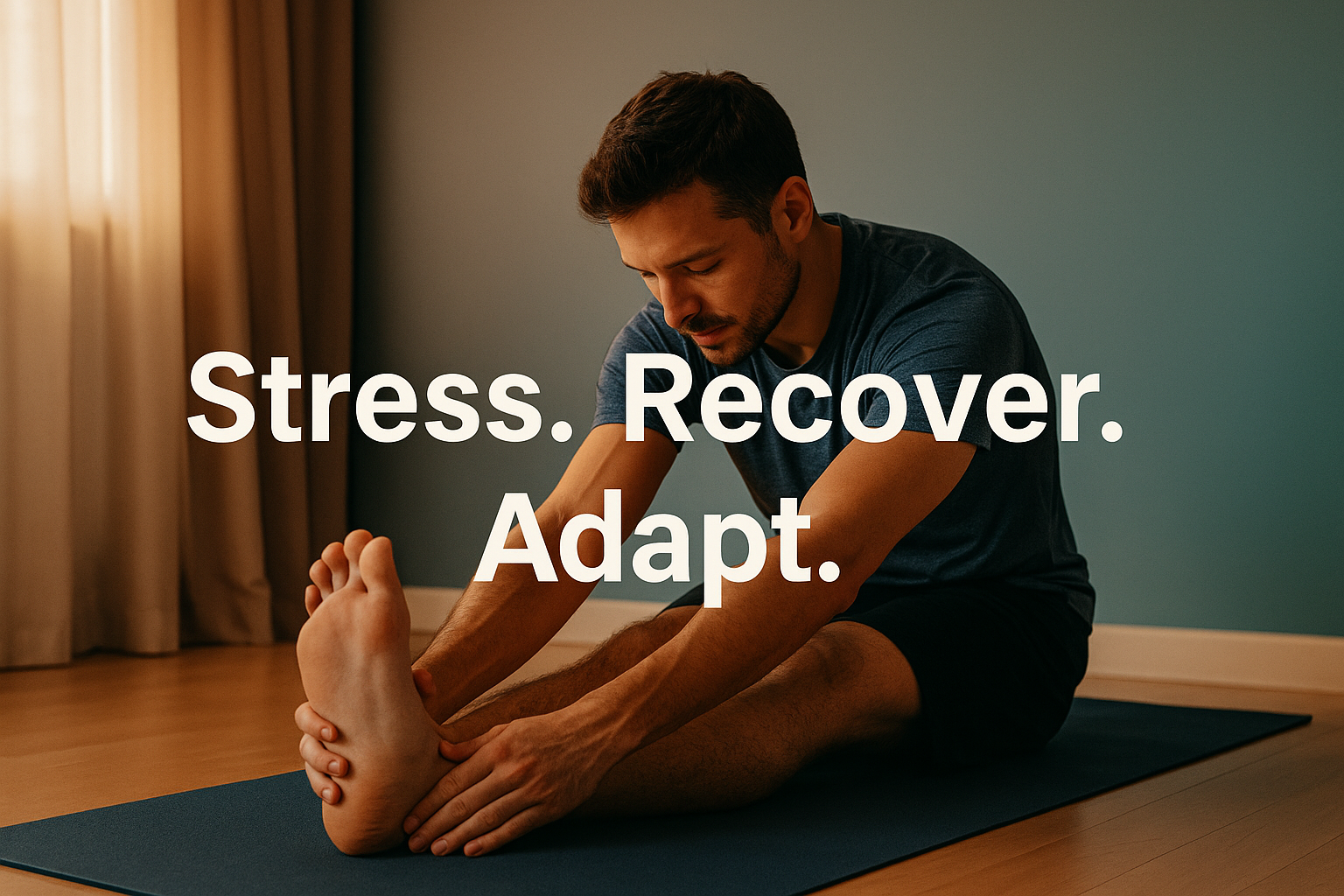
Recovery, Explained: How Your Body Rebuilds After Stress
Your body follows a predictable pattern when recovering from mental stress or physical training. Learn what actually happens during recovery — and how to support each phase to improve performance and resilience.
Stress shapes you. Recovery strengthens you.
Your body is constantly balancing breakdown and rebuild — and with the right inputs, you can turn stress into adaptation rather than exhaustion.
When it comes to stress, recovery, and adaptations the body treats mental and physical stressors in the same fashion with a very similar process. Knowing how this process works not only will help you as you look to make progress, but also pinpoint one of the biggest culprits in leading to plateaus. These stressors can be planned workouts, busy days at work, illness, relationships, or all of them combined and it becomes crucial to account for this when looking at how much you're trying to accomplish and what results are reasonable to expect.
The first step in this process is an immediate response to this stressor that includes things like an increase in heart rate, cortisol and adrenaline rise, mental focus increase, and an increase in blood sugar to provide more energy to meet the increased need. After the stressor has passed the body then shifts into repair mode shifting those resources to stabilize which will include things like a normalization of hormone levels, and repair of any tissue damage. Finally we get into the adaptation phase where muscle strength increases, muscular endurance improves, cognitive resilience increases, and there's a mood improvement all with the goal to better handle the next stressor that comes.
The challenge for many is balancing out the stressors such that this entire process can run from start to finish in an efficient manner. Too strong or too quick of a stressor and the body never finishes the repair mode and as such can't adapt or grow stronger. The repair process can also be delayed by other factors too, such as poor sleep, underfueling, or even relationship stress. Some indicators that you may be stuck in this cycle are consistent muscle soreness or perpetual fatigue. The flip side can also cause problems as too weak of a stressor, or ones spaced too far apart and the body never triggers an adaptation as it doesn't need to.
Unfortunately, there is no one single test that can identify either of these as the exact problem you may be facing in hitting your goals. However, if you find yourself stuck at a plateau or feel like you're just going through the motions, the first place to start would be that honest assessment of your stressors and what actions you're currently taking. If you feel like you're perhaps putting your body under too much stress, look for ways to either reduce some of that or change up your workouts by reducing the duration or intensity. Most workout programs have a built-in de-load period to help the body adjust, but depending on where you're starting from it may take longer than that. If you feel like you're on the other side of the fence, I wouldn't suggest increasing your stress (don't go out purposely to get poor sleep) but look to change up or increase your workout frequency/intensity. With either of these paths, I wouldn't look to change too many things or make a drastic change but start small and evaluate progress.
Stress is unavoidable — but recovery is intentional.
When you understand how your body repairs, resets, and rebuilds, you can train harder, handle stress better, and perform at a higher level.
Support the process. Build resilience. Keep forging forward.
🔗 Subscribe to The Wellness Forge for strategies that help you recover smarter and perform stronger.