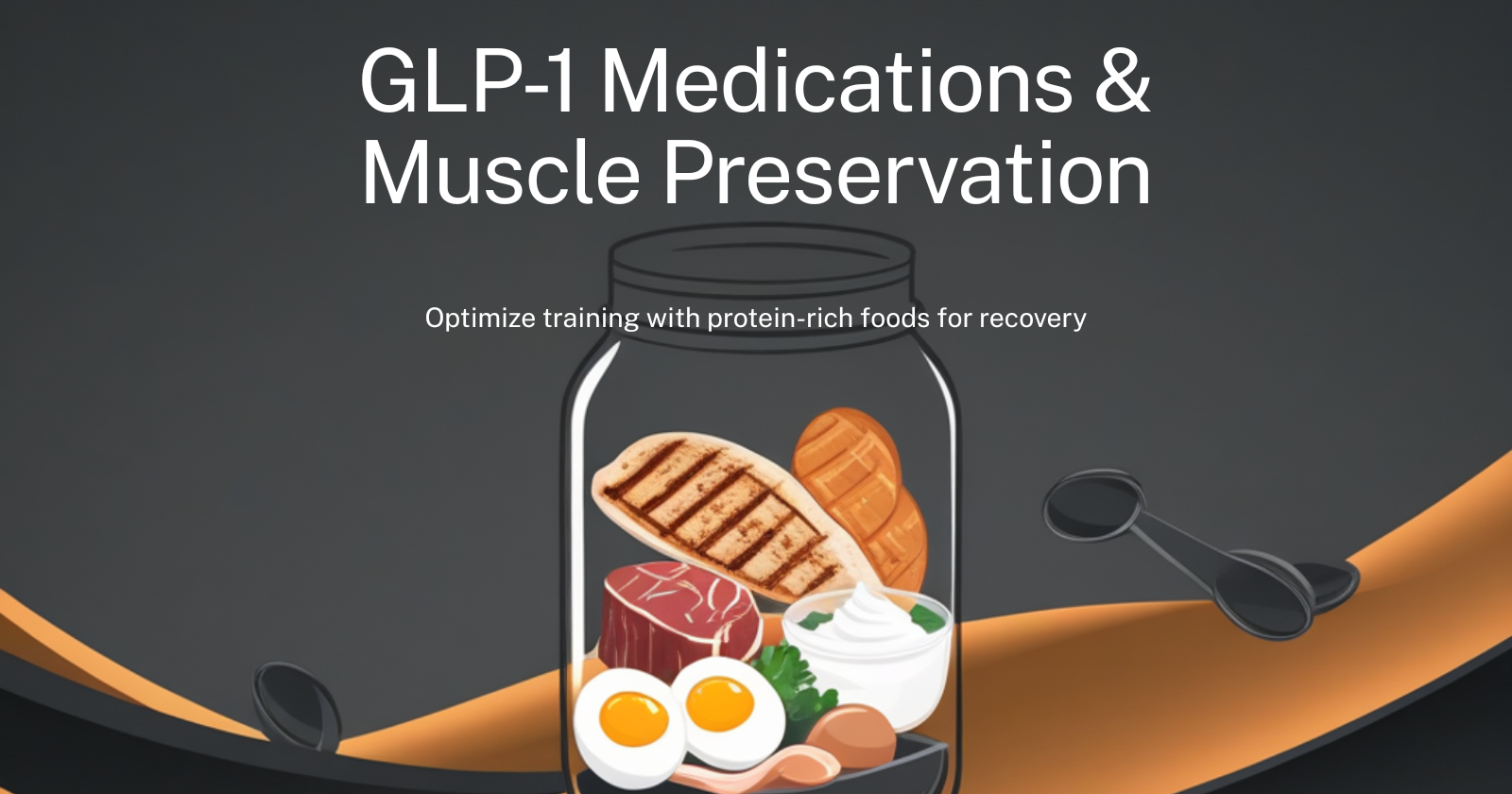
The GLP-1 Conversation Nobody's Having With Individuals Who Train
Most GLP-1 conversations stop at weight loss. For men over 40 who train, that's the wrong finish line — appetite suppression has downstream effects on protein intake and recovery that most prescribers aren't tracking.
The GLP-1 medication conversation has been dominated by the weight loss frame.
If you are over 40 who trains consistently, that frame is incomplete.
Here is what matters for your specific situation.
GLP-1 receptor agonists significantly reduce appetite. That is the mechanism. In the context of a structured training protocol, reduced appetite has downstream effects that most prescribers are not monitoring: lower protein intake, reduced glycogen availability, compromised recovery capacity.
Training 4 days per week on a GLP-1 while not actively managing protein targets is an almost guaranteed way to lose significant muscle alongside fat.
This doesn’t appear until his performance drops, his body composition looks wrong despite the weight loss, or his labs show what is happening.
The solution is not to avoid the medication. The solution is to build the nutritional protocol that makes it work the way it is capable of working.
Protein-first nutrition framework
Resistance training maintained or increased
Recovery protocol supporting the reduced caloric environment
Periodic clinical assessment to verify lean mass is being preserved.
I have walked several clients through this. The outcomes are different when the framework is built correctly.
If you are on a GLP-1 or considering one and you are training, you need a nutrition protocol designed around the medication. Not a generic plan. Not the macros you used before you started.
Comment AUDIT below. I built a free tool to start this conversation.
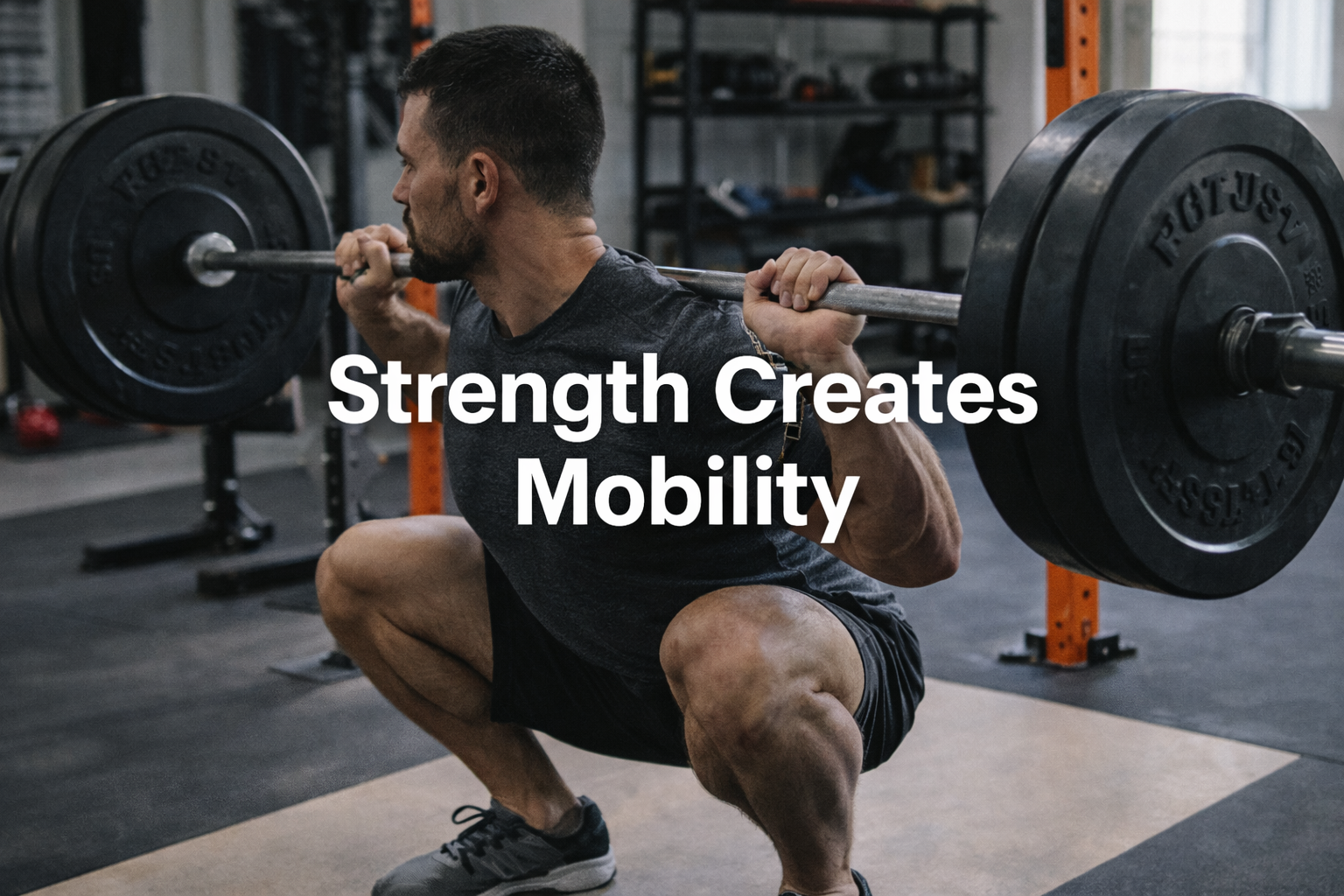
Stretching Isn’t the Fix: Strength & Movement Are
If you feel tight or stiff, stretching alone may not be the answer. Learn why strength and movement create lasting mobility — and how to use stretching effectively without overdoing it.
If you feel stiff, sore, or restricted, your first instinct is probably to stretch more.
But for most people, tightness isn’t a flexibility problem — it’s a capacity problem.
Strength and movement solve far more issues than endless stretching ever will.
I've had many clients initially tell me they wanted to be more flexible and I appreciate that we all have goals however I believe there are better goals to strive for than flexibility out of the gate. One quick test is a standing squat, notice the depth you can achieve and then perform that same squat using a door frame, bar, squat rack, anything for support and notice the depth again. For most people, there is a significant difference which shows the issue isn't flexibility (at least in legs) but in strength for your body to get into and out of that position. Now if you're one of the few that those 2 exercises have similar depths, than yes perhaps mobility is an issue. However, the second question I then ask is what everyday activities are restricted by this "lack of mobility" and usually there aren't any. Again, if something comes up that should be addressed but for most they would be better served to chase strength, especially at the edges of their range of motion than spending time on stretching.
The first thing to look at when working on mobility and flexibility, and that is to maximize the range of motion with your exercises. This may require using less weight than normal, but that additional range of motion will provide a large stimulus that will dramatically increase overall strength. Another good option is to hold at that full range of motion to provide a specific stimulus at your weakest portion of the movement. Not only will this combination increase your overall mobility but that increased mobility will greatly decrease your likelihood of injury.
The next best way to increase mobility is through frequent movement of those joints with minimal stress but full range of motion. Think of things like walking, easy bike rides, or perhaps even swimming as activities that fall into this bucket. The main benefits of this kind of movement is that it:
lubricates joints
increases blood-flow throughout the body which brings nutrients and removes waste
and it reinforces natural movement patterns
This movement doesn't need to be a long duration, even short durations can be beneficial - try to at least get to the point where you feel your body loosen up.
All this isn't to say that stretching doesn't have a place in a healthy lifestyle - it certainly can, but many either implement it incorrectly or at the wrong times. There are typically two kinds of stretching:
Dynamic, or moving stretches - these typically incorporate slow movements through an entire range of motion. Think leg swings, arm swings, body leans, etc.
Static stretching - holding the same stretched position for anywhere from 10 seconds through multiple minutes.
Dynamic stretching is best used before exercise as a warm-up to prime the muscles for whatever exercise you're about to start. Static stretching is best used either as a cool-down after exercise or as part of a night-time routine to calm the muscles and nervous system before sleep. Stretching then becomes the enhancement tool for your exercise and not the main event.
Most people don’t need more mobility drills — they need more movement and more strength.
Build capacity. Move often. Use stretching as a tool, not a crutch.
When strength and movement lead the way, mobility follows naturally.
🔗 Subscribe to The Wellness Forge for practical, sustainable strategies that build resilient bodies — not fragile routines.

From Reflection to Direction: My New Year Process
Instead of rigid resolutions, this is the process I use to set intentional, sustainable goals across personal health, training, and business — built around energy, consistency, and long-term progress.
A strong year isn’t forged by one bold resolution — it’s shaped by consistent intention.
Before setting goals, I step back, assess the last year, and choose how I want to show up in the next one.
One of the most common traditions this time of year is some sort of resolution, change, plan, or something to do differently to start off year. Over the past few years, I have switched up towards more of a process that I also implement around any other significant event such as a race or work event. I use this as a time for reflection, looking at the things I did well in the previous year, some areas that didn't go so well and lessons learned from them, and finally a look forward to next year with a combination of incremental process goals, things I want to improve on, and then a "big scary goal" or two. I'm sharing this here for two reasons, one to walk through what I believe is a more successful concept, and two to provide myself with a level of accountability.
Looking back at last year, I didn't have any of those stand-out wins or massive highs but it definitely was a year of consistency. I feel like this consistency applies to the business side most with regards to my clients, my level of service to them, and also with my consistently looking to learn and continue to improve. I also feel like I managed to gradually work on my sleep, the most challenging part getting to bed earlier. There's still lots of room to improve but the increased awareness and small shift should help lead into this year for even more improvement. My training didn't go quite as planned as I started the year recovering from a torn labrum, and then later in the year picked up another hip injury. But I do feel like both of these injuries brought me greater awareness of my body, especially while running as I needed to make various tweaks based on my physical therapy. This awareness also helped me more smartly adhere to my training plan and also know when I needed to make shifts in the plan. The last area I wanted to call out was not only a better handle on my schedule, but also doing a better job of protecting the parts of my schedule that I needed (or wanted) to hold. While this may sound trivial, I have a habit of rearranging my schedule to fit others and while that has certain obvious advantages it does create other challenges for me and my mental outlook. Shifting just a little bit along that scale towards protecting my schedule helps me strike a better balance in my life.
As for areas that didn't go as well, I don't go into this process trying to find every issue or mistake but instead look at one or two significant aspects that were the most impactful on the year. Probably the most obvious one that jumps out to me was my consistency with strength training, which I realize might sound odd coming from someone who knows how important it is. I will firmly admit that I am one of my toughest clients, and spoiler this will be an item coming up that I plan to work on. I also recognize that I probably got a little too comfortable with my client base and didn't push as hard I as I could to grow that, or improve what I'm doing for my existing clients. This is also one of those areas where I am my worst critic as well, but I do feel like there's room for improvement there. Finally the other aspect I recognize got a bit out of control was my ability to check out for longer than I probably should. Yes there are times when I need to zone out to relax and recharge, but far too often a 30 minute mental break turned into multiple hours. This one will probably be tough to break, but I feel like one of the tweaks I made towards the end of the year will help with this and more awareness will also help reign this habit in a bit.
So what does my plan for 2026 look like? As part of this process, I look to identify a couple of processes that I want to improve, a couple of specific targets (usually with a couple levels to them), and then a "scary" goal or two. I mentioned it above, but top of the list that I need to work on is my strength training consistency and I've already addressed many of the logistical challenges with a routine - I simply need to do it. My plan to improve my consistency starts with actually scheduling the slot on my calendar, as only having it on my training plan doesn't seem to work. I will also make the mental shift that these workouts are my most important ones of the week, and need to happen before I "reward" myself with my long run. I also want to work on keeping my schedule more in control, satisfying my clients but also leaving room for myself. I've made strides this year, but feel like there's a gap between the day to day scheduling and longer term stuff. I'm recently starting using a tool called Notion (just the free version at this time) to help better organize and visualize my longer term projects and that coupled with my existing calendar should help improve this situation. I do have some specific business goals with regards to numbers I want to hit and the success of a new program I will be launching (👀SOON! 👀) but the scheduling improvement I mentioned will also have a significant positive impact on my business. I'm taking a break this year from setting a specific financial target but I will gauge this success based on my comfort level with additional expenditures, primarily vacation and travel. I know that may sound vague but it has a very specific and real meaning to me, which is the important part. As for my "scary" goals, technically I have two of them but they're related and based on how the year starts off with my injury may collapse to one. But I have some relatively lofty goals that I want to hit with regards to my marathon time, and full distance Ironman Triathlon. But before I can really narrow in on these, I need to see how the next couple weeks of training goes as that will drive whether I can tackle both of them, or if I need to focus on just one.
The New Year isn’t about doing everything — it’s about doing the right things with intention.
When your personal health, training, and business goals align, progress becomes sustainable and meaningful.
This year, to summarize my outlook, I’m focused on clarity, consistency, and energy — and helping others do the same.
🔗 Subscribe to The Wellness Forge for weekly insights on building strength, resilience, and sustainable performance.
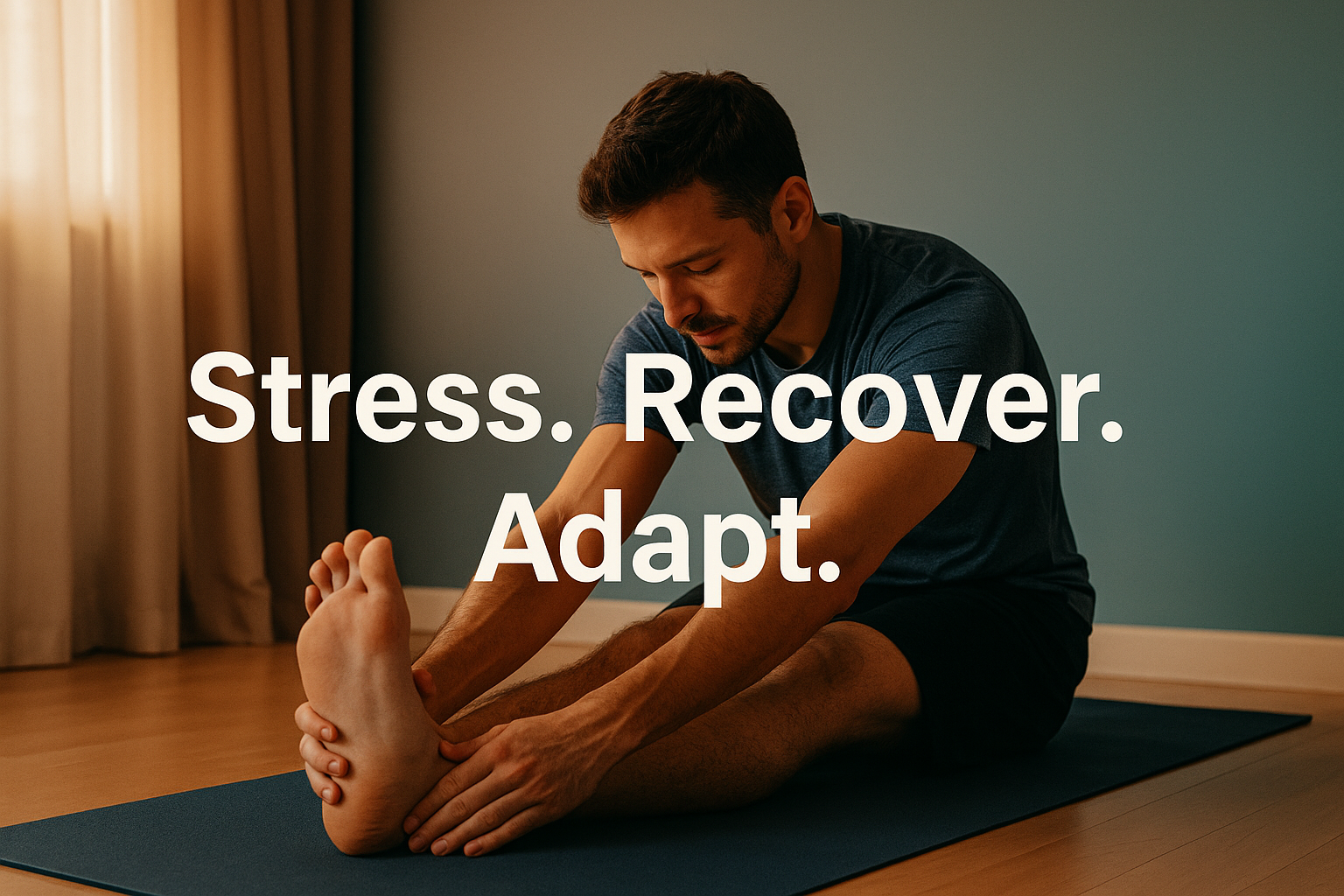
Recovery, Explained: How Your Body Rebuilds After Stress
Your body follows a predictable pattern when recovering from mental stress or physical training. Learn what actually happens during recovery — and how to support each phase to improve performance and resilience.
Stress shapes you. Recovery strengthens you.
Your body is constantly balancing breakdown and rebuild — and with the right inputs, you can turn stress into adaptation rather than exhaustion.
When it comes to stress, recovery, and adaptations the body treats mental and physical stressors in the same fashion with a very similar process. Knowing how this process works not only will help you as you look to make progress, but also pinpoint one of the biggest culprits in leading to plateaus. These stressors can be planned workouts, busy days at work, illness, relationships, or all of them combined and it becomes crucial to account for this when looking at how much you're trying to accomplish and what results are reasonable to expect.
The first step in this process is an immediate response to this stressor that includes things like an increase in heart rate, cortisol and adrenaline rise, mental focus increase, and an increase in blood sugar to provide more energy to meet the increased need. After the stressor has passed the body then shifts into repair mode shifting those resources to stabilize which will include things like a normalization of hormone levels, and repair of any tissue damage. Finally we get into the adaptation phase where muscle strength increases, muscular endurance improves, cognitive resilience increases, and there's a mood improvement all with the goal to better handle the next stressor that comes.
The challenge for many is balancing out the stressors such that this entire process can run from start to finish in an efficient manner. Too strong or too quick of a stressor and the body never finishes the repair mode and as such can't adapt or grow stronger. The repair process can also be delayed by other factors too, such as poor sleep, underfueling, or even relationship stress. Some indicators that you may be stuck in this cycle are consistent muscle soreness or perpetual fatigue. The flip side can also cause problems as too weak of a stressor, or ones spaced too far apart and the body never triggers an adaptation as it doesn't need to.
Unfortunately, there is no one single test that can identify either of these as the exact problem you may be facing in hitting your goals. However, if you find yourself stuck at a plateau or feel like you're just going through the motions, the first place to start would be that honest assessment of your stressors and what actions you're currently taking. If you feel like you're perhaps putting your body under too much stress, look for ways to either reduce some of that or change up your workouts by reducing the duration or intensity. Most workout programs have a built-in de-load period to help the body adjust, but depending on where you're starting from it may take longer than that. If you feel like you're on the other side of the fence, I wouldn't suggest increasing your stress (don't go out purposely to get poor sleep) but look to change up or increase your workout frequency/intensity. With either of these paths, I wouldn't look to change too many things or make a drastic change but start small and evaluate progress.
Stress is unavoidable — but recovery is intentional.
When you understand how your body repairs, resets, and rebuilds, you can train harder, handle stress better, and perform at a higher level.
Support the process. Build resilience. Keep forging forward.
🔗 Subscribe to The Wellness Forge for strategies that help you recover smarter and perform stronger.
How to Measure Progress (Even When the Scale or Stopwatch Won’t Budge)
Progress isn’t linear — and plateaus don’t mean you’re stuck. Learn how to measure progress more effectively and break through plateaus in strength and endurance using simple, sustainable strategies.
Iron sharpens through challenge — not repetition.
Plateaus aren’t roadblocks. They’re invitations to refine your approach, dial in your habits, and train with intention.
Let’s break down how to progress with purpose.
Progress is one of the key metrics we all pay attention to as we train, and we primarily focus on two types of progress - quantitative and qualitative. However, I will admit, for myself and many of my clients, the fixation on the quantitative (numbers/metrics) can be overpowering and dominate the thought process. That's not to say focusing on numbers is a bad thing, for the most part they can be a great metric as they're usually very cut and dry. You either hit that metric/goal or you don't. However, these only tell part of the story and shouldn't be used as the sole metric for gauging progress. You'll want to pair those metrics with some qualitative guides to help you understand HOW you're hitting those numbers. For example, if one of the metrics you're tracking is how much weight you're squatting, it is very easy to keep track of how much weight you load onto the bar (or hold in your hands, or how many body weight squats you're doing). But you'll also want to keep track of qualitative things like how easy/hard those reps feel, how you recover from that workout, how is your range of motions (think squat depth) is improving, and the list goes on from there. Pairing the numbers with the feel gives you a more complete understanding of how you're progressing with your squats, in this example, and a better grasp of when you might actually be hitting a plateau. Many consider plateaus when just the numbers stall, but if you're able to do the same weight but it feels easier, that's not a hard plateau, you're most likely very close to being able to increase the weight.
There are many reasons why you might be hitting an actual plateau where not only are the numbers not moving, but the workouts don't feel any different and they mainly will fall into 3 types:
Too much training or not enough fueling - these essentially get to the same problem, too much training load that the body can't properly recover from and as such never adapts.
Too little training which doesn't challenge the body enough such that it needs to adapt.
The wrong kind of training, an extreme example of this would be doing lots of speed work during your marathon training
So what does it look like to pull out of a plateau, it first starts with understanding IF you're actually in one and then figuring out which of the above three buckets your training falls into. Some of the solutions are simpler to figure out, for example an over training imbalance can be helped with either adding in a de-load week or an increase of calories. Starting with that honest assessment of where you currently are not only with training, but fueling and your other stressors will help narrow down the challenges to work to adjust. My recommendation would be to pick one aspect and make a small change to see if you notice things moving in the right direction, then lean in further. As an example, if you feel your fueling may be off, look to add a small snack, or slightly larger meals, to add around 100-300 calories a day for a week, and see how that impacts not only your training but how you recover and feel. Another option if you're feeling truly stuck, and assuming you don't have a calendar restriction (like a race in 3 weeks), would be to pivot to something completely different for a few weeks. This will provide a radically different stimulus and force your body to respond and adapt.
Sometimes it can be hard to be objective about progress, and it helps to have someone else to observe and discuss your current training. While this is the exact purpose of having a coach or trainer, you can also look to other training partners, friends, relatives, etc to get some feedback on not only the training but how they view your recovery and mentality. This outside viewpoint may be the missing piece in helping crack the plateau challenge.
Plateaus aren’t a dead end — they’re a sign to adjust.
Progress comes from intention, not intensity.
Change the stimulus, fuel well, recover well, and track your trends — and your progress will keep moving forward.
🔗 Subscribe to The Wellness Forge for strategies that build long-term strength, endurance, and resilience.
Strength Training Anywhere: Build on What You Already Have
Strength training doesn’t require a gym — it requires consistency.
Learn how to stay strong through home workouts and holiday travel using what you already have.
Strength doesn’t live in the gym — it lives in your habits.
Whether you’re training from home, a hotel, or halfway across the country visiting family, you can still build on the foundation you’ve created.
This season is about consistency, not perfection. Here’s how to make it happen.
In my earlier post on strength training I provided some ideas for getting started, as well as some ways to progress what you're currently doing. Another key aspect of consistent strength training is pivoting when your situations change, and the holiday season is right around the corner. So what kinds of options should we look at to continue our training during a busy travel and gathering time period?
The first conversation to have with yourself is the duration of the travel or holiday window you're working with. Missing one workout over a long weekend really won't have much of an impact, but a week or two starts to slide into the period where it might matter physically and definitely has a mental impact. Also consider your current stress levels and how the holidays and/or travel will impact that, taking some time off or scaling back might be the best long term answer. And then of course, think about your goals and how those align with your timing. Personally for me, I typically travel between Christmas and New Year's, and then have the Houston Half-marathon in early January, such that training is important for me. But I also know that trip is very restorative for me and I can handle the training load.
So what does it look like to strength train through this period? I would look at 3 main options that are not only scalable for anyone of any level but very portable:
Body weight exercises, think squats, step ups, core work, and pushups all provide value and can be progressed reasonably well.
Resistance bands easily fit into a suitcase and can scale to pretty much any difficulty level and provide a full body workout.
A Suspension Trainer is another very portable option that does require a mount point (tree, bar, outward opening door) but allows another option for a full body workout and most likely a different stimulus.
I would then think about shortening your workout time and pivot towards more workouts. For example, instead of two hour long workouts, think of four thirty minute workouts. You can look at either mimicking your current exercises with these tools, or maybe take advantage of the novelty and try some new movements. All of the above tools allow for lots of variations of angles and pivot points which can significantly change the stimulus that exercise provides. This unfamiliarity will not only help with your training, but also mentally it will allow you to focus on the experience and not get caught up in trying to compare numbers.
The holidays don’t have to be a setback — they’re an opportunity to stay grounded and keep your momentum.
You don’t need a perfect plan, just a flexible one.
Build on what you already have, adapt when life gets messy, and keep forging forward.
💪 Subscribe to The Wellness Forge for practical, adaptable training strategies you can take anywhere.
You Can’t Outperform Stress — But You Can Learn to Recover From It
Every athlete, executive, and high performer faces stress — the difference lies in how they recover.
You can’t grind your way out of chronic stress.
Recovery isn’t weakness — it’s the process that makes progress possible.
Here’s how to manage stress better and optimize recovery 👇
Even iron needs time to cool before it can be forged again.
Your body and mind are no different.
Today, we’ll explore the balance between stress and recovery — and how to strengthen both.
Stress is a part of all of our lives and what complicates the challenge is that stress is required for the exact kind of healthy adaptations we all strive for, that's the good stress. Most people think of stress as a bad thing, and in many cases it is, but the majority of stress actually has a positive impact on the body. Where stress becomes a problem is when there is too much of it for the body to handle, the classic too much of a good thing problem. Let's start with something you can implement today that will have an immediate impact on how your body handles stress. Like I've mentioned before, awareness is where I start with all my clients - but I'll admit, that process takes time (a few days) so today take at least one 5 minute break during the day to pause, reset, and get ready to tackle the next task. Maybe even take part of that 5 minutes to practice awareness of your stressors.
Taking a deeper look at stress, it typically can be divided into 6 buckets:
Physical - exercise or injury would be examples.
Mental - think learning tasks or prepping for a meeting.
Environmental - outside noise, pollution, temperature, and allergens fall into this bucket.
Emotional - general mood and happiness
Existential - why are we here and what is our purpose?
Relation - friends, family, and coworkers would fall here.
Inside of these buckets there are good stressors and bad ones, which are usually rather obvious, but there are some good stressors that can become bad if done at the wrong time or at too high of an intensity. For example, strength training when done appropriately is a great form of exercise. However, lifting too hard for what your body can handle that day will most likely lead to soreness and potential injury with long term impacts if consistently overused. This is where that self awareness comes into play, having a feel for your body and knowing when it is a day to push, when to pull back, and understanding that when you have to over-reach because of a deadline or race, you will need extra recovery on the other side. Using wearables can be a help in this area to monitor the body's response to stress and help give some quantitative measurements on things like Heart Rate Variability and Resting Heart Rate which are both good indicators of overall stress and how primed your body is to handle more. The best approach is a mixture of the numbers and the knowledge of your body to form that complete picture.
What does recovery look like then from all these different kind of stressors? As you've probably guessed, that first step in a awareness or audit of your primary stressors and then looking for ways to handle them. Some may have immediate simple solutions, for example an air filter in your office to help remove allergens and other contaminates if that's an area you struggle with. Others are more complicated and 100% might require some outside assistance to help work towards resolving. And some are constant parts of life and need continual work to manage. Inside each of those stress buckets are also recovery techniques that you can apply, here are some examples:
Physical - sleep, stretching, low intensity exercise
Mental - reading, preparation, planning
Environmental - air filters, blankets for warmth, air conditioning
Emotional - honest communication, mental exercises such as reframing
Existential - prayer or meditation
Relation - that supportive friend or family member
This isn't to say that the best way to recover from a stressor in one area is recovery in that same area, sometimes it is, sometimes it isn't. You've probably noticed that you have great ideas when taking a long hot shower - that physical recovery technique can not only relive physical stress, but open you up to recovering from pretty much all the other types of stress too. You will notice over time, what recovery techniques work for you and which ones work best for specific stressors you face. My two most consistent tools I use for recovery are my sauna blanket and reaching out to friends and/or family. These 2 not only hit multiple buckets but also are examples of a daily routine and a more tactical tool to handle the stress spikes we all go through. The way to become adept at managing your stress is to develop a full tool chest of recovery options that you know work for you, can be pulled out when needed, and used as backups when your first choice doesn't yield the results you're looking for.
Stress isn’t the enemy — it’s the signal. Recovery is the response.
You can’t eliminate stress, but you can build systems that help you handle it better and bounce back stronger.
🔗 Subscribe to The Wellness Forge for more actionable tools to help you perform, recover, and thrive — without burning out.
Strength Training 101: A Foundation for Health and Performance
Strength training isn’t just for athletes — it’s one of the most powerful tools for improving health, performance, and longevity. Learn what it is, why it matters, and how to get started with simple, sustainable steps.
Most people chase fitness trends, but few invest in what actually moves the needle: strength.
Whether your goal is longevity, performance, or simply feeling better in your body, strength training is the foundation.
Here’s how to get started — and why it matters more than you think.
When it comes to starting any new routine, you must understand where you're starting from and adjust accordingly. If you're completely new it would be prudent to verify with your health professional that there are no underlying issues you need to be aware of, and consulting with some sort of advisor through this process might help reduce your ramp up time. Assuming you've progressed past that point, whether you're brand new or have lifted for years and have just taken a break, always start with less then what you think is needed. It is way easier and more productive to add more to your routine than struggle because you went too hard that first session and can't move for 3 days because you're too sore. I'll go into more details in future emails, but a good starting point would be a routine you feel 95% certain is maintainable, the goal is consistency, not hammering yourself from the start. Even 1 workout a week can yield results! Another key aspect to consider is where to workout as both gyms and home have advantages and disadvantages. This is one of those honest discussions you need to have with yourself to understand if working out with other people with all the equipment you could ever want helps you, or if you'd be better served by the time flexibility and comfort of working out in your house. Neither is necessarily better than the other, but their effectiveness is highly dependant on the individual. The last suggestion I'll make, at this time, is that if you are going to go the home gym route, start small and incrementally add as you go. Don't go and spend thousands on what could become expensive hangers if you come to find out there are too many distractions at home for a consistent workout.
Let's step back and define what strength training is, and what forms don't provide the same kind of results. By definition, strength training is movement with resistance, which would include using your own body weight, bands, dumbbells, barbells, or anything else you might have lying around. The key to reaping all the benefits is to lift as if you're trying to get stronger which means you'll want to chose a weight that is challenging for you to complete 5-15 repetitions, keeping good form. To continue to see the benefits you also need make sure to progress to higher weight when those reps become too easy. Another key component to strength training, resting in between sets, should range from at least a minute to upwards of 5 minutes depending on what you're doing. Resting allows for your muscles to recover their energy stores and be ready to exert maximal effort again. The exercises themselves are not what provides the benefits, it is the body's reaction (building muscle) to those exercises as it adapts to the increased demands. This means not only do you need rest intervals during your workout, but days off between workouts such that your body has time to recover AND adapt to these stimuli. Each session should provide as different of a stimulus as possible from your normal daily routine to maximize the benefits. Because of this, "lower" repetition amounts with "heavier" weight shows far better results than lots (anything over 30) of repetitions with lighter weights.
I've mentioned the results and benefits of strength training, without any further context. Here are just some of the ways in which strength training has a positive impact on your body:
The obvious one, you get stronger. But that's not just your muscles, your tendons and ligaments which support those muscles and movements get stronger. And all of those pieces attach to your bones that then also getting stronger. Not only will this help with many daily activities and tasks (as well as any sort of performance venture) it can also help reverse or prevent bone issues like Osteoporosis and Osteopenia.
Some of the muscles that will be strengthened are the stabilizing muscles which will in turn help with balance. Not only will this help with performance, but it will dramatically increase your injury resilience. Certainly losing balance could result in falls which are a major health risk as we age, but also the majority of soft tissue injuries (think ligament tears - ACL, MCL, Achilles, etc) result from those tendons filling in the gaps for weak muscles.
Another important aspect of building more muscle is that it is one of the primary locations the body stores glucose (think sugar or carbs) which not only means that there's more energy available for the body but it is actually better at managing the energy levels. This then translates into a better insulin response which helps drive down many of the factors that leads to ailments like diabetes.
Muscle requires more energy to sustain itself than fat does, even at rest, which means that your body will naturally burn more calories because of the additional muscle mass. This allows for an increased level of metabolic flexibility since the body consumes more calories it becomes easier to either increase the amount of food you enable more muscle growth, or reduce calories to lose weight.
These are just a few of the benefits, but are some of the most impactful.
Strength training isn’t just about building muscle — it’s about building capability, confidence, and longevity.
Start small, stay consistent, and give yourself credit for each rep of progress.
Ready to build your foundation? Join The Wellness Forge and get clear, actionable guidance to help you move, perform, and live stronger.