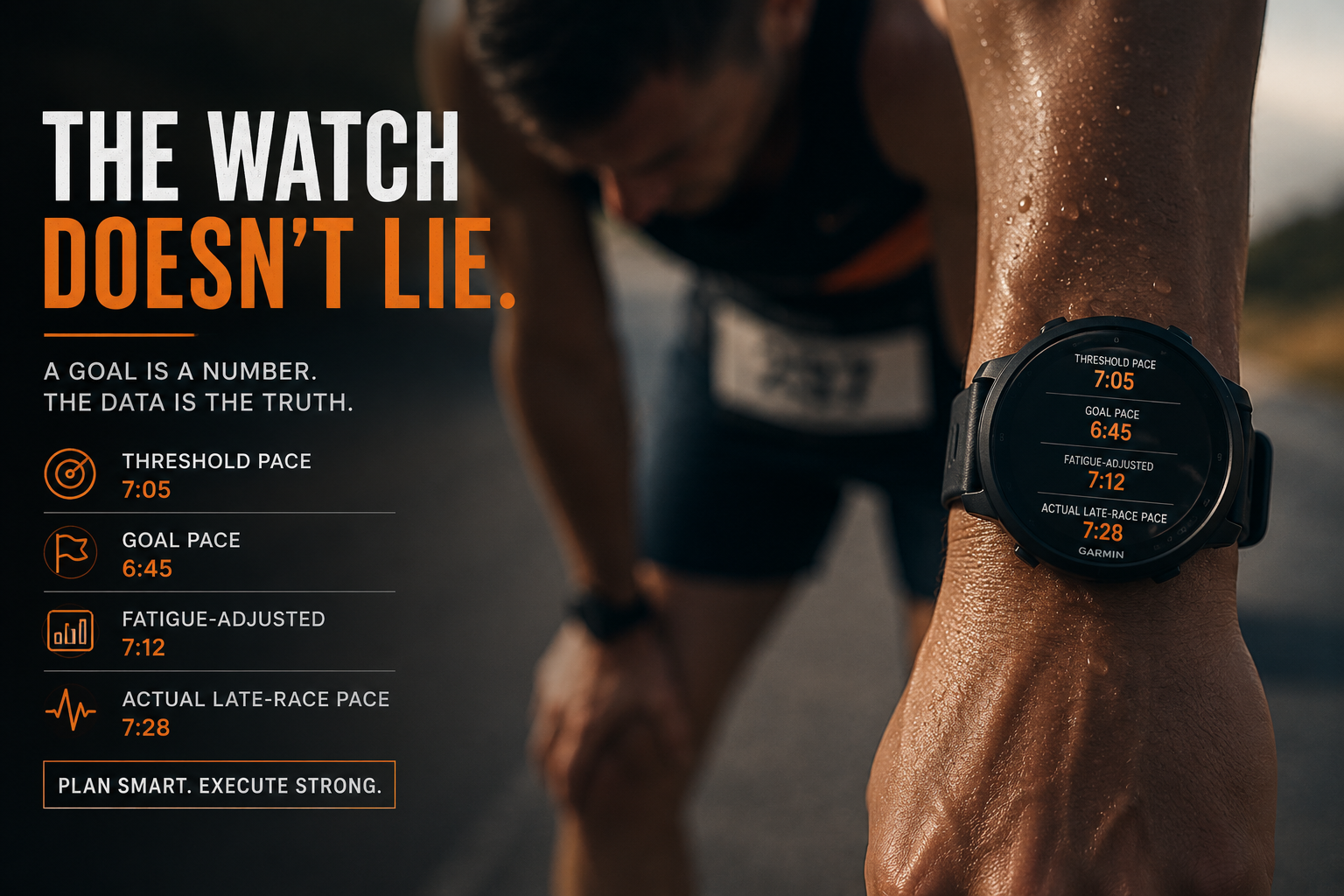
The Pacing Plan Problem Nobody Talks About Until Mile 20
Same athlete, different name: strong training block, a pacing plan built on a goal number, and a back half that falls apart. Here's the actual gap.
Same athlete, different name — I keep seeing this one.
Strong training block. Fitness is there. Then race week hits, and the pacing plan comes from a goal number — not from what the data actually says about that day.
Back half falls apart. Not from lack of fitness. From a plan that was never built on the athlete's real numbers in the first place.
This shows up constantly, and it's rarely a training gap. It's a data gap. → Threshold pace isn't the same as goal pace. → Fatigue-adjusted splits aren't the same as flat splits. → "What I think I can hold" isn't the same as "what my last 3 sessions say I can hold."
I built a free Race Preparedness Checklist to help athletes catch this — and four other blind spots — before race day, not after. It covers baseline data, fueling, recovery, race execution (pacing under fatigue included), and strength/durability. Takes a few minutes, and flags exactly where your prep has a gap.
And if pacing-under-fatigue is the piece you're missing: I'm finishing an 8-week Race-Ready Playbook that sits on top of whatever training plan you're already running — it walks through baseline testing, fueling, a race simulation dress rehearsal, and a full pacing/execution strategy so the back half doesn't come down to guesswork. Dropping soon — comment below to get it first.
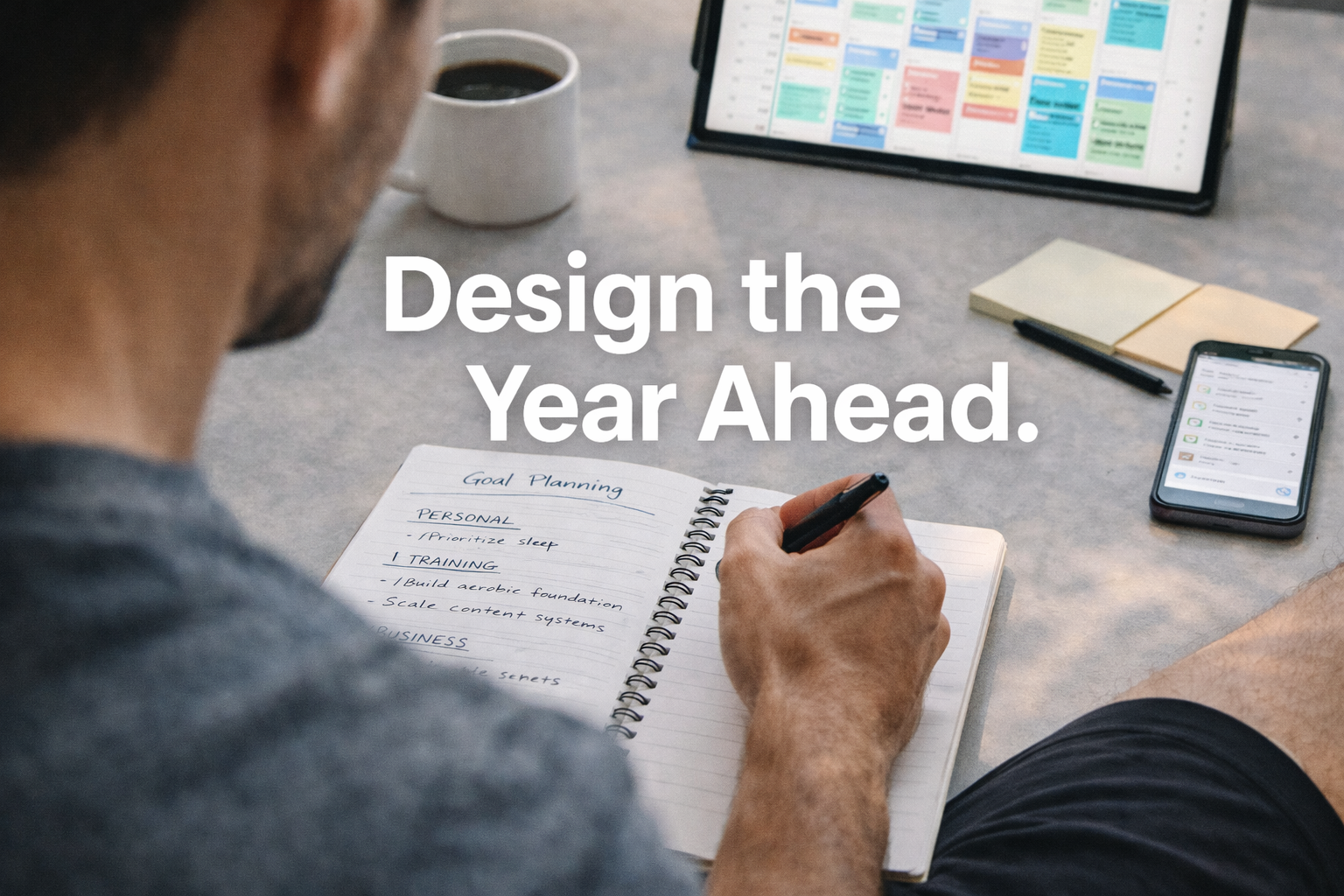
From Reflection to Direction: My New Year Process
Instead of rigid resolutions, this is the process I use to set intentional, sustainable goals across personal health, training, and business — built around energy, consistency, and long-term progress.
A strong year isn’t forged by one bold resolution — it’s shaped by consistent intention.
Before setting goals, I step back, assess the last year, and choose how I want to show up in the next one.
One of the most common traditions this time of year is some sort of resolution, change, plan, or something to do differently to start off year. Over the past few years, I have switched up towards more of a process that I also implement around any other significant event such as a race or work event. I use this as a time for reflection, looking at the things I did well in the previous year, some areas that didn't go so well and lessons learned from them, and finally a look forward to next year with a combination of incremental process goals, things I want to improve on, and then a "big scary goal" or two. I'm sharing this here for two reasons, one to walk through what I believe is a more successful concept, and two to provide myself with a level of accountability.
Looking back at last year, I didn't have any of those stand-out wins or massive highs but it definitely was a year of consistency. I feel like this consistency applies to the business side most with regards to my clients, my level of service to them, and also with my consistently looking to learn and continue to improve. I also feel like I managed to gradually work on my sleep, the most challenging part getting to bed earlier. There's still lots of room to improve but the increased awareness and small shift should help lead into this year for even more improvement. My training didn't go quite as planned as I started the year recovering from a torn labrum, and then later in the year picked up another hip injury. But I do feel like both of these injuries brought me greater awareness of my body, especially while running as I needed to make various tweaks based on my physical therapy. This awareness also helped me more smartly adhere to my training plan and also know when I needed to make shifts in the plan. The last area I wanted to call out was not only a better handle on my schedule, but also doing a better job of protecting the parts of my schedule that I needed (or wanted) to hold. While this may sound trivial, I have a habit of rearranging my schedule to fit others and while that has certain obvious advantages it does create other challenges for me and my mental outlook. Shifting just a little bit along that scale towards protecting my schedule helps me strike a better balance in my life.
As for areas that didn't go as well, I don't go into this process trying to find every issue or mistake but instead look at one or two significant aspects that were the most impactful on the year. Probably the most obvious one that jumps out to me was my consistency with strength training, which I realize might sound odd coming from someone who knows how important it is. I will firmly admit that I am one of my toughest clients, and spoiler this will be an item coming up that I plan to work on. I also recognize that I probably got a little too comfortable with my client base and didn't push as hard I as I could to grow that, or improve what I'm doing for my existing clients. This is also one of those areas where I am my worst critic as well, but I do feel like there's room for improvement there. Finally the other aspect I recognize got a bit out of control was my ability to check out for longer than I probably should. Yes there are times when I need to zone out to relax and recharge, but far too often a 30 minute mental break turned into multiple hours. This one will probably be tough to break, but I feel like one of the tweaks I made towards the end of the year will help with this and more awareness will also help reign this habit in a bit.
So what does my plan for 2026 look like? As part of this process, I look to identify a couple of processes that I want to improve, a couple of specific targets (usually with a couple levels to them), and then a "scary" goal or two. I mentioned it above, but top of the list that I need to work on is my strength training consistency and I've already addressed many of the logistical challenges with a routine - I simply need to do it. My plan to improve my consistency starts with actually scheduling the slot on my calendar, as only having it on my training plan doesn't seem to work. I will also make the mental shift that these workouts are my most important ones of the week, and need to happen before I "reward" myself with my long run. I also want to work on keeping my schedule more in control, satisfying my clients but also leaving room for myself. I've made strides this year, but feel like there's a gap between the day to day scheduling and longer term stuff. I'm recently starting using a tool called Notion (just the free version at this time) to help better organize and visualize my longer term projects and that coupled with my existing calendar should help improve this situation. I do have some specific business goals with regards to numbers I want to hit and the success of a new program I will be launching (👀SOON! 👀) but the scheduling improvement I mentioned will also have a significant positive impact on my business. I'm taking a break this year from setting a specific financial target but I will gauge this success based on my comfort level with additional expenditures, primarily vacation and travel. I know that may sound vague but it has a very specific and real meaning to me, which is the important part. As for my "scary" goals, technically I have two of them but they're related and based on how the year starts off with my injury may collapse to one. But I have some relatively lofty goals that I want to hit with regards to my marathon time, and full distance Ironman Triathlon. But before I can really narrow in on these, I need to see how the next couple weeks of training goes as that will drive whether I can tackle both of them, or if I need to focus on just one.
The New Year isn’t about doing everything — it’s about doing the right things with intention.
When your personal health, training, and business goals align, progress becomes sustainable and meaningful.
This year, to summarize my outlook, I’m focused on clarity, consistency, and energy — and helping others do the same.
🔗 Subscribe to The Wellness Forge for weekly insights on building strength, resilience, and sustainable performance.

Track Your Progress — Without Letting the Data Run Your Life
Wearables and tracking tools can dramatically improve your progress — but only if you avoid obsessing over the wrong metrics. Learn what to track, what to ignore, and how to build a healthy, balanced relationship with data.
You don’t forge better performance by chasing perfect numbers.
You forge it by combining objective data with subjective awareness — using both to make better decisions, one day at a time.
Data pertaining to our health and wellness has never been more in-depth or more available than it is today with the digitization of medical records, more control given to individuals, and the boom of apps and wearables. This data can be incredibly useful to track things like performance, recovery, progress, and spot trends or illnesses early enough to act before they get out of hand. However, that amount of data sometimes become overwhelming, and it can also become easy to get wrapped up in individual metrics and miss the bigger picture.
There ae some pieces of data that are rathe straightforward and can combined with objective data to make them even more powerful indicators. For example, the weight you can squat is a good strength metric, but when you combine that with level of effort you now have a gauge for how well you're performing at that weight on that given day. As you progress lifting with that same weight, it will feel easier, and that ease (in this example) is an indication of when you're ready to progress and increase the weight. Another example would be from your blood work (something everyone should do at least a couple times a year) vitamin levels compared with the optimal levels for that nutrient helps guide towards potential supplementation, with repeat tests helping to understand absorption.
Where this process can lead to challenges is when focus is put on any one signal number with the exclusion of any subjective correlation. For example, many wearables provide some metric that represents how ready you are for the next day. And while that information usually combines a number of different pieces of information (heart rate, heart rate variability, previous days activates, sleep, etc.) it is only a snapshot of those metrics and even ignoring any potential inaccuracies, that is only one snapshot in time such that it is providing a limited view into the complex working of the body. Over time, you may come to find you typically feel similar to how that "ready" score indicates you should feel, but it is an important exercise to continue to check in to verify you feel in the ballpark of that number. Chasing the numbers can lead to additional stress, over-reaction/correction, exercising too hard or too easy, or prioritizing the wrong behaviors. It is more important to chase the process and not the numbers.
Another powerful way to leverage data is to not look at the single values, but the trends in those values over a longer period of time. When looking at something like sleep duration or heart rate variability, individual values don't tell the whole story but general movement or significant outliers can be useful to look at. Trends can help determine if behavioral changes are having a positive or negative impact while outliers can be an indication of a potential illness. Looking at trends, also helps with looking at the bigger picture as each data point builds on the previous data to form a more powerful story and helps minimize focusing on the small details.
If you're looking to make a change in a metric, first make sure it is one that you can easily and consistently track, and remember that absolute accuracy isn't a firm requirement, but the data should be consistent, or accurate compared to itself. Track that metric for a week without making any changes so you have a decent starting trend and rough idea of the variations. Then change one (maybe two) behaviors and continue monitoring for at least two weeks. This period will allow you to account for any normal variations and any issues with consistency in your behavior changes. After that period, you should be able to determine if the changes improved your metric or not. Based on that, either continue, shift behaviors, or maybe look at the next metric to attack.
Data is powerful — but only when used wisely.
Track what matters. Ignore what distracts. Let the numbers guide, not judge.
When you combine data with awareness, you make better decisions, improve consistency, and unlock higher performance.
If you want support building a balanced, data-informed approach to your health and training, I’m here to help.
🔗 Subscribe to The Wellness Forge to get weekly insights that strengthen your body, mind, and performance without the burnout.

Macro Balance: How to Fuel Your Body for Real Performance
Macro balance is one of the simplest ways to improve energy, performance, and recovery. Learn what each macro does, why it matters, and how to build meals that support your goals.
Executives and athletes have something in common: they live in energy-demanding environments.
Yet most underfuel, over-restrict, or eat meals that don’t match their needs.
Macro balance is one of the simplest ways to improve daily energy, mental clarity, and training performance — without dieting.
In any given day, I'm sure you hear at least 10 different ideas of what macros (protein, carbohydrates, and fat) should be what percentage of your caloric intake. The short answer, as with most things health related, is that it depends. There is no set of ratios that works for everyone all of the time. Even for an individual, there may be times where it makes sense to shift things around based on the current life situation. Finding the right balance that works best for you and understanding how you might want to make changes as you move through different seasons of your life is a very important skill to learn. At the core, it requires not only an understanding of what you're putting in your body but also a consistent assessment of how your body is responding to that fuel.
When I start working with clients on their nutrition, I always start with protein as it is one of the easier ones mathematically and is also one that many struggle with. Protein is the primary building block and repair tool for muscles and is incredibly helpful in managing satiety and blood sugar. Because of these 2 factors it is probably the biggest (or at least near the top of the list) nutritional factor in achieving long term weight management. As an initial optimal target, I tend to use the 1 gram of protein per target weight (in pounds) since this makes the math nice and simple. Now, this is a target, not a firm rule - but in aiming high, even if falling a little short, you're still getting sufficient levels. If you're looking to get started, keep track of your current protein consumption and aim to gradually move towards your optimal target. How much additional protein you can add will vary, but start with 15 grams per day for a week and go from there.
Most of what you read will at least be in the ballpark with protein, but where the variations really come out are when it comes to fat and carbohydrates. The main role of carbohydrates is to provide fast energy to the body, muscles, and brain in the most efficient way. Yes fats and protein can be broken down to create energy, but that process takes longer and is significantly less efficient. Fats do quite a lot for the body and as such can't be ignored either as they are the building blocks for hormones, aide in nutrient absorption, brain health, and help control inflammation. There are many fads out there that suggest reducing, or eliminating, fat or carbohydrate intake will be the best option. I tend to avoid recommending the exclusion of macros or foods (unless there's a medical reason) as that withholds vital nutrients from the body and in most cases sets the individual up cravings, dietary issues, and general challenges with weight management. For most people in most situations, the best solution for the body to function optimally is some level of all 3 macro nutrients. A good starting point s to balance out the calories left over after your protein target. As an example take a 2000 daily calorie target for an individual targeting 150 pounds, such that their protein target is 150 grams. That leaves 1400 calories (2000 - 150 g * 4 calories per gram) for carbs and fat that I'd split evenly to start. That works out to 175 grams of carbs (700 calories divided be 4 calories per gram) and 78 grams of fat (700 calories divided be 9 calories per gram) as a starting point. Using these as a starting point, keep track of not only how you're hitting those numbers but also more importantly how you feel based on that, as naturally there will be some variance to the balance of fats and carbs on a day to day basis. Understanding how your body responds to those shifts in each macro will allow you to better understand how your body responds and which macros it tends to like most. For an individual, it may end up looking more like a 60/40 split or some other number, however it is important to not go below 20% of total calories from fat as that can cause some potentially significant problems for hormones and nutrient absorption.
The last "macro" I want to mention is alcohol as the body does treat it differently but it does get converted to energy with 1 gram working out to 7 calories. Many look at the health benefits of some alcohol, however many of the benefits very well could be from the associated social behaviors. There have recently been numerous studies on the disruptions alcohol has on sleep and recovery as well as other potential downsides. As with everything, the right amount for anyone may shift and change but it definitely needs to be accounted for when looking at overall intake and how the body responds to it.
I know this may sound like a lot but the good thing is that for many people this is a one time process with check-ins as necessary based on shifting life patterns. If you're starting a new training program, increasing your carbohydrates will allow you to perform better in your sessions and recover better. On the flip side, some folks notice that they feel more bloated when they eat carbs (a very natural process) and as such they may feel better with a lower percentage of carbs. There are lots of apps out there that can help with this process, you can also use a notebook, or enlist the help of a coach to keep you organized.
You don’t need a restrictive meal plan — you need balanced fuel.
Protein rebuilds. Carbs energize. Fats support. Alcohol disrupts.
When you understand what your body needs, every meal becomes an opportunity to improve performance.
🔗 Subscribe to The Wellness Forge for more practical, science-backed strategies to fuel your day and strengthen your long-term health.
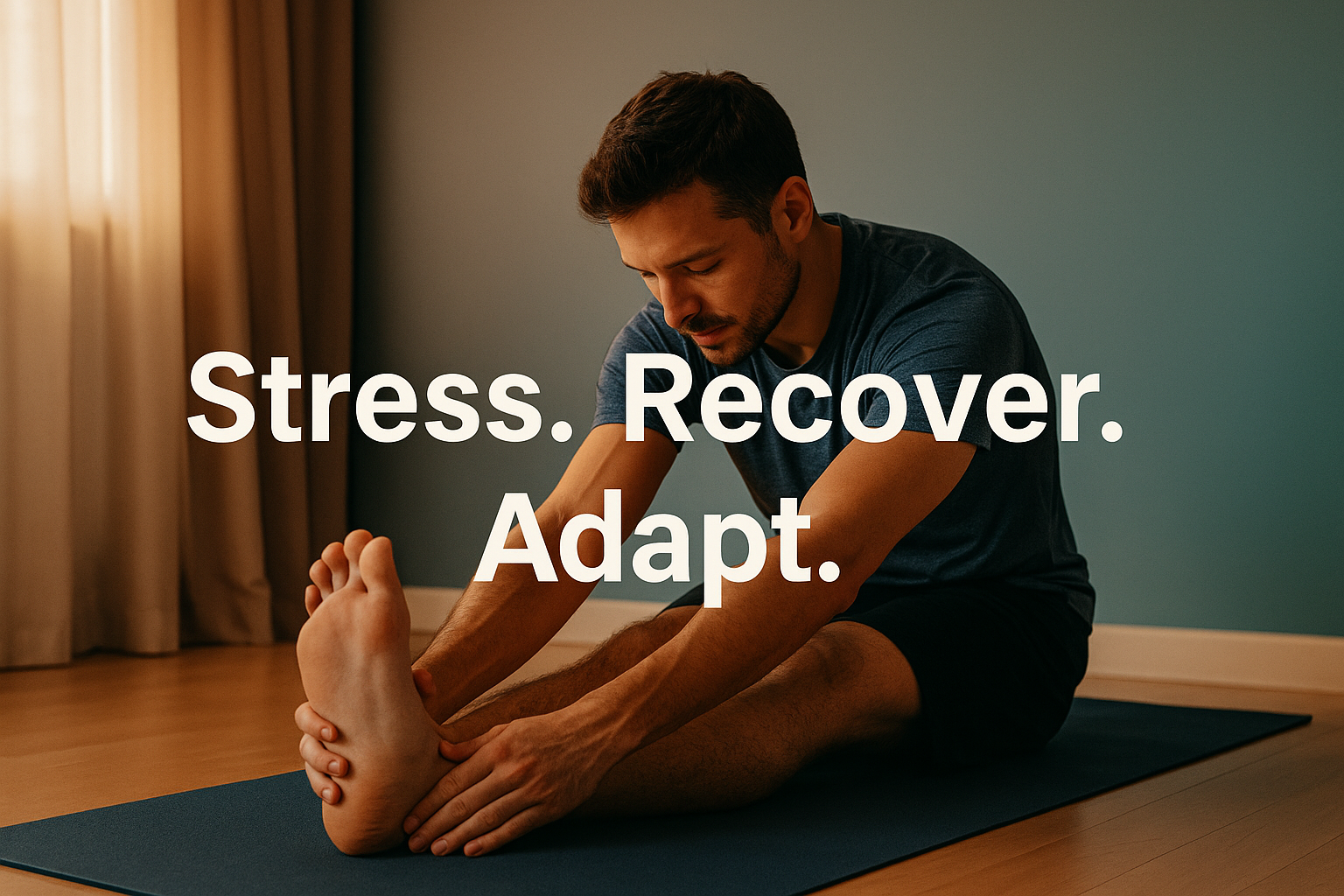
Recovery, Explained: How Your Body Rebuilds After Stress
Your body follows a predictable pattern when recovering from mental stress or physical training. Learn what actually happens during recovery — and how to support each phase to improve performance and resilience.
Stress shapes you. Recovery strengthens you.
Your body is constantly balancing breakdown and rebuild — and with the right inputs, you can turn stress into adaptation rather than exhaustion.
When it comes to stress, recovery, and adaptations the body treats mental and physical stressors in the same fashion with a very similar process. Knowing how this process works not only will help you as you look to make progress, but also pinpoint one of the biggest culprits in leading to plateaus. These stressors can be planned workouts, busy days at work, illness, relationships, or all of them combined and it becomes crucial to account for this when looking at how much you're trying to accomplish and what results are reasonable to expect.
The first step in this process is an immediate response to this stressor that includes things like an increase in heart rate, cortisol and adrenaline rise, mental focus increase, and an increase in blood sugar to provide more energy to meet the increased need. After the stressor has passed the body then shifts into repair mode shifting those resources to stabilize which will include things like a normalization of hormone levels, and repair of any tissue damage. Finally we get into the adaptation phase where muscle strength increases, muscular endurance improves, cognitive resilience increases, and there's a mood improvement all with the goal to better handle the next stressor that comes.
The challenge for many is balancing out the stressors such that this entire process can run from start to finish in an efficient manner. Too strong or too quick of a stressor and the body never finishes the repair mode and as such can't adapt or grow stronger. The repair process can also be delayed by other factors too, such as poor sleep, underfueling, or even relationship stress. Some indicators that you may be stuck in this cycle are consistent muscle soreness or perpetual fatigue. The flip side can also cause problems as too weak of a stressor, or ones spaced too far apart and the body never triggers an adaptation as it doesn't need to.
Unfortunately, there is no one single test that can identify either of these as the exact problem you may be facing in hitting your goals. However, if you find yourself stuck at a plateau or feel like you're just going through the motions, the first place to start would be that honest assessment of your stressors and what actions you're currently taking. If you feel like you're perhaps putting your body under too much stress, look for ways to either reduce some of that or change up your workouts by reducing the duration or intensity. Most workout programs have a built-in de-load period to help the body adjust, but depending on where you're starting from it may take longer than that. If you feel like you're on the other side of the fence, I wouldn't suggest increasing your stress (don't go out purposely to get poor sleep) but look to change up or increase your workout frequency/intensity. With either of these paths, I wouldn't look to change too many things or make a drastic change but start small and evaluate progress.
Stress is unavoidable — but recovery is intentional.
When you understand how your body repairs, resets, and rebuilds, you can train harder, handle stress better, and perform at a higher level.
Support the process. Build resilience. Keep forging forward.
🔗 Subscribe to The Wellness Forge for strategies that help you recover smarter and perform stronger.
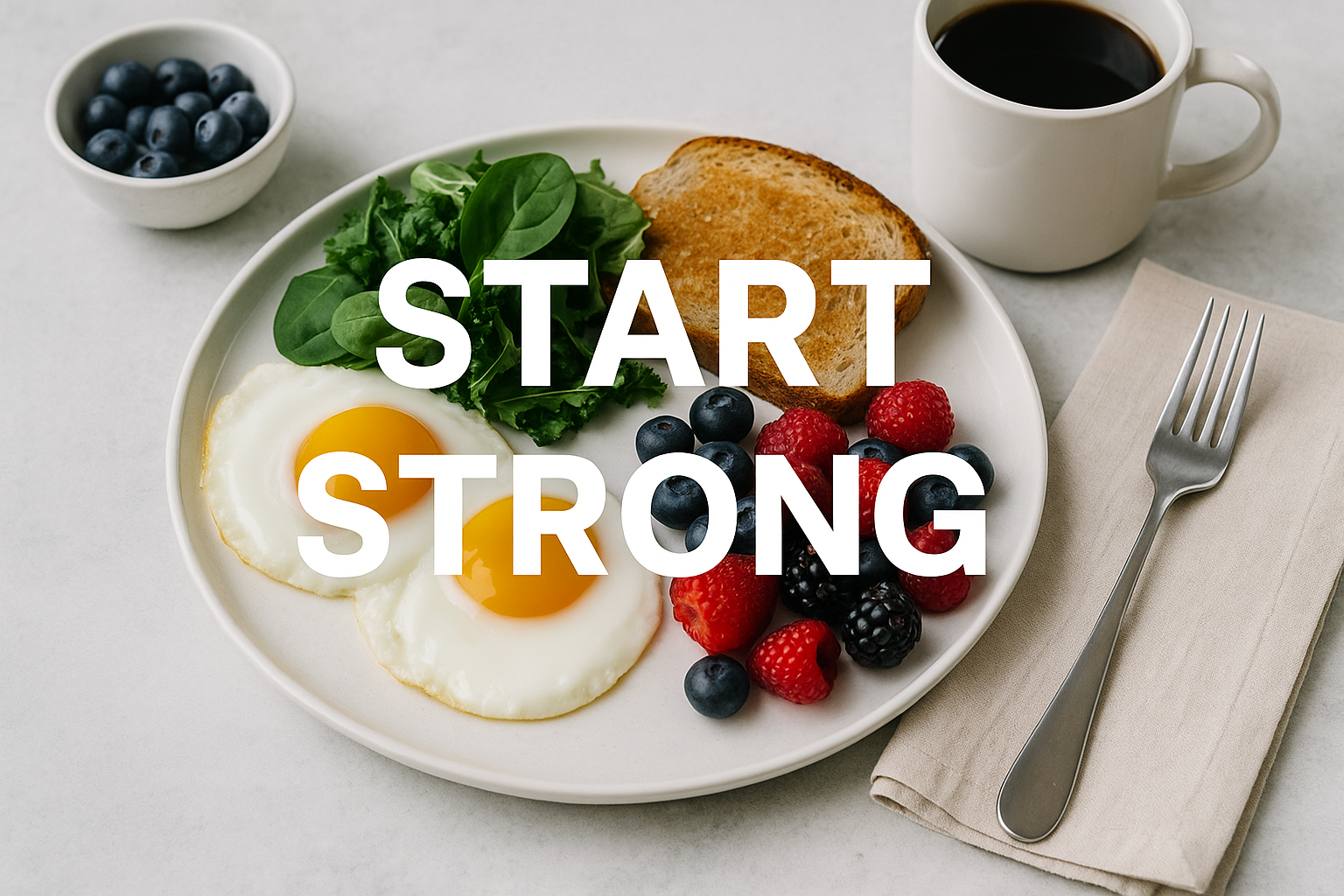
Breakfast: The Why and The What
Breakfast is one of the most powerful tools for stable energy, improved performance, and better appetite regulation. Learn why it matters — and how to build a breakfast that actually fuels your day.
Whether you’re an executive juggling meetings or an athlete in training, your morning fuel sets the tone for the entire day.
Breakfast isn’t just a meal — it’s a performance tool.
Used well, it gives you steady energy, better focus, and stronger training sessions.
For many of my clients, breakfast can be one of the most challenging habits to change and then it can also be one of those most impactful changes they can make. There are lots of explanations I've heard (and used myself) for not eating breakfast but the advantages of breakfast far outweigh any of the other options by a large margin. What I try to walk through with my clients are the benefits of breakfast, and what can we do to gradually work towards a better solution. For those with looking to perform either physically or mentally, or those looking to better manage their weight in a sustainable way, some sort of breakfast is one of the best starting points.
Let's start with the benefits:
Eating breakfast works to stabilize your blood sugar after a natural period of fasting (overnight sleep) which is one of the leading causes not only of fatigue during the day but also cravings.
An early meal helps regulate and promote the normal hormone cycles of cortisol such that it can start to decrease during the day as well as helping to regulate the appetite hormones.
From a practical standpoint, eating an early meal helps with getting not only the proper macro nutrients (primarily protein) but also getting in enough other nutrients from things like fruits and vegetables.
So what should a breakfast look like? Just like every other meal, there should be a good mix of protein, complex carbs, healthy fats, and some color typically coming from fruits or vegetables. Three options that can not only knock out those requirements but are either quick to throw together or can be batch made ahead of time:
A combination of eggs, meat (or tofu), potatoes (or toast), and veggies. This can be done as a scramble, omelette, casserole, or a burrito and each of those present other options for additional flavors and prep times.
An oat mixture is a great bulk option, I use a version of overnight oats that tastes like a chocolate chip cookie and is not only one of my breakfast staples, but my pre-race meal as well.
A shake is another great quick and portable option that allows for the combination of a lot of things, with the taste of the veggies masked by the other items.
If you're starting from not eating anything, maybe think about adding something into your tea or coffee increase calories. Things like protein powder, collagen protein, creatine, and MCT oil are all good options that dissolve well and can either be flavorless or give a nice twist to your beverage of choice.
Each of these options has its advantages and which one is best will vary by the individual, circumstances, and you may even want to rotate through to provide a level of variety. As I've said numerous times, start with understanding of where you currently are and look to make small shifts to make consistent progress.
If you want better energy, stronger workouts, and fewer cravings — don’t skip the foundation.
Build a breakfast that supports your goals and sets the tone for your entire day.
Start strong. Fuel early. Perform better.
🔗 Subscribe to The Wellness Forge for more practical strategies to fuel your body and optimize performance.
How to Measure Progress (Even When the Scale or Stopwatch Won’t Budge)
Progress isn’t linear — and plateaus don’t mean you’re stuck. Learn how to measure progress more effectively and break through plateaus in strength and endurance using simple, sustainable strategies.
Iron sharpens through challenge — not repetition.
Plateaus aren’t roadblocks. They’re invitations to refine your approach, dial in your habits, and train with intention.
Let’s break down how to progress with purpose.
Progress is one of the key metrics we all pay attention to as we train, and we primarily focus on two types of progress - quantitative and qualitative. However, I will admit, for myself and many of my clients, the fixation on the quantitative (numbers/metrics) can be overpowering and dominate the thought process. That's not to say focusing on numbers is a bad thing, for the most part they can be a great metric as they're usually very cut and dry. You either hit that metric/goal or you don't. However, these only tell part of the story and shouldn't be used as the sole metric for gauging progress. You'll want to pair those metrics with some qualitative guides to help you understand HOW you're hitting those numbers. For example, if one of the metrics you're tracking is how much weight you're squatting, it is very easy to keep track of how much weight you load onto the bar (or hold in your hands, or how many body weight squats you're doing). But you'll also want to keep track of qualitative things like how easy/hard those reps feel, how you recover from that workout, how is your range of motions (think squat depth) is improving, and the list goes on from there. Pairing the numbers with the feel gives you a more complete understanding of how you're progressing with your squats, in this example, and a better grasp of when you might actually be hitting a plateau. Many consider plateaus when just the numbers stall, but if you're able to do the same weight but it feels easier, that's not a hard plateau, you're most likely very close to being able to increase the weight.
There are many reasons why you might be hitting an actual plateau where not only are the numbers not moving, but the workouts don't feel any different and they mainly will fall into 3 types:
Too much training or not enough fueling - these essentially get to the same problem, too much training load that the body can't properly recover from and as such never adapts.
Too little training which doesn't challenge the body enough such that it needs to adapt.
The wrong kind of training, an extreme example of this would be doing lots of speed work during your marathon training
So what does it look like to pull out of a plateau, it first starts with understanding IF you're actually in one and then figuring out which of the above three buckets your training falls into. Some of the solutions are simpler to figure out, for example an over training imbalance can be helped with either adding in a de-load week or an increase of calories. Starting with that honest assessment of where you currently are not only with training, but fueling and your other stressors will help narrow down the challenges to work to adjust. My recommendation would be to pick one aspect and make a small change to see if you notice things moving in the right direction, then lean in further. As an example, if you feel your fueling may be off, look to add a small snack, or slightly larger meals, to add around 100-300 calories a day for a week, and see how that impacts not only your training but how you recover and feel. Another option if you're feeling truly stuck, and assuming you don't have a calendar restriction (like a race in 3 weeks), would be to pivot to something completely different for a few weeks. This will provide a radically different stimulus and force your body to respond and adapt.
Sometimes it can be hard to be objective about progress, and it helps to have someone else to observe and discuss your current training. While this is the exact purpose of having a coach or trainer, you can also look to other training partners, friends, relatives, etc to get some feedback on not only the training but how they view your recovery and mentality. This outside viewpoint may be the missing piece in helping crack the plateau challenge.
Plateaus aren’t a dead end — they’re a sign to adjust.
Progress comes from intention, not intensity.
Change the stimulus, fuel well, recover well, and track your trends — and your progress will keep moving forward.
🔗 Subscribe to The Wellness Forge for strategies that build long-term strength, endurance, and resilience.
Why You’re Tired, Craving Sugar, and Plateauing: Underfueling Explained
Underfueling is one of the most common — and most overlooked — reasons people feel tired, unfocused, and stuck. Learn how to identify it and build simple fueling habits that support energy, strength, and performance.
If you’re tired, unfocused, craving sugar by mid-afternoon, or feeling flat during workouts, there’s a good chance your problem isn’t discipline — it’s underfueling.
High performers burn more energy than they think. And most of them aren’t eating nearly enough to support the pace they’re trying to maintain.
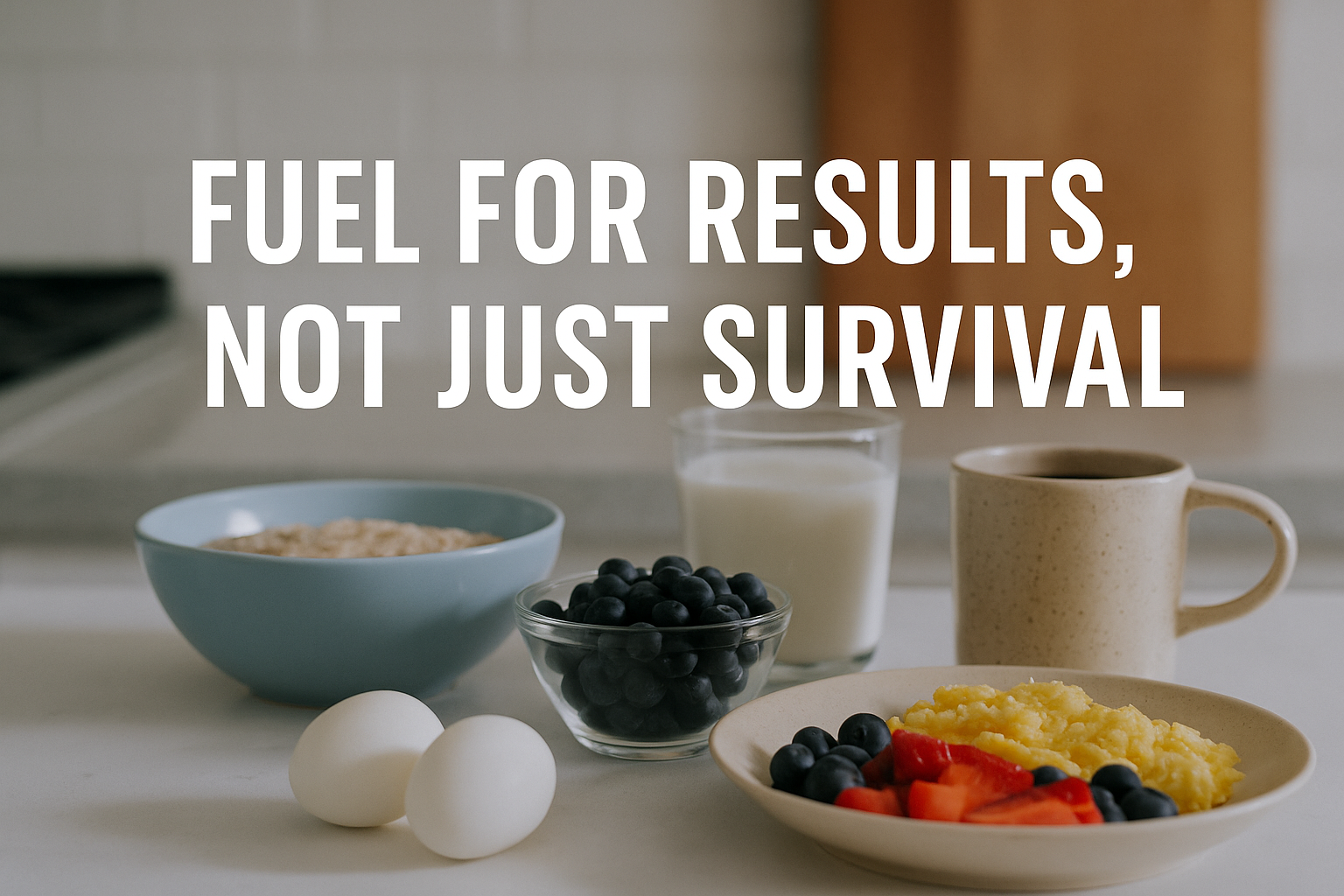
One of the sneakiest ways I see many of my clients run into roadblocks with their progress boils down to a matter of underfueling, which can eating too little, fueling incorrectly, or not balancing fuel for the demands put on the body - or for a combination of all three. In many cases these aren't conscious decisions being made, or they're decisions that seem correct but lack context, and as such correcting them can be challenging. It takes a little more digging to not only identify the issue but also recognize how simple the solution might be.
Underfueling is one of those concepts that sounds simple and yet in practice is complicated enough that it goes unnoticed. The main idea is that you're not providing enough quality fuel for you body to perform the tasks that you're asking it to. The body is also very good at adapting and compensating for these deficiencies, but can only do so for a period of time before it becomes overwhelmed. A couple of the main culprits are caffeine and fiber as while they are beneficial in many ways, they also will dull or mask hunger queues such that skipping meals entirely or not fueling enough becomes not only easy but can become consistent. The first part of the challenge is underestimating the caloric needs of the body, some like basic daily needs (Basal Metabolic Rate or BMR) and training load are relatively straightforward to get a good estimate as there are calculators and wearables to help. However, these can also be wildly inaccurate, especially when estimating caloric needs based on exercise. In addition, other factors such as poor sleep, mental stress load, travel, and injuries will all skew your fueling needs and not always in magnitudes or directions as you might expect. Based on all these factors, it can be hard to get a handle on the caloric needs and even being off a couple hundred calories a day can create a sizeable enough gap to cause challenges.
So what does underfueling look like, or what are some of the symptoms you might notice? First off, physically you may notice:
Low energy or consistent fatigue
Inability to concentrate or brain fog
Frequent illness
Poor sleep
The symptoms don't stop there, you will also notice struggles mentally as well:
Irritability or mood swings
Decreased libido
CRAVINGS
night time snacking
And then to further compound all of this, you'll notice some performance and metrics dip as well:
Workouts feeling harder than normal
Heart rate variability (HRV) dips
Higher than normal resting heart rate
With all of this, it may seem daunting to overcome this challenge - however, the first step is quite simple, remember simple doesn't always mean easy. I've mentioned this before, and will continue to suggest it - but awareness is your greatest asset for this kind of situation. And that comes down to:
Understanding your body's needs including not just calories but the allocation of those calories between carbohydrates, protein, and fat.
A good handle on your intake and timing of your fueling including the macro breakdown.
A honest self assessment of how you feel on a daily basis such that you can better understand where you may be lacking.
Another option you could consider, if you feel like you're experiencing a number of the symptoms, would be to increase your caloric intake by 200 to 500 calories, paying attention to how you feel. This could come from the addition of a snack, or if there's a particular meal (like breakfast) you typically skip, add that back in. Do this for a week or so, and see if you notice any differences. This is also a time when using a scale can be helpful to notice if you're gaining any weight, but with the increases I'm suggesting it would probably take a couple of weeks before you noticed anything significant considering the normal day to day weight fluctuations. Continue to balance how you feel with the numbers you're seeing on the scale and look to continue to increase the calories without seeing a consistent weight increase. I typically recommend increasing for a couple of weeks, then taking a week to hold steady to help accurately assess the dynamics.
Travel, busy seasons, and packed schedules make underfueling even more common. But they don’t have to derail your performance.
Learn how to fuel consistently no matter where life takes you — and build the foundation that drives your energy all year long.
🔗 Subscribe to The Wellness Forge for more tools to support strength, energy, and recovery.
The Most Underrated Performance Tool: Sleep
Sleep isn’t just rest—it’s recovery. From sharper focus to faster training gains, even small improvements in sleep can fuel measurable performance benefits. Here’s how to sleep smarter.
Sleep is the highest ROI habit in health.
One extra hour can boost focus, regulate hormones, and even improve training outcomes.
Here’s how to start improving your sleep tonight — and what happens when you don’t.
Most people I work with have an understanding or a desire to improve either their sleep quality or the amount of sleep they get, but struggle to effectively make a change. Like I mentioned in my previous post on Nutrition, awareness is the key first step. Start a sleep log - paper, electronic, or via an app, doesn't matter at this stage, and start to look for trends to target. But, something you can start tonight that will make a difference and build towards better sleep hygiene - before you try to go to sleep, take 5 minutes for the following:
Put your phone/tablet/laptop down for the night
Focus on your breathing, taking deep controlled breaths
Reflect on your day, focus on the good things of the day to help calm the nervous system and relax
Think about 1 thing you want to do tomorrow. This isn't about creating your to-do list, or run through your calendar, but 1 tangible thing you want to do better tomorrow. Maybe this is walking more during the day, taking the stairs, drinking more water, picking fruit for a snack and not the candy, or whatever small tangible step seems plausible to accomplish. And then check in on your progress with that the next night.
What does this 5 minutes get you? It starts you on the path to establishing a night time ritual that you can build on that doesn't have to be overly complex. It simply needs to be a series of things you do (ideally around the same time each night) that helps you signal your body that it is time to sleep. As you progress on the journey towards better sleep, there are lots of other things you can look to change, but for now, start small and build momentum. Another simple (not necessarily easy though) step to take that you can implement immediately, start reframing sleep from something you need to do to prevent the negative impacts, towards an attitude that embraces the restorative and supercharging benefits more productive sleep provides.
I know many live by the "I'll sleep when I'm dead" mantra, and I lived that way for a while too, but at some point that lack of sleep will come back around. Lack of sleep is one of the biggest stressors you can subject your body to, so it will dramatically limit your ability to perform as well as fight off any illnesses or injuries. The mental impact sometimes is hard to recognize as so often we've gotten used to the feelings and don't really appreciate it until we start getting CONSISTENT good sleep. Also it is hard to compare the impact on our body as there isn't a great way to quantitatively compare what it could be if we were getting better sleep. Some wearables can help address this and provide some insights, I personally have been using Whoop for almost 5 years now and have a pretty good feel how impactful sleep is on my mental and physical performance. However, there are numerous studies that look at exactly that - the dramatic impacts poor sleep has on your mental performance and capacity, as well as your physical performance. Physically it is even more damaging as the lack of sleep not only diminishes your performance but it will also prevent you from absorbing the same amount of your training such that you see reduced gains from your daily (or however frequently you work out) efforts. I could go on talking about the negative aspects, but honestly that list is VERY long!
Not only will you see the opposite of the above problems when you start getting consistently solid sleep, but you will also start to notice long term trends as well. The big health metrics - things like body fat percentage, blood pressure, and metabolism will all trend better as you work on your sleep quality. This is not only due to the short term impacts, but while we sleep the body has the opportunity to recover and repair itself. This recovery and repairing then compounds with your training load to create a very powerful healthy stress, recover, and adapt cycle that allows your brain and body to best leverage the hard work you're doing.
To summarize the last two paragraphs simply - progressing towards healthier sleep is the single best way to supercharge your tomorrow. It is one of the harder changes to make, but the benefits can be life changing.
Sleep is the foundation — not the reward — for your hard work.
You don’t earn it after performing; you build everything from it.
Small changes tonight can create measurable improvements in your energy, focus, and recovery tomorrow.
💡 Subscribe to The Wellness Forge for more practical, evidence-based strategies to perform better, recover faster, and live stronger.
You Can’t Outperform Stress — But You Can Learn to Recover From It
Every athlete, executive, and high performer faces stress — the difference lies in how they recover.
You can’t grind your way out of chronic stress.
Recovery isn’t weakness — it’s the process that makes progress possible.
Here’s how to manage stress better and optimize recovery 👇
Even iron needs time to cool before it can be forged again.
Your body and mind are no different.
Today, we’ll explore the balance between stress and recovery — and how to strengthen both.
Stress is a part of all of our lives and what complicates the challenge is that stress is required for the exact kind of healthy adaptations we all strive for, that's the good stress. Most people think of stress as a bad thing, and in many cases it is, but the majority of stress actually has a positive impact on the body. Where stress becomes a problem is when there is too much of it for the body to handle, the classic too much of a good thing problem. Let's start with something you can implement today that will have an immediate impact on how your body handles stress. Like I've mentioned before, awareness is where I start with all my clients - but I'll admit, that process takes time (a few days) so today take at least one 5 minute break during the day to pause, reset, and get ready to tackle the next task. Maybe even take part of that 5 minutes to practice awareness of your stressors.
Taking a deeper look at stress, it typically can be divided into 6 buckets:
Physical - exercise or injury would be examples.
Mental - think learning tasks or prepping for a meeting.
Environmental - outside noise, pollution, temperature, and allergens fall into this bucket.
Emotional - general mood and happiness
Existential - why are we here and what is our purpose?
Relation - friends, family, and coworkers would fall here.
Inside of these buckets there are good stressors and bad ones, which are usually rather obvious, but there are some good stressors that can become bad if done at the wrong time or at too high of an intensity. For example, strength training when done appropriately is a great form of exercise. However, lifting too hard for what your body can handle that day will most likely lead to soreness and potential injury with long term impacts if consistently overused. This is where that self awareness comes into play, having a feel for your body and knowing when it is a day to push, when to pull back, and understanding that when you have to over-reach because of a deadline or race, you will need extra recovery on the other side. Using wearables can be a help in this area to monitor the body's response to stress and help give some quantitative measurements on things like Heart Rate Variability and Resting Heart Rate which are both good indicators of overall stress and how primed your body is to handle more. The best approach is a mixture of the numbers and the knowledge of your body to form that complete picture.
What does recovery look like then from all these different kind of stressors? As you've probably guessed, that first step in a awareness or audit of your primary stressors and then looking for ways to handle them. Some may have immediate simple solutions, for example an air filter in your office to help remove allergens and other contaminates if that's an area you struggle with. Others are more complicated and 100% might require some outside assistance to help work towards resolving. And some are constant parts of life and need continual work to manage. Inside each of those stress buckets are also recovery techniques that you can apply, here are some examples:
Physical - sleep, stretching, low intensity exercise
Mental - reading, preparation, planning
Environmental - air filters, blankets for warmth, air conditioning
Emotional - honest communication, mental exercises such as reframing
Existential - prayer or meditation
Relation - that supportive friend or family member
This isn't to say that the best way to recover from a stressor in one area is recovery in that same area, sometimes it is, sometimes it isn't. You've probably noticed that you have great ideas when taking a long hot shower - that physical recovery technique can not only relive physical stress, but open you up to recovering from pretty much all the other types of stress too. You will notice over time, what recovery techniques work for you and which ones work best for specific stressors you face. My two most consistent tools I use for recovery are my sauna blanket and reaching out to friends and/or family. These 2 not only hit multiple buckets but also are examples of a daily routine and a more tactical tool to handle the stress spikes we all go through. The way to become adept at managing your stress is to develop a full tool chest of recovery options that you know work for you, can be pulled out when needed, and used as backups when your first choice doesn't yield the results you're looking for.
Stress isn’t the enemy — it’s the signal. Recovery is the response.
You can’t eliminate stress, but you can build systems that help you handle it better and bounce back stronger.
🔗 Subscribe to The Wellness Forge for more actionable tools to help you perform, recover, and thrive — without burning out.