Micro-Recovery: Small Actions That Drive Big Performance Gains
Micro-recovery is about small, intentional actions that help your body and mind reset throughout the day. Learn simple tactics you can use anywhere to improve energy, focus, and recovery.
Most people think recovery requires time they don’t have.
In reality, recovery works best when it happens in small doses, often.
These micro-recovery habits can change how you feel, train, and perform — without adding anything to your calendar.
While looking at some of the big movers for recovery, things like nutrition and sleep, there's also lots to be gained from thinking small when it comes to recovery. And by small, I mean short periods of dedicated time that can have outsized benefits in both physical and mental recovery. As with other topics, I wouldn't suggest trying to implement ALL of these, but pick one or two and see if they help. Don't panic if something doesn't work for you, pick something else and keep trying. Once you find something that works, keep it consistent and try to make it part of your normal routines.
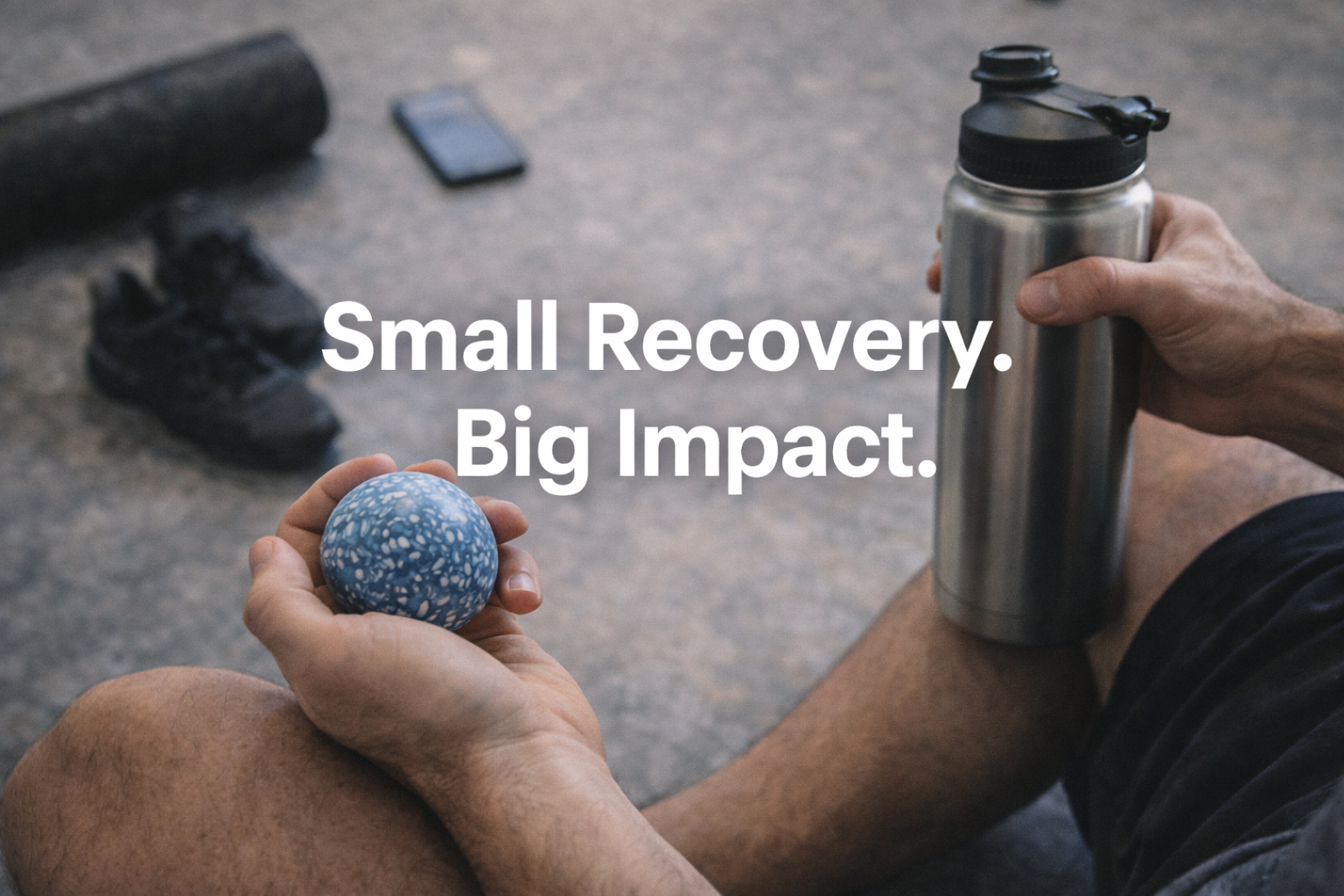
Let's start with some that are more physical in nature, with probably the simplest and lowest barrier to entry being a short walk - even just a couple of minutes provides not only muscular benefits, improves digestion, but it can be a nice mental break as well. Also in this bucket would be some sort of mobility work focusing on whatever joints or muscles that may be nagging you, either while sitting by moving through the joints' full range of motion, or coupled with a walk and making it a bit more of a dynamic stretch. Maybe even incorporate some sort of recovery tool in this process, foam rollers may be tougher in the office, but massage guns or a lacrosse ball work wonders and can travel pretty easily. The last one I'll touch on in this article would be to have some sort of a snack, sometimes the best way to break up your day is the injection of a little energy. This snack doesn't have to be large but something that can not only distract you physically (and mentally) but also provide a nice energy boost.
The other aspect of these little recovery breaks are ones that I'll put into more of a mental space or requiring little physical movement. A couple of examples of these kinds of breaks would be:
Breathing resets - think deep breaths, either structured or just a pause
Giving your eyes a rest - look away from screens, or close your eyes for a period (don't try this while driving!)
Another idea to consider in this area would be ways to shift your environment to reduce or shift the stressors in some way:
Wearing Blue light blocking glasses
Noise generator - white noise works for many, but there are different options that work better for some
Background music
If you're looking for a plan to implement a break or two into your day, pay attention to your energy levels during the day and see if you notice a period (or two) where you struggle. That's the time you'll want to apply one of these techniques, and try the same one for a couple days to see if you notice a benefit. This is also a case where having some sort of logging or journal routine will come in handy to not only find those lulls, but see what works and what doesn't. I personally use the journal function in the Whoop app to help with these kinds of trials and shoot for a handful of days with the routine and without to have a somewhat decent comparison. The actual tool used doesn't really matter, it is the process of adding that recovery tactic and monitoring how (if) it impacts your body and mentality.
Recovery doesn’t need to be dramatic to be effective.
Small, consistent recovery habits protect your energy, sharpen focus, and keep performance sustainable — especially on busy days.
Start small. Repeat often. Let recovery work with you.
🔗 Subscribe to The Wellness Forge for practical strategies that help you train, work, and live stronger — without burnout.
Ergonomics for Recovery: Setting Up a Standing Desk to Reduce Pain and Prevent Flare-Ups
I didn’t add a standing desk because I wanted to “biohack” my workday—I added it because I was tired of feeling worse the longer I sat. During my own injury recovery, the biggest shift wasn’t standing all day; it was having the ability to change positions whenever symptoms started creeping in. In this post, I share what helped (and what didn’t), how I used sit-stand intervals as “active recovery,” and the key ergonomic and movement cues that made my desk setup part of the comeback—not part of the problem.
As I discussed last week, there are lots of benefits to a standing desk but I wanted to get a little more personal on how it has helped me during this past year. As a Health Coach, I spend most of my time working with my clients to help them realize how some of their habits and environments are not set up for their success, but I will admit it isn't always easy for me to do that same thing for myself. Over this past year, I've suffered two significant injuries that have not only derailed my training but have also had a massive impact on my quality of life. Based on these two injuries, I have looked into things I could put into practice during my daily life to not only help heal those injuries but better recover from my training and life activities. I do find myself sitting for a good portion of the day, not only at my desk, but also in my car as I drive quite a bit for clients. I have made some changes in the car, but those are more complicated and not quite as significant, and with both of these being hip injuries (both sides) I wanted to make changes not only in my posture but my overall workspace.
I've had my current workspace for over 6 years now, and while it mostly worked I noticed it was starting to lead to more aches and pains if I sat for too long. It also didn't have much flexibility in movement as managing all of the cables became unwieldy. I had tried a couple of half measures to piece together a standing option but with the system being manual, it was clunky and often created more problems than it solved. I then looked into the UPLIFT Desk and realized this could solve multiple problems and provide a badly needed refresh of my workspace.
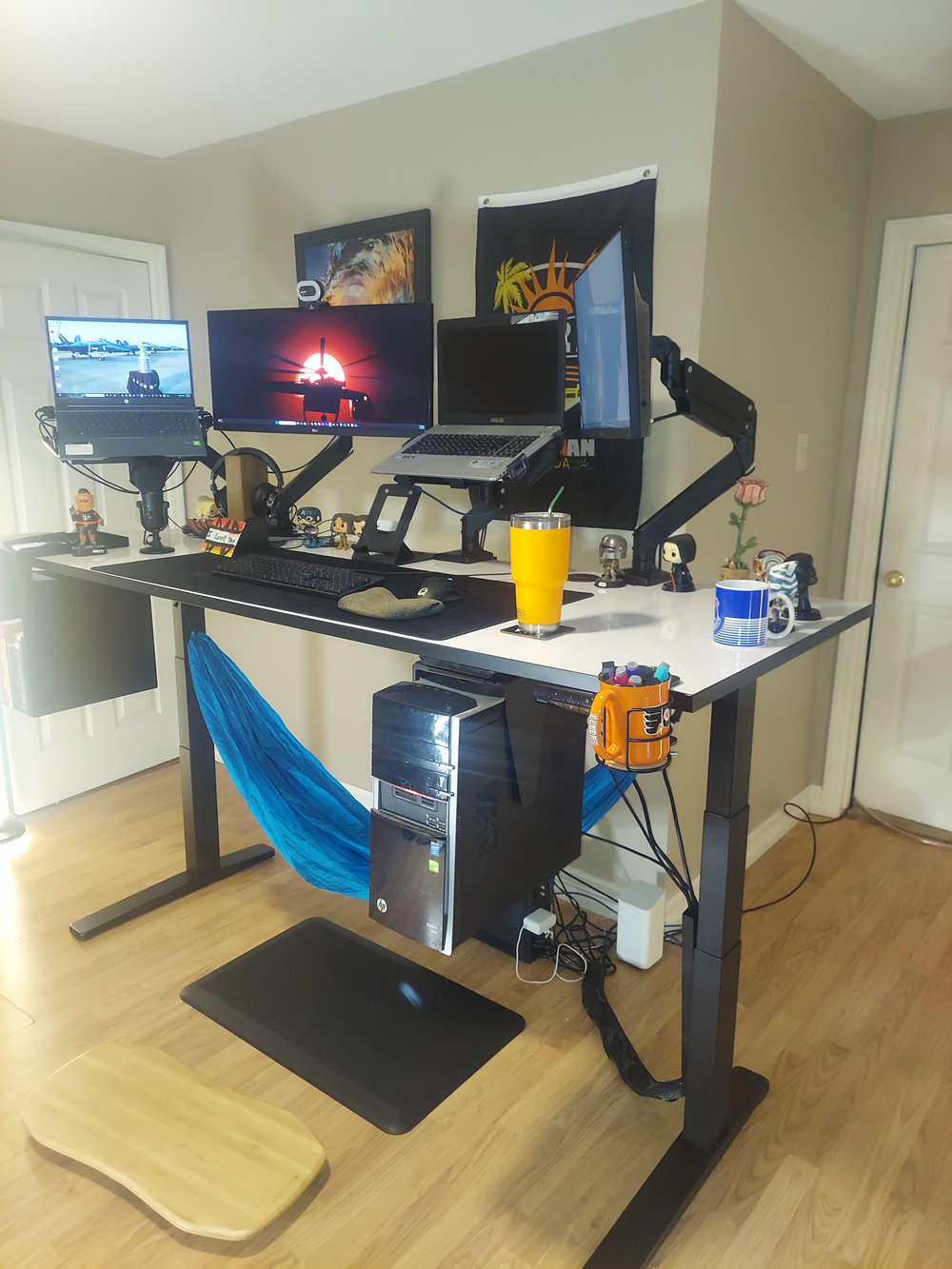
When configuring my new UPLIFT v3 Standing Desk workspace, the primary requirement for me was the simple process of converting from sitting to standing, with the capabilities to provide the peace of mind with the UPLIFT Desk FlexMount Cable Manager system so that I wouldn't have to worry about any of my cords or cables or make a series of adjustments once that transition is made. Over the years, I've realized if there's any hesitation that I'll cut a cord, or yank something off the table, I won't bother with standing at all. The UPLIFT Desk provides numerous different ways to bundle, hide, and route all of the cables (and yes I have LOTS of them) to the places they need to go, maintain their functionality, and most importantly work exactly the same sitting and standing.
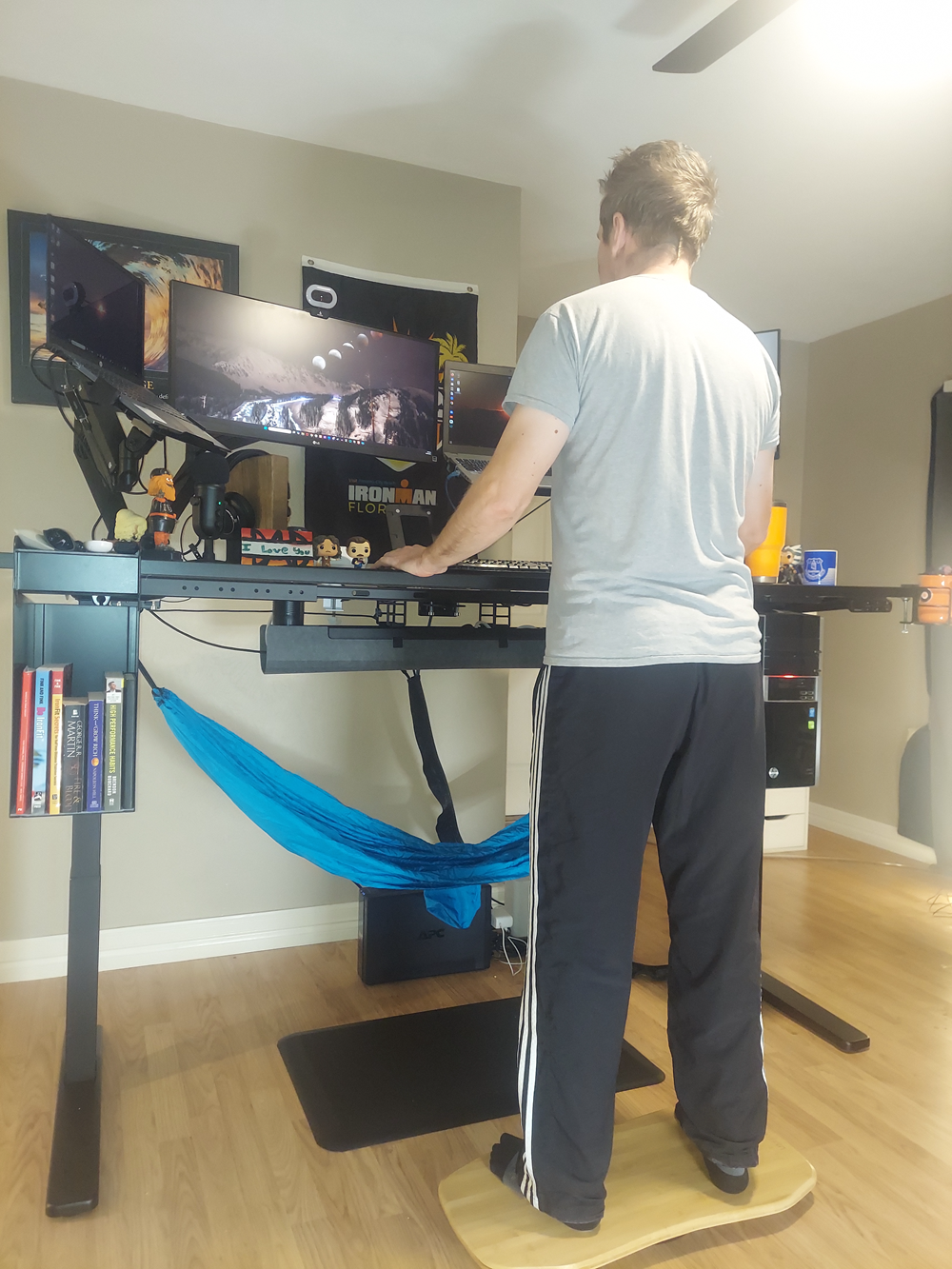
Another key component with my success with this new workstation has been the comfort while standing, having multiple options has been key. There are days when I want that cushy pad underneath my feet to provide that extra level of comfort. Then there are days where I want a little challenge, that's where the Motion X-Board comes in as it provides just enough instability to keep me mentally alert but also enough movement to help my ankles, knees, and most importantly (for me) my hips. Not only have these options allowed me to extend the time I spend standing, but also provide movement when I need it. This movement and changing of positions increases the amount of blood flowing through the legs and in general keeps the body in a more neutral position which promotes recovery.
The other key component for me of a successful workstation, is the aesthetics of it - or the looks. This isn't just the design of the desk and the material options, but the ability to keep it clean, organized, functional, and still a little fun! Being able to lift my monitors and computers off the desk clears up the entire workspace for not only utility, but allows me to display some of the other fun items in my collection. And since the entire workspace moves, I don't have to do any re-organizing when I stand or sit. Speaking of fun, another option that I initially thought was silly was the concept of having a hammock as part of my desk. But now that I have it, I love it - and not necessarily for the reasons you might think. Sure it is comfortable and fun, but it actually does help me stay more productive, let me explain. As someone who works from home (and have for the better part of 20 years) I can always find distractions if I want to (and yes, distractions are also in the office too) but on the days when I want to stretch out a little bit the hammock provides a great option that still keeps me physically in the office. I can use that time to quickly recharge and not end up on the couch where I might end up accidentally watching an entire season of Stranger Things!
All of these features and options, especially the UPLIFT Desk’s ergonomic benefits, have enabled me to successfully rehab from my injuries and build healthier more sustainable habits that should help to keep me more injury free going forward.
If you’re dealing with nagging pain or coming back from injury, think of your desk as part of your rehab plan. The goal isn’t to stand all day—it’s to create more movement opportunities and reduce time spent in the positions that provoke symptoms. Start with 10–20 minute standing blocks a couple times a day, keep your posture relaxed, and use the desk transition as a cue to reset: a few breaths, a quick walk, a gentle stretch. Want the easiest way to build that routine into your day? Explore UPLIFT Desk and set up a sit-stand station that makes consistency automatic.
If you choose to purchase through this link, I will earn an affiliate commission on that purchase - feel free to use that link or share it with others as a way to support what I do
Less Sitting, More Moving: Standing Desks, Mobility Breaks, and Everyday Comfort
Stiff hips, tight backs, and that “creaky by 5pm” feeling usually aren’t a motivation problem—they’re a positioning problem. A standing desk doesn’t magically fix mobility, but it does make it easier to change positions, move more often, and build quick “micro-breaks” into your day. This article breaks down the real mobility benefits of a sit-stand setup, how to alternate sitting and standing without fatigue, and simple movement resets you can do in under a minute to feel better during (and after) the workday.
As we start off the new year, many of us are looking for ways to improve our health, and as a Health Coach one of the main things I look for are those minor changes in a clients' lives that can stacked or progressed to accomplish a much larger change. One of those aspects I look for is movement as it has become far too easy for us to sit (or lay) in one position for far too long. I always look to incorporate small changes that can add a little movement, but that small change is then repeated multiple times throughout the day. There are many examples of this, choosing the further bathroom, walking the stairs and not using the elevator, parking further away, and so on, but another great one comes from the desk that we spend a good portion of our day behind. If we can switch that to an UPLIFT Standing Desk, even for a portion of a day, that change of position and posture plus the natural shifts and sways that will happen will naturally result in more movement during the day. Not to mention that we've now included at least two more squats during the day, which do add up.
First let's talk a bit about some of the challenges that come from sitting for long periods of time during the day. Even if you have perfect sitting posture, most of us don't, there is only so much movement you can encourage while sitting and that lack of movement not only creates stiffness but it also reduces blood flow. That stiffness and reduced blood flow makes moving even harder and creates that reinforcing circle that feeds on itself making you less likely to move. Poor posture combined with that reduced blood flow over time will reduce overall range of movement in your joints and as your body gets more used to sitting it will reduce resources sent to your leg muscles as they are spending large portions of the day resting. Yes you can (and should) strength train, but sitting for long periods makes those gains in the gym even harder to accomplish.
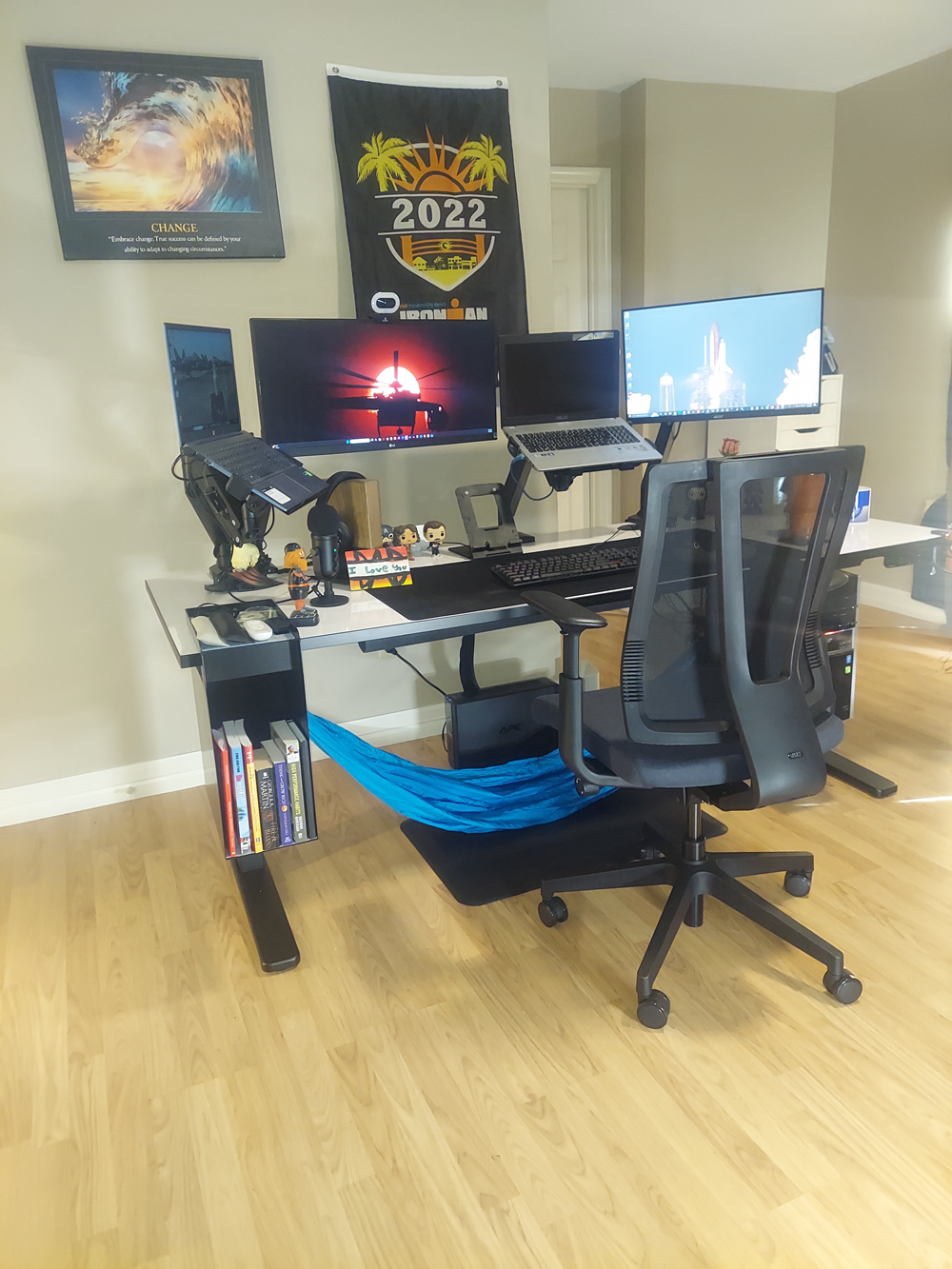
My UPLIFT Desk in the sitting configuation
One of the advantages of something like the UPLIFT Desk is that standing encourages your body to operate in a healthier fashion. First off, while it won't fix your posture, you're more likely to be in a neutral posture standing then most are when they're sitting. This posture shift not only promotes more blood flow but it removes so many of those sticking points that we sometimes find ourselves in while sitting. Also while standing there are many more opportunities even for subtle movements like shifting of weight, swaying, and small steps taken will all add up to increase your daily step count but a healthier working body overall. Standing requires your leg muscles to be activated and that will reinforce the work you're doing in the gym to help build and maintain strength. Having a standing option at your desk also promotes more movement as it presents more options.
When looking at standing options, a big component to consider is the ease at which you can switch from sitting to standing. I've tried a number of other options over the years, but one of the reasons I went with the UPLIFT Desk was the superior cable management options that can cause significant challenges if not handled properly. Also of consideration should be the ability to keep the workspace clean but also function in a similar fashion standing as it does while sitting. If you need to do a bunch of different things or use the space differently in different configurations, it becomes more of a hassle and as such you naturally won't leverage the options as frequently.
If you're looking to make a change in your workstation, I do recommend an audit of your current space, workflow, and current habits to make sure you account for as much as possible. While it may seem like a "nice to have" using mounting arms to lift and position monitors and laptops definitely is worth any extra fee they might come with. Not only does this free up your workspace but it also allows you to set it up in a way that reinforces proper posture. It is also important to look at the cable management options, something the UPLIFT Desk excels at, such that you can not only make it aesthetically pleasing, but also fully functional while both sitting and standing, without having any adjustments needed.
Mobility isn’t something you earn in one long stretching session—it’s something you build through frequent, low-effort movement. A standing desk turns everyday work into more opportunities to change angles, open up the hips, and keep the spine from locking into the same position for hours. Use the raise/lower button as your cue for a quick reset: a few breaths, a calf stretch, a hip hinge, or a 30-second walk. Want an easy way to bake that routine into your workday? Explore UPLIFT Desk and set up a sit-stand station that makes movement breaks automatic.
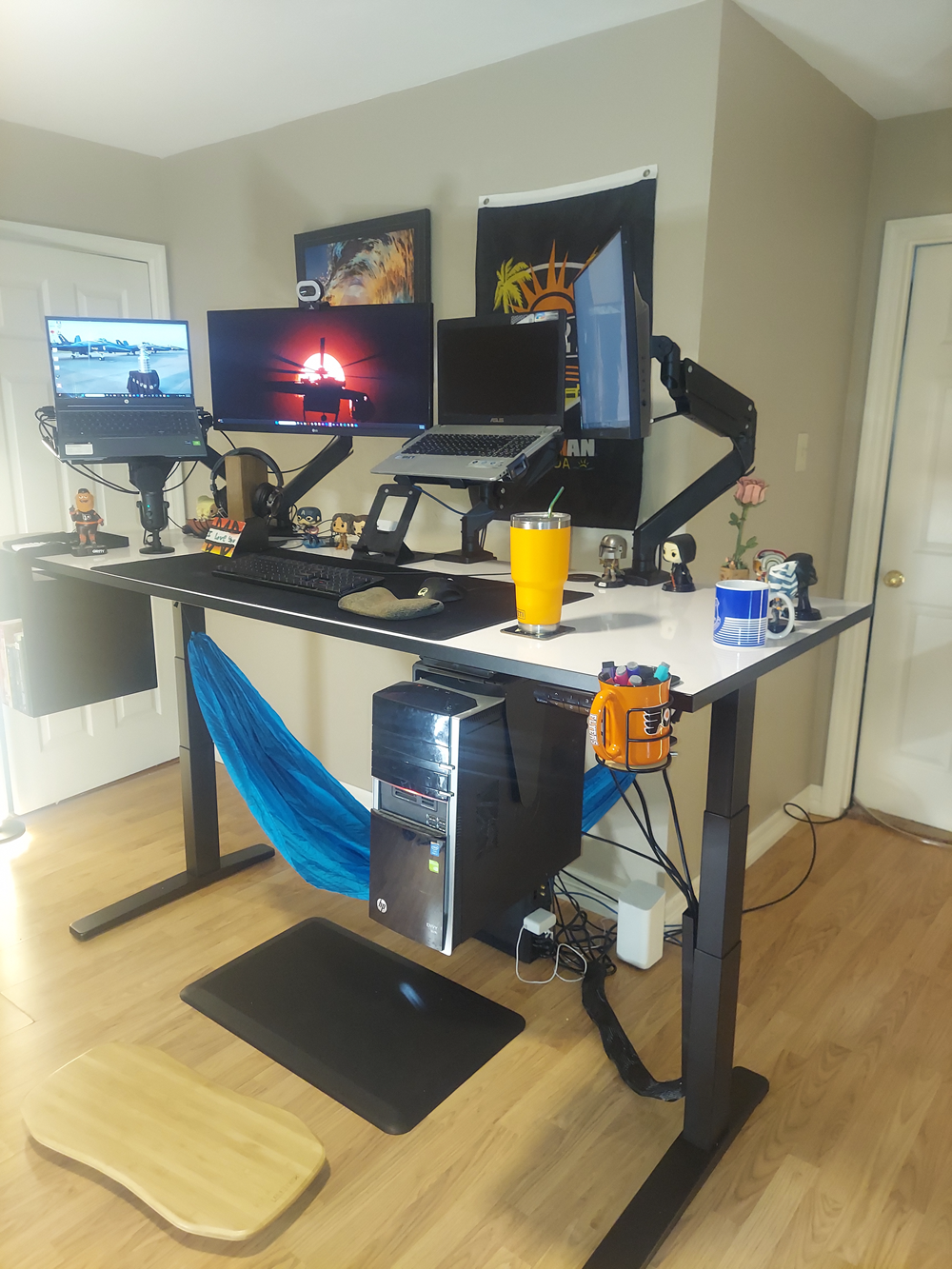
My UPLIFT Desk in the standing configuration.
If you choose to purchase through this link, I will earn an affiliate commission on that purchase - feel free to use that link or share it with others as a way to support what I do.
Why Energy Matters More Than Time
High performers don’t run on constant intensity. Learn how to manage daily and weekly energy cycles to improve focus, recovery, and long-term performance.
Some days everything clicks. Other days, it feels like you’re dragging uphill.
That’s not a motivation problem — it’s biology.
When you learn to work with your energy patterns instead of fighting them, performance becomes far more sustainable.
When I look back at this past year one of my more successful changes I made was a shift in my schedule and leaning into my energy fluctuations. This allowed me to be more present for the aspects of my life I wanted to, excel when I needed to, enjoy my days more, and feel more rested - despite failing to get as much sleep as I'd want (and probably need). For me this comprised of a few small but specific changes:
Loaded up my mornings
Built in an early afternoon down time
Protected my Friday evenings such that they became my recharge time.
Shifted my workouts as needed when life necessitated it
Now I realize, not all of this will work for everyone and we all will approach this differently (as we should) but the process I went through to make these changes can work for everyone. And as we look forward to a new year, it is a great opportunity to make schedule shifts.
I started this process by recognizing what my daily energy shifts looked like and when I typically feel most energetic as well as where my lulls are. Some of this I was mostly aware of, but keeping track for a couple weeks really helped prove it to myself. Allowing for some variance week to week helps to make sure it is a real pattern and not just a one off. Not all of this is completely within our control based on work or kids so this process won't be perfect, however we can look to make progress towards a better solution. I then made a shift in my mornings since I've always been a morning person, it seemed logical to me to lean into that such that the bulk of my daily work (and workouts) were done before noon. This shift then created a gap in my early afternoon that I began to relish as an opportunity to refuel, refresh, and take some time to orient the rest of my day. Those two pieces came together rather seamlessly and in conjunction, but the Friday one took longer for me to finally acknowledge as it more or less came out of necessity. At the end of the week, Sunday is the start of my work/exercise week, I was crashing pretty hard and early in the evening. That still opened up Saturday evenings if I wanted to, but allowing Friday to be a "down" evening really helped anchor my week giving my brain and body an opportunity to recover.
While there are some differences between individuals (primarily whether you're a morning person or night-owl) the general biology and trends are consistent. Mornings are associated with a higher cortisol level which helps with mental focus and physical performance. There's a natural dip at some point "mid-day" that's a function of hormone shifts, blood sugar, and stress load. And then in the evenings the shift is toward winding down the day towards recovery. Now the magnitude of the variations aren't consistent from person to person and of course can be "controlled" to some degree by willpower and caffeine. However, understanding these variations allows you to work with your day not against it and save the coffee powered sessions for when you really need it.
So what are some of the signs that a schedule shift might be helpful?
Living on caffeine
Poor sleep, especially when feeling exhausted
Emotional swings
Forcing workouts when tired
Consistent lack of focus
There are more, but these are the key ones to look for and for me caffeine was the biggest flag that suggested I should think about a shift. I could tell that what I was doing, while working, wasn't something I could realistically sustain indefinitely, and most likely would create a problem down the road. This is where having some level of awareness and data tracking comes in handy (or a coach) to help spot these trends and allow you to do some experiments on yourself to see what moves the needle in the desired direction. I'm excited to see what I can accomplish this next year based on the continuation of this adjustment process!
Energy isn’t something to dominate — it’s something to manage.
When you learn to roll with daily and weekly trends, performance becomes more consistent, recovery improves, and burnout fades.
High performance isn’t about doing more — it’s about doing the right things at the right time.
🔗 Subscribe to The Wellness Forge for practical strategies to manage energy, reduce stress, and perform at your best.
Track Your Progress — Without Letting the Data Run Your Life
Wearables and tracking tools can dramatically improve your progress — but only if you avoid obsessing over the wrong metrics. Learn what to track, what to ignore, and how to build a healthy, balanced relationship with data.
You don’t forge better performance by chasing perfect numbers.
You forge it by combining objective data with subjective awareness — using both to make better decisions, one day at a time.
Data pertaining to our health and wellness has never been more in-depth or more available than it is today with the digitization of medical records, more control given to individuals, and the boom of apps and wearables. This data can be incredibly useful to track things like performance, recovery, progress, and spot trends or illnesses early enough to act before they get out of hand. However, that amount of data sometimes become overwhelming, and it can also become easy to get wrapped up in individual metrics and miss the bigger picture.
There ae some pieces of data that are rathe straightforward and can combined with objective data to make them even more powerful indicators. For example, the weight you can squat is a good strength metric, but when you combine that with level of effort you now have a gauge for how well you're performing at that weight on that given day. As you progress lifting with that same weight, it will feel easier, and that ease (in this example) is an indication of when you're ready to progress and increase the weight. Another example would be from your blood work (something everyone should do at least a couple times a year) vitamin levels compared with the optimal levels for that nutrient helps guide towards potential supplementation, with repeat tests helping to understand absorption.
Where this process can lead to challenges is when focus is put on any one signal number with the exclusion of any subjective correlation. For example, many wearables provide some metric that represents how ready you are for the next day. And while that information usually combines a number of different pieces of information (heart rate, heart rate variability, previous days activates, sleep, etc.) it is only a snapshot of those metrics and even ignoring any potential inaccuracies, that is only one snapshot in time such that it is providing a limited view into the complex working of the body. Over time, you may come to find you typically feel similar to how that "ready" score indicates you should feel, but it is an important exercise to continue to check in to verify you feel in the ballpark of that number. Chasing the numbers can lead to additional stress, over-reaction/correction, exercising too hard or too easy, or prioritizing the wrong behaviors. It is more important to chase the process and not the numbers.
Another powerful way to leverage data is to not look at the single values, but the trends in those values over a longer period of time. When looking at something like sleep duration or heart rate variability, individual values don't tell the whole story but general movement or significant outliers can be useful to look at. Trends can help determine if behavioral changes are having a positive or negative impact while outliers can be an indication of a potential illness. Looking at trends, also helps with looking at the bigger picture as each data point builds on the previous data to form a more powerful story and helps minimize focusing on the small details.
If you're looking to make a change in a metric, first make sure it is one that you can easily and consistently track, and remember that absolute accuracy isn't a firm requirement, but the data should be consistent, or accurate compared to itself. Track that metric for a week without making any changes so you have a decent starting trend and rough idea of the variations. Then change one (maybe two) behaviors and continue monitoring for at least two weeks. This period will allow you to account for any normal variations and any issues with consistency in your behavior changes. After that period, you should be able to determine if the changes improved your metric or not. Based on that, either continue, shift behaviors, or maybe look at the next metric to attack.
Data is powerful — but only when used wisely.
Track what matters. Ignore what distracts. Let the numbers guide, not judge.
When you combine data with awareness, you make better decisions, improve consistency, and unlock higher performance.
If you want support building a balanced, data-informed approach to your health and training, I’m here to help.
🔗 Subscribe to The Wellness Forge to get weekly insights that strengthen your body, mind, and performance without the burnout.

Macro Balance: How to Fuel Your Body for Real Performance
Macro balance is one of the simplest ways to improve energy, performance, and recovery. Learn what each macro does, why it matters, and how to build meals that support your goals.
Executives and athletes have something in common: they live in energy-demanding environments.
Yet most underfuel, over-restrict, or eat meals that don’t match their needs.
Macro balance is one of the simplest ways to improve daily energy, mental clarity, and training performance — without dieting.
In any given day, I'm sure you hear at least 10 different ideas of what macros (protein, carbohydrates, and fat) should be what percentage of your caloric intake. The short answer, as with most things health related, is that it depends. There is no set of ratios that works for everyone all of the time. Even for an individual, there may be times where it makes sense to shift things around based on the current life situation. Finding the right balance that works best for you and understanding how you might want to make changes as you move through different seasons of your life is a very important skill to learn. At the core, it requires not only an understanding of what you're putting in your body but also a consistent assessment of how your body is responding to that fuel.
When I start working with clients on their nutrition, I always start with protein as it is one of the easier ones mathematically and is also one that many struggle with. Protein is the primary building block and repair tool for muscles and is incredibly helpful in managing satiety and blood sugar. Because of these 2 factors it is probably the biggest (or at least near the top of the list) nutritional factor in achieving long term weight management. As an initial optimal target, I tend to use the 1 gram of protein per target weight (in pounds) since this makes the math nice and simple. Now, this is a target, not a firm rule - but in aiming high, even if falling a little short, you're still getting sufficient levels. If you're looking to get started, keep track of your current protein consumption and aim to gradually move towards your optimal target. How much additional protein you can add will vary, but start with 15 grams per day for a week and go from there.
Most of what you read will at least be in the ballpark with protein, but where the variations really come out are when it comes to fat and carbohydrates. The main role of carbohydrates is to provide fast energy to the body, muscles, and brain in the most efficient way. Yes fats and protein can be broken down to create energy, but that process takes longer and is significantly less efficient. Fats do quite a lot for the body and as such can't be ignored either as they are the building blocks for hormones, aide in nutrient absorption, brain health, and help control inflammation. There are many fads out there that suggest reducing, or eliminating, fat or carbohydrate intake will be the best option. I tend to avoid recommending the exclusion of macros or foods (unless there's a medical reason) as that withholds vital nutrients from the body and in most cases sets the individual up cravings, dietary issues, and general challenges with weight management. For most people in most situations, the best solution for the body to function optimally is some level of all 3 macro nutrients. A good starting point s to balance out the calories left over after your protein target. As an example take a 2000 daily calorie target for an individual targeting 150 pounds, such that their protein target is 150 grams. That leaves 1400 calories (2000 - 150 g * 4 calories per gram) for carbs and fat that I'd split evenly to start. That works out to 175 grams of carbs (700 calories divided be 4 calories per gram) and 78 grams of fat (700 calories divided be 9 calories per gram) as a starting point. Using these as a starting point, keep track of not only how you're hitting those numbers but also more importantly how you feel based on that, as naturally there will be some variance to the balance of fats and carbs on a day to day basis. Understanding how your body responds to those shifts in each macro will allow you to better understand how your body responds and which macros it tends to like most. For an individual, it may end up looking more like a 60/40 split or some other number, however it is important to not go below 20% of total calories from fat as that can cause some potentially significant problems for hormones and nutrient absorption.
The last "macro" I want to mention is alcohol as the body does treat it differently but it does get converted to energy with 1 gram working out to 7 calories. Many look at the health benefits of some alcohol, however many of the benefits very well could be from the associated social behaviors. There have recently been numerous studies on the disruptions alcohol has on sleep and recovery as well as other potential downsides. As with everything, the right amount for anyone may shift and change but it definitely needs to be accounted for when looking at overall intake and how the body responds to it.
I know this may sound like a lot but the good thing is that for many people this is a one time process with check-ins as necessary based on shifting life patterns. If you're starting a new training program, increasing your carbohydrates will allow you to perform better in your sessions and recover better. On the flip side, some folks notice that they feel more bloated when they eat carbs (a very natural process) and as such they may feel better with a lower percentage of carbs. There are lots of apps out there that can help with this process, you can also use a notebook, or enlist the help of a coach to keep you organized.
You don’t need a restrictive meal plan — you need balanced fuel.
Protein rebuilds. Carbs energize. Fats support. Alcohol disrupts.
When you understand what your body needs, every meal becomes an opportunity to improve performance.
🔗 Subscribe to The Wellness Forge for more practical, science-backed strategies to fuel your day and strengthen your long-term health.
Breakfast: The Why and The What
Breakfast is one of the most powerful tools for stable energy, improved performance, and better appetite regulation. Learn why it matters — and how to build a breakfast that actually fuels your day.
Whether you’re an executive juggling meetings or an athlete in training, your morning fuel sets the tone for the entire day.
Breakfast isn’t just a meal — it’s a performance tool.
Used well, it gives you steady energy, better focus, and stronger training sessions.
For many of my clients, breakfast can be one of the most challenging habits to change and then it can also be one of those most impactful changes they can make. There are lots of explanations I've heard (and used myself) for not eating breakfast but the advantages of breakfast far outweigh any of the other options by a large margin. What I try to walk through with my clients are the benefits of breakfast, and what can we do to gradually work towards a better solution. For those with looking to perform either physically or mentally, or those looking to better manage their weight in a sustainable way, some sort of breakfast is one of the best starting points.
Let's start with the benefits:
Eating breakfast works to stabilize your blood sugar after a natural period of fasting (overnight sleep) which is one of the leading causes not only of fatigue during the day but also cravings.
An early meal helps regulate and promote the normal hormone cycles of cortisol such that it can start to decrease during the day as well as helping to regulate the appetite hormones.
From a practical standpoint, eating an early meal helps with getting not only the proper macro nutrients (primarily protein) but also getting in enough other nutrients from things like fruits and vegetables.
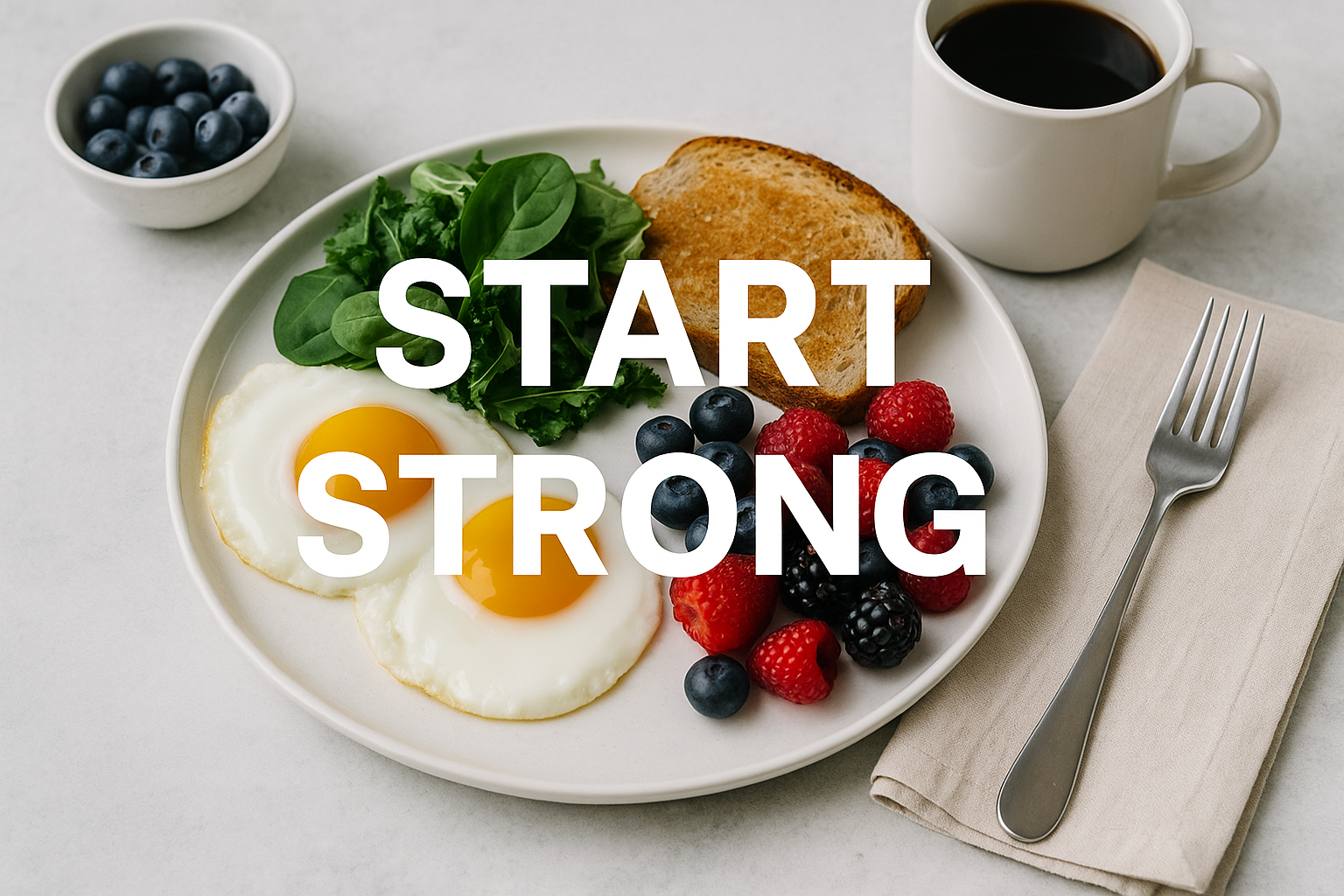
So what should a breakfast look like? Just like every other meal, there should be a good mix of protein, complex carbs, healthy fats, and some color typically coming from fruits or vegetables. Three options that can not only knock out those requirements but are either quick to throw together or can be batch made ahead of time:
A combination of eggs, meat (or tofu), potatoes (or toast), and veggies. This can be done as a scramble, omelette, casserole, or a burrito and each of those present other options for additional flavors and prep times.
An oat mixture is a great bulk option, I use a version of overnight oats that tastes like a chocolate chip cookie and is not only one of my breakfast staples, but my pre-race meal as well.
A shake is another great quick and portable option that allows for the combination of a lot of things, with the taste of the veggies masked by the other items.
If you're starting from not eating anything, maybe think about adding something into your tea or coffee increase calories. Things like protein powder, collagen protein, creatine, and MCT oil are all good options that dissolve well and can either be flavorless or give a nice twist to your beverage of choice.
Each of these options has its advantages and which one is best will vary by the individual, circumstances, and you may even want to rotate through to provide a level of variety. As I've said numerous times, start with understanding of where you currently are and look to make small shifts to make consistent progress.
If you want better energy, stronger workouts, and fewer cravings — don’t skip the foundation.
Build a breakfast that supports your goals and sets the tone for your entire day.
Start strong. Fuel early. Perform better.
🔗 Subscribe to The Wellness Forge for more practical strategies to fuel your body and optimize performance.
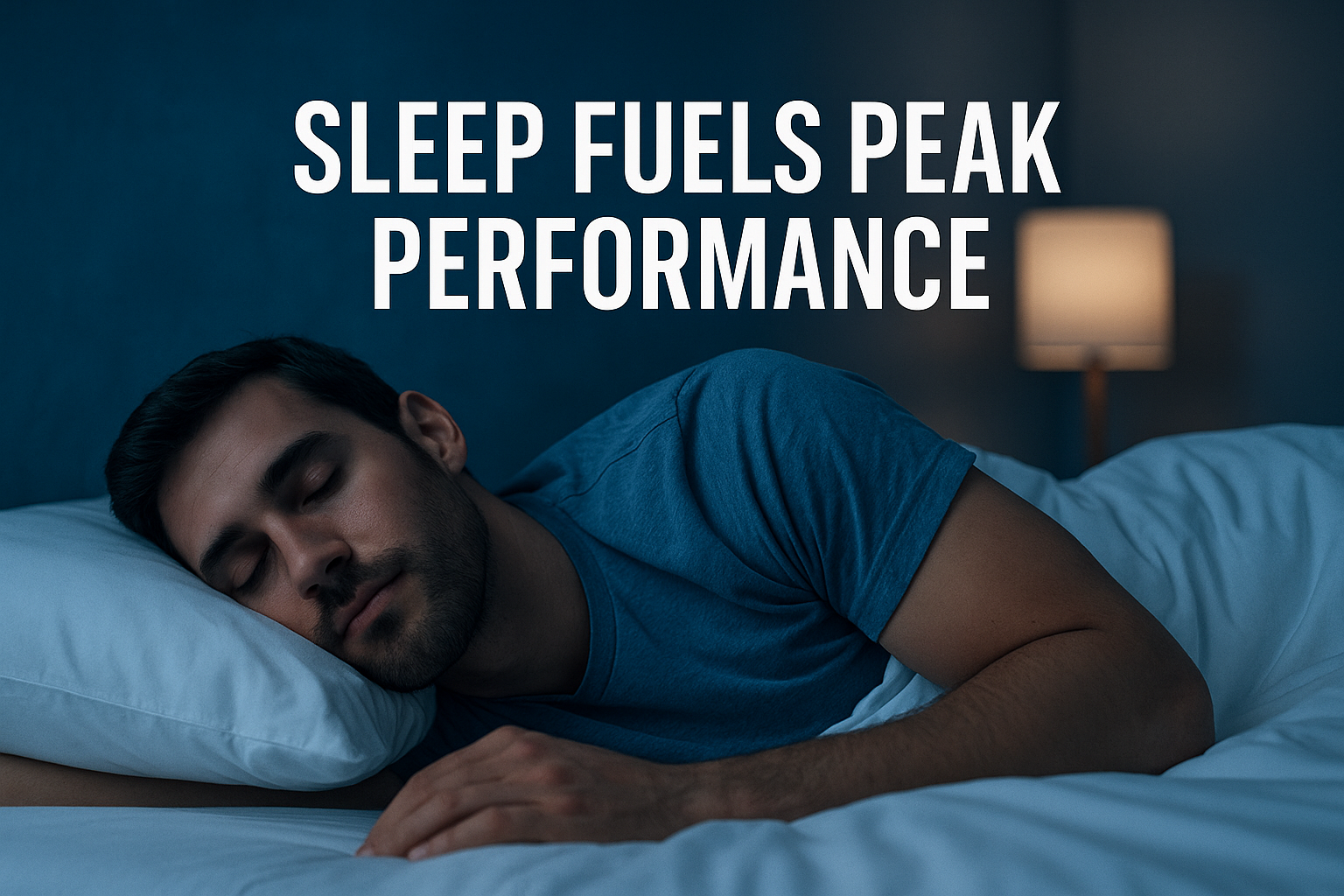
The Most Underrated Performance Tool: Sleep
Sleep isn’t just rest—it’s recovery. From sharper focus to faster training gains, even small improvements in sleep can fuel measurable performance benefits. Here’s how to sleep smarter.
Sleep is the highest ROI habit in health.
One extra hour can boost focus, regulate hormones, and even improve training outcomes.
Here’s how to start improving your sleep tonight — and what happens when you don’t.
Most people I work with have an understanding or a desire to improve either their sleep quality or the amount of sleep they get, but struggle to effectively make a change. Like I mentioned in my previous post on Nutrition, awareness is the key first step. Start a sleep log - paper, electronic, or via an app, doesn't matter at this stage, and start to look for trends to target. But, something you can start tonight that will make a difference and build towards better sleep hygiene - before you try to go to sleep, take 5 minutes for the following:
Put your phone/tablet/laptop down for the night
Focus on your breathing, taking deep controlled breaths
Reflect on your day, focus on the good things of the day to help calm the nervous system and relax
Think about 1 thing you want to do tomorrow. This isn't about creating your to-do list, or run through your calendar, but 1 tangible thing you want to do better tomorrow. Maybe this is walking more during the day, taking the stairs, drinking more water, picking fruit for a snack and not the candy, or whatever small tangible step seems plausible to accomplish. And then check in on your progress with that the next night.
What does this 5 minutes get you? It starts you on the path to establishing a night time ritual that you can build on that doesn't have to be overly complex. It simply needs to be a series of things you do (ideally around the same time each night) that helps you signal your body that it is time to sleep. As you progress on the journey towards better sleep, there are lots of other things you can look to change, but for now, start small and build momentum. Another simple (not necessarily easy though) step to take that you can implement immediately, start reframing sleep from something you need to do to prevent the negative impacts, towards an attitude that embraces the restorative and supercharging benefits more productive sleep provides.
I know many live by the "I'll sleep when I'm dead" mantra, and I lived that way for a while too, but at some point that lack of sleep will come back around. Lack of sleep is one of the biggest stressors you can subject your body to, so it will dramatically limit your ability to perform as well as fight off any illnesses or injuries. The mental impact sometimes is hard to recognize as so often we've gotten used to the feelings and don't really appreciate it until we start getting CONSISTENT good sleep. Also it is hard to compare the impact on our body as there isn't a great way to quantitatively compare what it could be if we were getting better sleep. Some wearables can help address this and provide some insights, I personally have been using Whoop for almost 5 years now and have a pretty good feel how impactful sleep is on my mental and physical performance. However, there are numerous studies that look at exactly that - the dramatic impacts poor sleep has on your mental performance and capacity, as well as your physical performance. Physically it is even more damaging as the lack of sleep not only diminishes your performance but it will also prevent you from absorbing the same amount of your training such that you see reduced gains from your daily (or however frequently you work out) efforts. I could go on talking about the negative aspects, but honestly that list is VERY long!
Not only will you see the opposite of the above problems when you start getting consistently solid sleep, but you will also start to notice long term trends as well. The big health metrics - things like body fat percentage, blood pressure, and metabolism will all trend better as you work on your sleep quality. This is not only due to the short term impacts, but while we sleep the body has the opportunity to recover and repair itself. This recovery and repairing then compounds with your training load to create a very powerful healthy stress, recover, and adapt cycle that allows your brain and body to best leverage the hard work you're doing.
To summarize the last two paragraphs simply - progressing towards healthier sleep is the single best way to supercharge your tomorrow. It is one of the harder changes to make, but the benefits can be life changing.
Sleep is the foundation — not the reward — for your hard work.
You don’t earn it after performing; you build everything from it.
Small changes tonight can create measurable improvements in your energy, focus, and recovery tomorrow.
💡 Subscribe to The Wellness Forge for more practical, evidence-based strategies to perform better, recover faster, and live stronger.
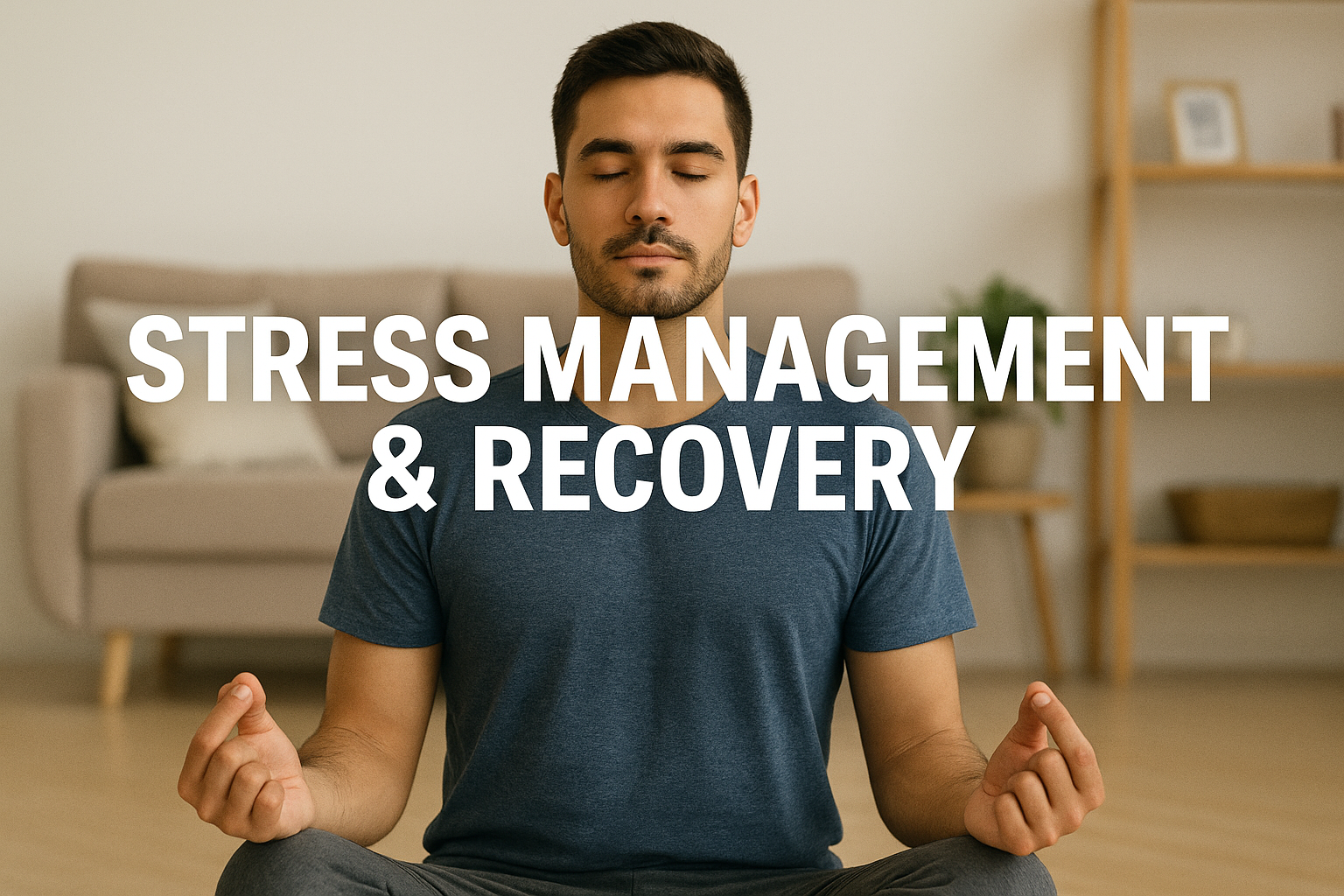
You Can’t Outperform Stress — But You Can Learn to Recover From It
Every athlete, executive, and high performer faces stress — the difference lies in how they recover.
You can’t grind your way out of chronic stress.
Recovery isn’t weakness — it’s the process that makes progress possible.
Here’s how to manage stress better and optimize recovery 👇
Even iron needs time to cool before it can be forged again.
Your body and mind are no different.
Today, we’ll explore the balance between stress and recovery — and how to strengthen both.
Stress is a part of all of our lives and what complicates the challenge is that stress is required for the exact kind of healthy adaptations we all strive for, that's the good stress. Most people think of stress as a bad thing, and in many cases it is, but the majority of stress actually has a positive impact on the body. Where stress becomes a problem is when there is too much of it for the body to handle, the classic too much of a good thing problem. Let's start with something you can implement today that will have an immediate impact on how your body handles stress. Like I've mentioned before, awareness is where I start with all my clients - but I'll admit, that process takes time (a few days) so today take at least one 5 minute break during the day to pause, reset, and get ready to tackle the next task. Maybe even take part of that 5 minutes to practice awareness of your stressors.
Taking a deeper look at stress, it typically can be divided into 6 buckets:
Physical - exercise or injury would be examples.
Mental - think learning tasks or prepping for a meeting.
Environmental - outside noise, pollution, temperature, and allergens fall into this bucket.
Emotional - general mood and happiness
Existential - why are we here and what is our purpose?
Relation - friends, family, and coworkers would fall here.
Inside of these buckets there are good stressors and bad ones, which are usually rather obvious, but there are some good stressors that can become bad if done at the wrong time or at too high of an intensity. For example, strength training when done appropriately is a great form of exercise. However, lifting too hard for what your body can handle that day will most likely lead to soreness and potential injury with long term impacts if consistently overused. This is where that self awareness comes into play, having a feel for your body and knowing when it is a day to push, when to pull back, and understanding that when you have to over-reach because of a deadline or race, you will need extra recovery on the other side. Using wearables can be a help in this area to monitor the body's response to stress and help give some quantitative measurements on things like Heart Rate Variability and Resting Heart Rate which are both good indicators of overall stress and how primed your body is to handle more. The best approach is a mixture of the numbers and the knowledge of your body to form that complete picture.
What does recovery look like then from all these different kind of stressors? As you've probably guessed, that first step in a awareness or audit of your primary stressors and then looking for ways to handle them. Some may have immediate simple solutions, for example an air filter in your office to help remove allergens and other contaminates if that's an area you struggle with. Others are more complicated and 100% might require some outside assistance to help work towards resolving. And some are constant parts of life and need continual work to manage. Inside each of those stress buckets are also recovery techniques that you can apply, here are some examples:
Physical - sleep, stretching, low intensity exercise
Mental - reading, preparation, planning
Environmental - air filters, blankets for warmth, air conditioning
Emotional - honest communication, mental exercises such as reframing
Existential - prayer or meditation
Relation - that supportive friend or family member
This isn't to say that the best way to recover from a stressor in one area is recovery in that same area, sometimes it is, sometimes it isn't. You've probably noticed that you have great ideas when taking a long hot shower - that physical recovery technique can not only relive physical stress, but open you up to recovering from pretty much all the other types of stress too. You will notice over time, what recovery techniques work for you and which ones work best for specific stressors you face. My two most consistent tools I use for recovery are my sauna blanket and reaching out to friends and/or family. These 2 not only hit multiple buckets but also are examples of a daily routine and a more tactical tool to handle the stress spikes we all go through. The way to become adept at managing your stress is to develop a full tool chest of recovery options that you know work for you, can be pulled out when needed, and used as backups when your first choice doesn't yield the results you're looking for.
Stress isn’t the enemy — it’s the signal. Recovery is the response.
You can’t eliminate stress, but you can build systems that help you handle it better and bounce back stronger.
🔗 Subscribe to The Wellness Forge for more actionable tools to help you perform, recover, and thrive — without burning out.
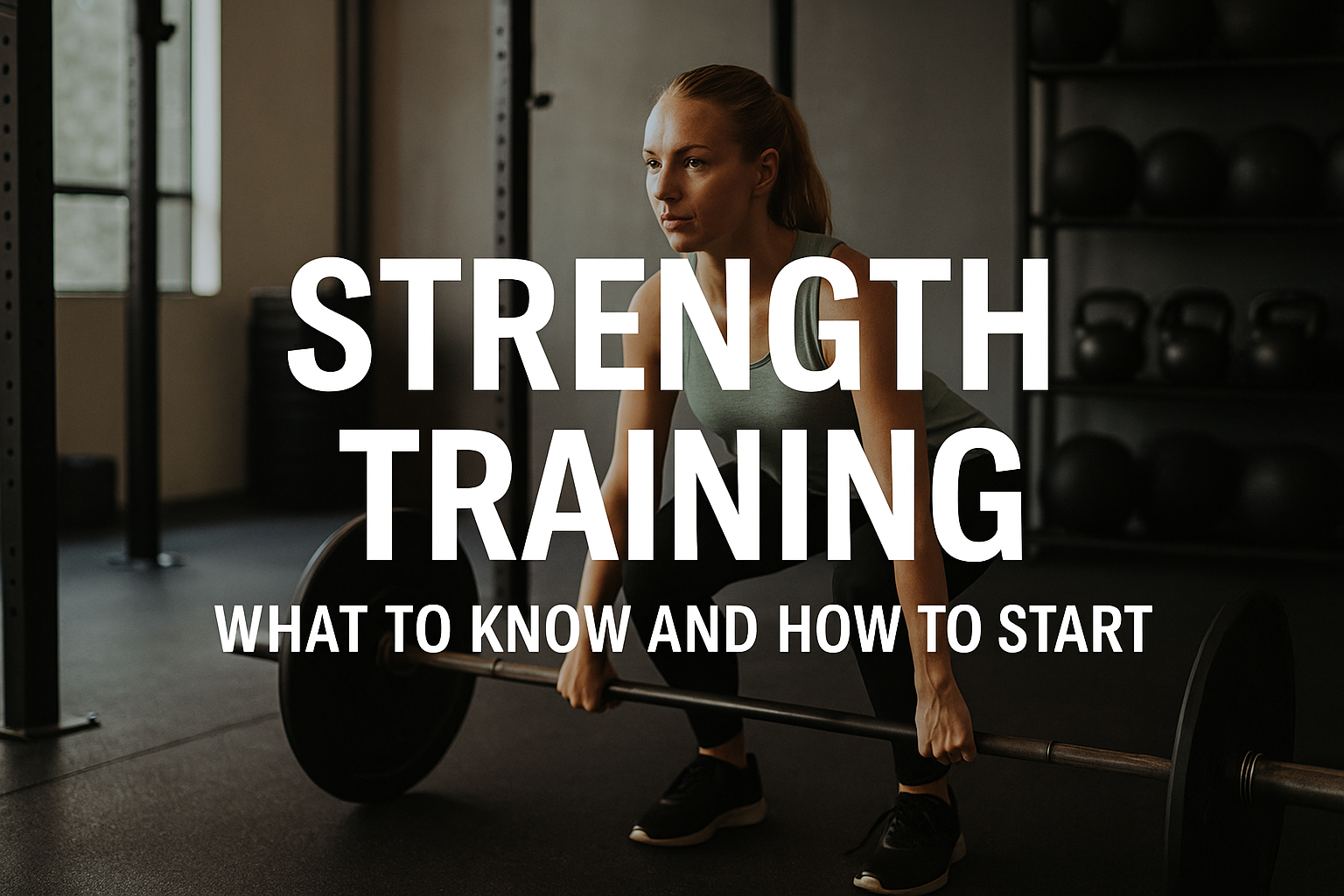
Strength Training 101: A Foundation for Health and Performance
Strength training isn’t just for athletes — it’s one of the most powerful tools for improving health, performance, and longevity. Learn what it is, why it matters, and how to get started with simple, sustainable steps.
Most people chase fitness trends, but few invest in what actually moves the needle: strength.
Whether your goal is longevity, performance, or simply feeling better in your body, strength training is the foundation.
Here’s how to get started — and why it matters more than you think.
When it comes to starting any new routine, you must understand where you're starting from and adjust accordingly. If you're completely new it would be prudent to verify with your health professional that there are no underlying issues you need to be aware of, and consulting with some sort of advisor through this process might help reduce your ramp up time. Assuming you've progressed past that point, whether you're brand new or have lifted for years and have just taken a break, always start with less then what you think is needed. It is way easier and more productive to add more to your routine than struggle because you went too hard that first session and can't move for 3 days because you're too sore. I'll go into more details in future emails, but a good starting point would be a routine you feel 95% certain is maintainable, the goal is consistency, not hammering yourself from the start. Even 1 workout a week can yield results! Another key aspect to consider is where to workout as both gyms and home have advantages and disadvantages. This is one of those honest discussions you need to have with yourself to understand if working out with other people with all the equipment you could ever want helps you, or if you'd be better served by the time flexibility and comfort of working out in your house. Neither is necessarily better than the other, but their effectiveness is highly dependant on the individual. The last suggestion I'll make, at this time, is that if you are going to go the home gym route, start small and incrementally add as you go. Don't go and spend thousands on what could become expensive hangers if you come to find out there are too many distractions at home for a consistent workout.
Let's step back and define what strength training is, and what forms don't provide the same kind of results. By definition, strength training is movement with resistance, which would include using your own body weight, bands, dumbbells, barbells, or anything else you might have lying around. The key to reaping all the benefits is to lift as if you're trying to get stronger which means you'll want to chose a weight that is challenging for you to complete 5-15 repetitions, keeping good form. To continue to see the benefits you also need make sure to progress to higher weight when those reps become too easy. Another key component to strength training, resting in between sets, should range from at least a minute to upwards of 5 minutes depending on what you're doing. Resting allows for your muscles to recover their energy stores and be ready to exert maximal effort again. The exercises themselves are not what provides the benefits, it is the body's reaction (building muscle) to those exercises as it adapts to the increased demands. This means not only do you need rest intervals during your workout, but days off between workouts such that your body has time to recover AND adapt to these stimuli. Each session should provide as different of a stimulus as possible from your normal daily routine to maximize the benefits. Because of this, "lower" repetition amounts with "heavier" weight shows far better results than lots (anything over 30) of repetitions with lighter weights.
I've mentioned the results and benefits of strength training, without any further context. Here are just some of the ways in which strength training has a positive impact on your body:
The obvious one, you get stronger. But that's not just your muscles, your tendons and ligaments which support those muscles and movements get stronger. And all of those pieces attach to your bones that then also getting stronger. Not only will this help with many daily activities and tasks (as well as any sort of performance venture) it can also help reverse or prevent bone issues like Osteoporosis and Osteopenia.
Some of the muscles that will be strengthened are the stabilizing muscles which will in turn help with balance. Not only will this help with performance, but it will dramatically increase your injury resilience. Certainly losing balance could result in falls which are a major health risk as we age, but also the majority of soft tissue injuries (think ligament tears - ACL, MCL, Achilles, etc) result from those tendons filling in the gaps for weak muscles.
Another important aspect of building more muscle is that it is one of the primary locations the body stores glucose (think sugar or carbs) which not only means that there's more energy available for the body but it is actually better at managing the energy levels. This then translates into a better insulin response which helps drive down many of the factors that leads to ailments like diabetes.
Muscle requires more energy to sustain itself than fat does, even at rest, which means that your body will naturally burn more calories because of the additional muscle mass. This allows for an increased level of metabolic flexibility since the body consumes more calories it becomes easier to either increase the amount of food you enable more muscle growth, or reduce calories to lose weight.
These are just a few of the benefits, but are some of the most impactful.
Strength training isn’t just about building muscle — it’s about building capability, confidence, and longevity.
Start small, stay consistent, and give yourself credit for each rep of progress.
Ready to build your foundation? Join The Wellness Forge and get clear, actionable guidance to help you move, perform, and live stronger.